Isaac Newton quick facts
- Newton was born on Christmas Day in 1642 and was so small his mother said he would fit in a jug.
- The apple did not hit him. He watched one fall and wondered how far that pull reached.
- His three laws of motion, published in 1687, are still used to design cars and rockets.
- He proved white light contains all the colours by splitting it and putting it back together.
- He spent over twenty years running Britain’s Royal Mint and personally hunted coin forgers.
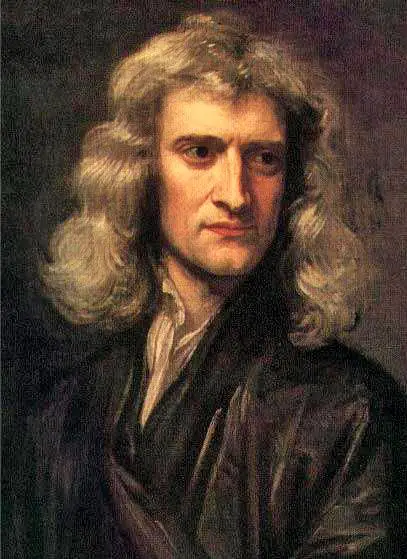
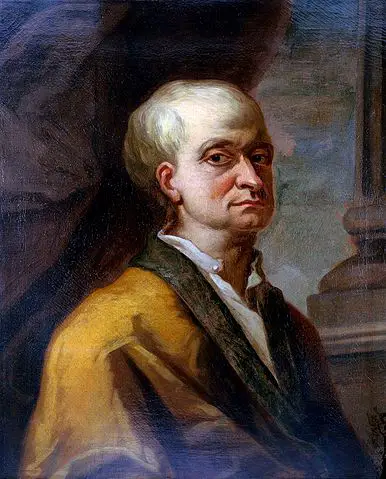
Isaac Newton worked out why apples fall and why planets orbit the Sun. He showed they are the same thing.
He was also born on Christmas Day, and the famous apple never hit him on the head.
Who was Isaac Newton?
| Born | 25 December 1642, Woolsthorpe, England |
| Died | 1727, aged 84 |
| Known for | gravity, laws of motion, light, calculus |
| Big book | Principia, published 1687 |
| Also did | ran the Royal Mint and hunted forgers |
| Buried | Westminster Abbey, London |
He was born early and very small. His mother is said to have remarked that he would have fitted inside a quart pot, about the size of a large jug.
The apple story, properly told
The apple is real. The bit about it bouncing off his head is not.
In 1665 a plague swept England and Cambridge University closed. Newton went home to the farm at Woolsthorpe and stayed for nearly two years.
Sitting in the garden, he watched an apple drop. The question that struck him was not why it fell, but why it fell straight down, always towards the centre of the Earth.
If that pull reached the top of a tree, how far did it reach? As far as the Moon? He told the story himself, years later, to a friend who wrote it down.
Those two plague years were the most productive of his life. He later called them his “year of wonders”.
One rule for apples and planets
Newton’s big idea was that everything pulls on everything else. He called it universal gravitation, and “universal” is the important word.
Before him, most people thought the heavens ran on different rules from the Earth. Newton said no: the force pulling an apple down is the same force holding the Moon in its orbit.
The Moon is falling, all the time. It is just moving sideways fast enough that it keeps missing the Earth.
The three laws of motion
Newton also set out three rules that describe how everything moves. Engineers still use them today.
- First law. A thing keeps doing what it is doing unless a force acts on it. A ball on the ground stays there until you kick it.
- Second law. The harder you push something, the faster it speeds up. Heavier things need a bigger push.
- Third law. Every push has an equal push back. A rocket goes up because it pushes gas down.
He published all of this in 1687 in a book known as the Principia. Many people call it the most important science book ever written.
He took light apart
People used to think a glass prism somehow stained white light with colour. Newton proved the opposite.
He let sunlight through a prism to make a rainbow, then sent that rainbow through a second prism, which turned it back into white light.
The colours were in the light all along. The prism only separates them, and a rainbow is the sky doing the same thing with raindrops.
He also built a new kind of telescope using mirrors instead of lenses. Reflecting telescopes work better at large sizes, and most big telescopes today still use his design.
The scientist who caught criminals
This is the part almost nobody knows. In 1696 Newton took charge of Britain’s coins as head of the Royal Mint.
Fake coins were a serious problem. Newton went after the forgers himself, gathering evidence in taverns around London and questioning witnesses.
He was very good at it. He spent more than twenty years at the Mint, longer than he ever spent teaching.
Three things people get wrong
The apple did not hit him. He watched one fall and started wondering how far that pull reached.
He did not discover gravity. Everybody already knew things fall. What Newton worked out was that one single rule explains falling apples and orbiting planets together.
He was not only a scientist. He wrote more about alchemy and religion than about physics. Those notebooks stayed hidden for centuries.
Newton was buried in Westminster Abbey in 1727, an honour usually reserved for kings and queens. Find more scientists and inventors on KidzFeed.
Did you know? Newton did his greatest work while hiding from a plague. Cambridge University closed in 1665, so he went home to the family farm for nearly two years. In that time he worked out gravity, the laws of motion, the nature of light and the basics of calculus. He later called it his year of wonders.
Try it
Newton’s third law says every push has an equal push back. Sit on a wheeled chair, hold something heavy, and throw it away from you. You will roll backwards. That is exactly how a rocket works: it pushes gas one way and goes the other.
Knowledge check
Did the apple really hit Newton on the head?
Show answer
No. He watched an apple fall in the garden at his family farm and started wondering why it fell straight down, towards the centre of the Earth, and how far that pull might reach. He told the story himself years later, and a friend wrote it down.
What did Newton discover about light?
Show answer
That white light is made of all the colours mixed together. He split sunlight into a rainbow with a prism, then sent that rainbow through a second prism which turned it back into white light. The colours were in the light all along.
Frequently asked questions
Who was Isaac Newton?
Isaac Newton was an English scientist and mathematician who lived from 1642 to 1727. He worked out how gravity holds the universe together, wrote the three laws of motion, showed that white light is made of all the colours, and invented the reflecting telescope.
Did an apple really fall on Newton’s head?
No, though there was a real apple. Newton watched one fall in the garden at Woolsthorpe and began wondering why things always fall straight down towards the centre of the Earth, and whether that same pull reached as far as the Moon.
What are Newton’s three laws of motion?
First, a thing keeps doing what it is doing unless a force acts on it. Second, the harder you push something the faster it speeds up, and heavier things need a bigger push. Third, every push has an equal push back, which is how rockets fly.
Did Newton discover gravity?
Not exactly. People already knew things fall down. What Newton worked out was that a single rule explains both the falling apple and the Moon’s orbit, and that everything in the universe pulls on everything else. That idea is called universal gravitation.
What else did Isaac Newton do?
He ran Britain’s Royal Mint for over twenty years and personally investigated coin forgers, gathering evidence in London taverns. He also wrote far more about alchemy and religion than about physics, though those notebooks stayed hidden for centuries.
When was Isaac Newton born?
On 25 December 1642, in the calendar England used at the time, at Woolsthorpe in Lincolnshire. He was born early and very small. He died in 1727, aged 84, and was buried in Westminster Abbey.
Sources
- Britannica: Isaac Newton — his life, the Principia, the laws of motion and his work on light.
- The Royal Society — Newton’s presidency and the publication of his work.
- Westminster Abbey: Sir Isaac Newton — his burial and memorial in the Abbey.