
New Year traditions differ around the world. Spanish families eat 12 grapes at midnight, Japanese temples ring bells 108 times, Scots go first-footing at Hogmanay and Danes jump off chairs. Some New Years fall at other times, such as Lunar New Year in January or February and Nowruz in March.
New Year quick facts
- Kiritimati in Kiribati is the first place to reach midnight on New Year’s Eve.
- Samoa skipped 30 December 2011 entirely when it moved across the International Date Line.
- Until 1752, England’s official new year began on 25 March.
- Japanese temple bells are struck 108 times, once for each worldly desire.
- Robert Burns said he wrote down “Auld Lang Syne” from an old song in 1788.
New Year around the world at a glance
New Year is one of the few celebrations shared by almost the whole world. On the night of 31 December, people count down, cheer, sing and set off fireworks. But every country adds its own customs.
Some people eat grapes at midnight. Some jump off chairs. Some ring a temple bell 108 times. And several cultures hold their New Year at a completely different time of year. This guide explains where New Year came from and how it is celebrated around the world.
| Tradition | Where | What happens |
|---|---|---|
| Hogmanay | Scotland | First-footing and singing “Auld Lang Syne” |
| Twelve grapes | Spain | One grape for each chime at midnight |
| Joya no kane | Japan | Temple bells rung 108 times |
| Chair jump | Denmark | Jumping “into” the new year at midnight |
| Seven waves | Brazil | Wearing white and jumping seven waves |
| Lunar New Year | China and East Asia | Red envelopes and lion dances; 6 February in 2027 |
Where New Year came from
People have celebrated a new year for about 4,000 years. History.com says the ancient Babylonians held an 11-day festival called Akitu, and their year began in spring, not winter.
The Babylonians also made promises to their gods at New Year. History.com calls this an early version of the New Year’s resolutions many people make today.
In 46 BC, the Roman leader Julius Caesar made 1 January the start of the year in his new Julian calendar. History.com says January is named after Janus, a Roman god with two faces. One face looked back at the old year, and the other looked forward to the new one.
Why the date of New Year moved
Caesar’s calendar was clever, but it was slightly wrong. Royal Museums Greenwich explains that it made the average year 365.25 days long. A real year is a little shorter, so the calendar slowly drifted away from the seasons.
In 1582, Pope Gregory XIII brought in a corrected calendar. This Gregorian calendar is the one most of the world uses now. It skips a few leap years, which is why 1900 was not a leap year but 2000 was.
Britain was slow to change. Royal Museums Greenwich says Britain switched only in 1752. That year, Wednesday 2 September was followed straight away by Thursday 14 September, so 11 days simply vanished.
Until 1752, the new year in England officially began on 25 March, not 1 January. Our England facts for kids has more about the country’s history.
The first and last places to see the new year
New Year does not arrive everywhere at once. It travels around the world with the time zones. Gulf News reports that Kiritimati, also called Christmas Island, in the Pacific nation of Kiribati is the first place to reach midnight.
The last places are Baker Island and Howland Island, two tiny US islands in the Pacific where nobody lives. Gulf News says that from first to last, New Year takes about 26 hours to go all the way round.
Samoa once had to choose a side. NBC News reported that on 30 December 2011, Samoa skipped a whole day, jumping straight from Thursday to Saturday. The country moved across the International Date Line so its days would match Australia and New Zealand.
Hogmanay in Scotland
In Scotland, New Year’s Eve is called Hogmanay. Scotland.org, the Scottish Government’s official site, says the word first appears in writing around 1604.
Scotland has a special reason to love New Year. After the Reformation, Christmas was discouraged there for a long time, so the parties and presents moved to New Year instead.
One famous custom is first-footing. The first-footer is the first visitor to step into a home after midnight. Scotland.org says the luckiest first-footer was once thought to be a tall, dark-haired man, carrying small gifts such as coal or shortbread.
Some celebrations are huge. Scotland.org says Edinburgh’s street party draws more than 80,000 people. In the town of Stonehaven, people swing giant fireballs of up to about 10 kg on poles through the streets.
Why people sing “Auld Lang Syne”
Around the world, many people link arms at midnight to sing “Auld Lang Syne”. Scotland.org says the Scottish poet Robert Burns wrote it down in 1788.
Burns did not claim to have invented it. He said it was an old song, and that he was the first person to write it down. The title means roughly “for old times’ sake”.
In Scotland, people stand in a circle holding hands. For the last verse, they cross their arms and hold hands with the people on either side. Scotland.org adds that most people only know the first verse and the chorus.
Grapes, beans and other lucky foods
Food is a big part of New Year. In Spain, people eat 12 grapes at midnight, one for each chime of the clock. The Philippine newspaper Daily Tribune says each grape stands for good luck in one month of the coming year.
History.com describes other lucky foods. In Italy and the southern United States, people eat beans or lentils, because they look like coins. In Sweden and Norway, a rice pudding hides a single almond, and whoever finds it will have good luck.
History.com adds that in the Netherlands, Mexico and Greece, people eat ring-shaped cakes and pastries. The ring stands for a year that comes full circle. You can learn more about one of those countries in our Mexico facts for kids.
In Greece, the Daily Tribune says, some families smash a pomegranate against the door at midnight. The scattered seeds are meant to bring good fortune.
Bells and noodles in Japan
In Japan, 31 December is called Ōmisoka. Nippon.com explains that temple bells are struck 108 times around midnight, in a Buddhist ceremony called joya no kane.
The Asian Art Museum in San Francisco says the 108 strikes stand for 108 worldly desires, such as greed and envy. Buddhists try to let go of these as the year ends. Monks usually ring the bell, but some temples let visitors take a turn.
Many families also eat toshikoshi soba on New Year’s Eve. The name means “year-crossing” noodles. Nippon.com says the long noodles stand for a long life, and because they break easily, they also stand for letting go of the old year’s bad luck.
Lunar New Year
In China and many other parts of East Asia, the biggest celebration is Lunar New Year, also called Chinese New Year or the Spring Festival. It follows the moon, so it does not have a fixed date.
The Farmers’ Almanac says it usually begins at the second new moon after the winter solstice, between about 21 January and 21 February. In 2027 it starts on Saturday 6 February, and it is the Year of the Goat.
The festival lasts 15 days and ends with the Lantern Festival. Children often receive red envelopes with money inside. The Farmers’ Almanac says the number 8 is lucky and the number 4 is avoided.
Homes are cleaned before the festival, and some families avoid sweeping on New Year’s Day so they do not sweep their good luck away. Red lanterns, lion dances and dragon dances fill the streets.
Jumping into the new year in Denmark
Denmark’s official website, Denmark.dk, says the evening begins at 6pm, when the country’s king gives a New Year speech on television. Families then settle down to a big dinner.
Just before midnight, Danes eat kransekage, a tall tower of marzipan rings. When the clock strikes twelve, many people stand on a chair or sofa and jump off together. Denmark.dk says they are jumping “into the new year”.
The Daily Tribune describes an old Danish custom of throwing old plates at friends’ doors, where a big pile of broken china meant lots of luck. Danish official sources do not mention it, so it is best thought of as a tradition from the past.
White clothes in Brazil and round fruit in the Philippines
In Brazil, most people wear white on New Year’s Eve. The Rio Times says the custom comes from Afro-Brazilian tradition, and white stands for peace.
At midnight, many Brazilians on the beach jump over seven waves and make a wish with each one. People also throw flowers into the sea for Iemanjá, the goddess of the sea. The Rio Times says about two million people gather on Rio de Janeiro’s Copacabana Beach.
In the Philippines, the Daily Tribune says, families put out round fruits, because round shapes look like coins and stand for wealth. People wear polka dots, and some children jump at midnight, hoping it will help them grow taller.
New Years at other times of year
Not every New Year starts on 1 January. Rosh Hashanah is the Jewish New Year, and its name means “head of the year”. Chabad.org says that in 2026 it began on the evening of 11 September and started the Jewish year 5787.
At Rosh Hashanah, a ram’s horn called a shofar is blown. Families dip apple slices in honey and wish each other a sweet new year.
Nowruz, the Persian New Year, means “new day”. It begins at the spring equinox, around 20 or 21 March. The United Nations says Nowruz is more than 3,000 years old, and in 2010 it named 21 March International Nowruz Day.
National Geographic says about 300 million people celebrate Nowruz. Families set a table with seven items whose Persian names begin with the letter “s”, such as sprouts for new life and garlic for health.
Fireworks over the big cities
Fireworks light up cities all over the world. For New Year 2026, Irish broadcaster RTÉ reported that Sydney set off 9 tonnes of fireworks in a 12-minute midnight show, stretching 7 km along the harbour.
The City of Sydney says up to a million people watched its fireworks at New Year 2025. Some shells shot more than 450 m (about 1,480 ft) into the sky. In London, the Greater London Authority says the fireworks are set off around the London Eye, beside the River Thames.
In New York, History.com says a ball has dropped in Times Square almost every year since 1907. It has grown from about 318 kg (700 lb) to nearly 5,400 kg (12,000 lb).
Fireworks are for adults to handle. The City of Sydney says its official show needed more than 1,000 staff and 250 volunteers, which shows how carefully big displays are planned. Watching an official display with a grown-up is the safest way to enjoy them.
New Year ideas to try at home
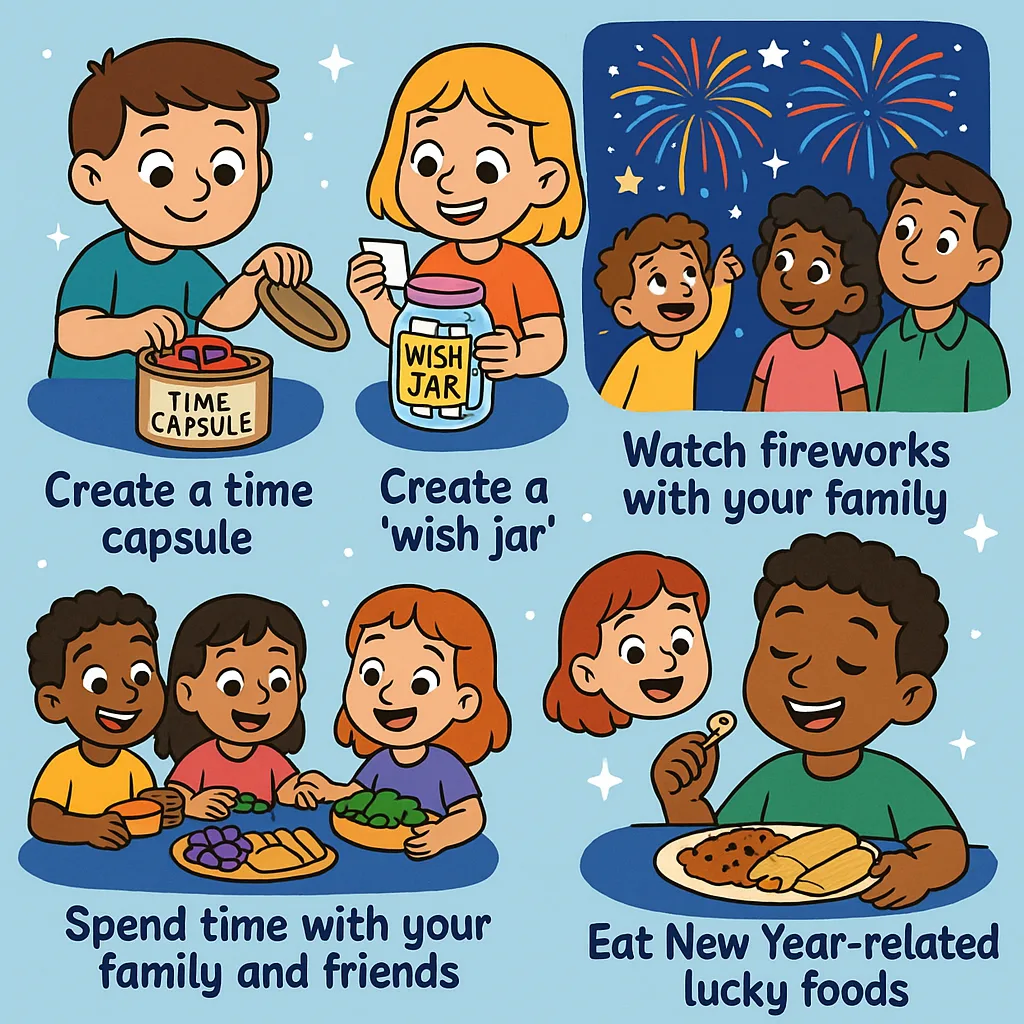
You do not need a big party to celebrate. You could make a time capsule with drawings, notes and small treasures, then open it in a year or two to see how much has changed.
A wish jar is another idea. Everyone in the family writes a hope for the year on a slip of paper. Open the jar next New Year and see which wishes came true.
You could also try a lucky food from this guide, such as grapes at midnight, noodles for a long life, or apple and honey for a sweet year. Other festivals have their own traditions too, from Halloween to Thanksgiving and Christmas.
Three things people get wrong
“New Year has always been on 1 January.” Royal Museums Greenwich says England’s official new year began on 25 March until 1752. The ancient Babylonians started their year in spring.
“Chinese New Year falls on the same date every year.” It moves with the moon, landing between about 21 January and 21 February. In 2027 it begins on 6 February.
“Everyone celebrates New Year in winter.” Nowruz begins at the spring equinox in March. Rosh Hashanah usually falls in September or early October.
Did you know? In 1752 Britain skipped 11 days: 2 September was followed straight away by 14 September.
Try it
Pick three countries from this guide and plan a mini New Year party using one tradition from each.
Knowledge check
What is New Year’s Eve called in Scotland?
Show answer
Hogmanay.
How many grapes do people eat at midnight in Spain?
Show answer
Twelve, one for each chime of the clock.
Frequently asked questions
Which country celebrates New Year first?
Kiribati celebrates first. Its island of Kiritimati uses the earliest time zone, UTC+14, so it reaches midnight before anywhere else.
Why do people eat 12 grapes at New Year?
Spanish families eat 12 grapes at midnight, one for each chime of the clock. Each grape stands for good luck in one month.
What is Hogmanay?
Hogmanay is the Scottish name for New Year’s Eve. Customs include first-footing, fireworks and singing “Auld Lang Syne” at midnight.
Why are bells rung 108 times in Japan?
Japanese temples ring bells 108 times at New Year in a Buddhist ceremony. The strikes stand for 108 worldly desires to let go of.
When is Lunar New Year in 2027?
Lunar New Year 2027 begins on Saturday 6 February and starts the Year of the Goat. The festival lasts 15 days.
Why was New Year moved to 1 January?
Julius Caesar made 1 January the start of the year in 46 BC. England still used 25 March officially until 1752.
Sources
- History.com: New Year’s — Babylon, Julius Caesar, Janus, lucky foods and the Times Square ball
- Royal Museums Greenwich: which years are leap years? — the Julian and Gregorian calendars and the 1752 change
- Scotland.org: Hogmanay — Hogmanay, first-footing, Edinburgh and Stonehaven; its Auld Lang Syne page was also used
- Nippon.com: Ōmisoka — joya no kane and toshikoshi soba
- Denmark.dk: Danish traditions — the King’s speech, kransekage and the chair jump
- United Nations: International Nowruz Day — the age of Nowruz and the 2010 UN day