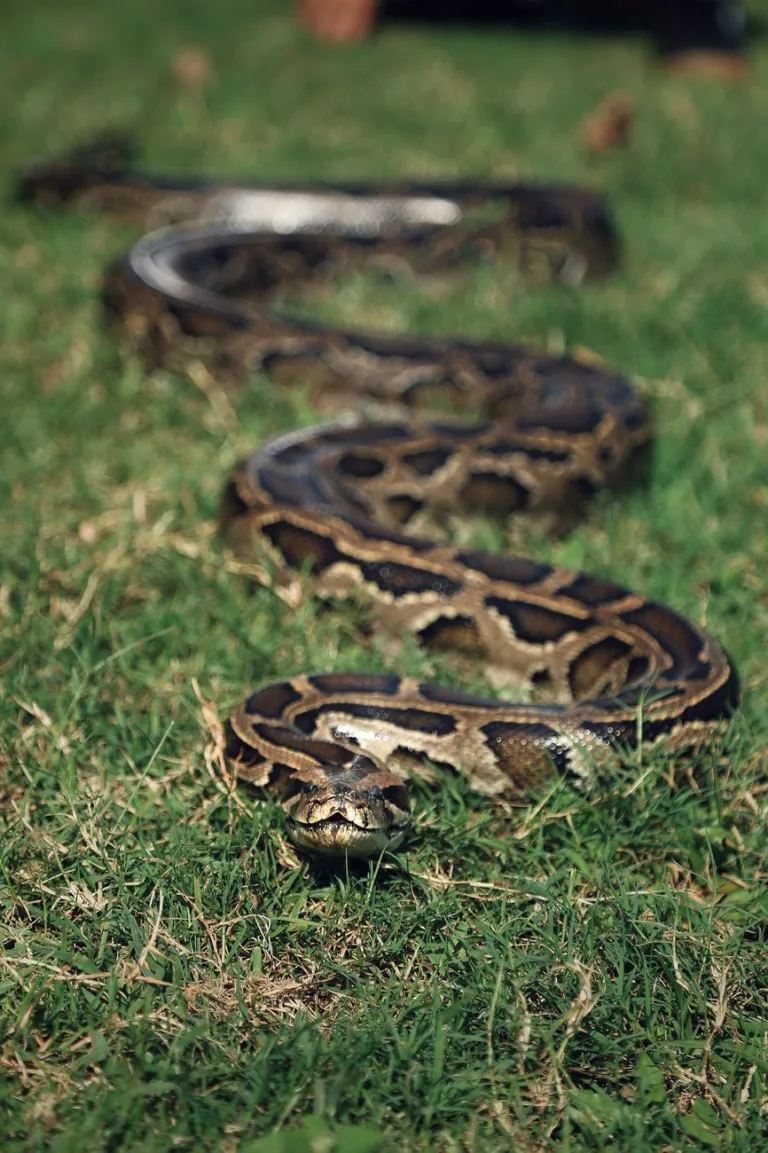
Crocodiles eat meat, and what they eat changes as they grow. Young crocodiles snap up insects and crabs. Adults take bigger prey: fish, water birds, sea turtles and mammals, some as large as a water buffalo. Crocodiles cannot chew. They swallow small prey whole and tear big prey apart, sometimes by rolling over and over in the water.
Crocodile diet quick facts
- Young crocodiles eat insects and crabs. Adults eat fish, birds, turtles and mammals.
- The saltwater crocodile has the strongest bite ever measured: 16,414 newtons.
- Crocodiles cannot chew. They swallow small prey whole.
- Crocodiles swallow stones, which scientists think may help break up food.
- Fruit-eating has been recorded in 13 of 18 crocodile and alligator species studied.

The saltwater crocodile has the strongest bite ever measured in any animal. Yet a baby crocodile starts life snapping up insects.
What a crocodile eats depends mostly on how big it is. Crocodiles are carnivores, and meat is their primary diet. But the menu changes a lot between a hatchling and a five-metre adult.
What crocodiles eat as they grow
| Stage | What it eats | How it hunts |
|---|---|---|
| Young crocodiles | Insects, crabs and other small animals | Waits in shallow water, or chases small prey |
| Adults | Fish, water birds, sea turtles and mammals | Creeps close underwater, then lunges |
| The biggest adults | Animals as big as a water buffalo, and smaller crocodiles | Drags prey underwater and tears it apart |
Young crocodiles eat often, because their prey is tiny. As they grow, they eat less often, but each meal is far bigger. Big crocodiles will even eat smaller crocodiles.
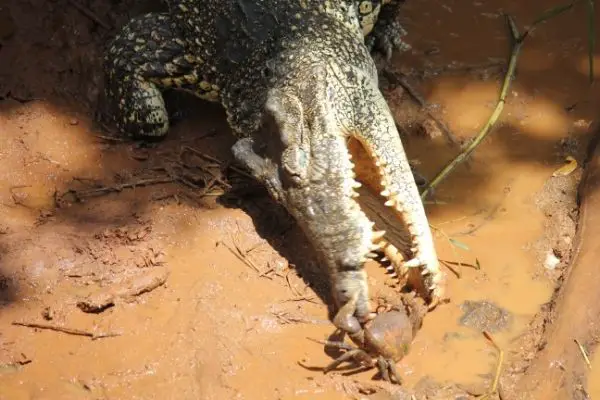
The saltwater crocodile
The saltwater crocodile is a true giant among reptiles. Adults are usually 3 to 5 metres long, and males grow much bigger than females. The biggest one ever reliably measured was at least 6.15 metres.
In Australia, it lives across the north, from Broome in Western Australia to Gladstone in Queensland. It can live in rivers, swamps, creeks and the sea. So its food comes from both land and water: water birds, sea turtles, and mammals that come to drink.
Other crocodiles live in Africa, Asia and the Americas. Each one eats whatever its rivers and swamps provide.
The gharial: a fish-catching specialist
Not every crocodilian is built to tackle a buffalo. The gharial lives in fast-flowing rivers of the Indian subcontinent, such as the Ganges, the Indus and the Brahmaputra.
Its jaws are extremely long and thin. A thin snout meets very little resistance in the water, so the gharial can snap at a fish very quickly. Young gharials eat insects, crabs and frogs. Adults eat almost nothing but fish.
Male gharials can grow to between 5 and 6.5 metres long. Yet the gharial is Critically Endangered. Its numbers fell by 58% between 1997 and 2006.
The Nile crocodile and the great migration
Every year, more than a million wildebeest migrate across the Serengeti and Mara region of Tanzania and Kenya. On the way, they have to cross the Mara River, where Nile crocodiles lie in wait.
Those crossings are famous for their crocodile attacks. But a 2017 study found something surprising. About 6,200 wildebeest drown in the Kenyan part of the river each year, adding up to around 1,100 tons of meat, skin and bone. The Nile crocodiles ate only about 2% of it.
Big crocodiles do not need to eat often, so most of the feast goes to other animals. For some fish, the drowned wildebeest make up a third to half of their food. Vultures and marabou storks take their share too. The bones last more than seven years in the river, slowly feeding it all that time.
How a crocodile catches its food
A big crocodile hunts by stealth. It moves close underwater, out of sight, and then it lunges.
Often the bite alone kills the prey. Small animals are crushed and swallowed whole.
Big prey is dragged into deeper water, where the crocodile tears it into pieces. It may grip the prey and spin its whole body over and over. People call this the death roll.
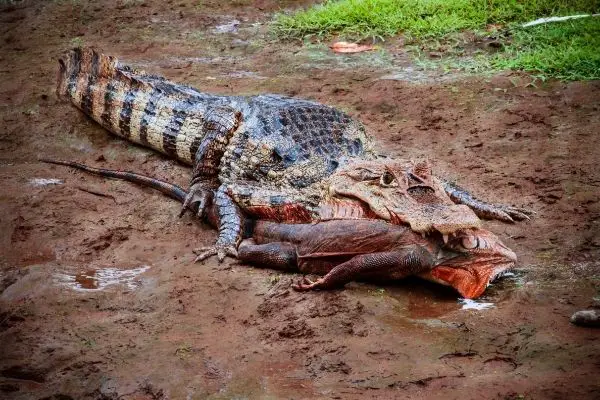
The strongest bite ever measured
In 2012, a team led by Gregory Erickson measured the bite of every kind of crocodile, alligator, caiman and gharial. There were 23 species in all.
A saltwater crocodile set the record at 16,414 newtons. That is about 3,689 pounds of force. No animal has ever been measured biting harder.
To picture it, imagine a big car pressing down on one spot. That is roughly the force.
You may read that the bite is “3,700 psi”. That is a common mix-up. The study measured force, not pressure, so the right figure is about 3,700 pounds of force.
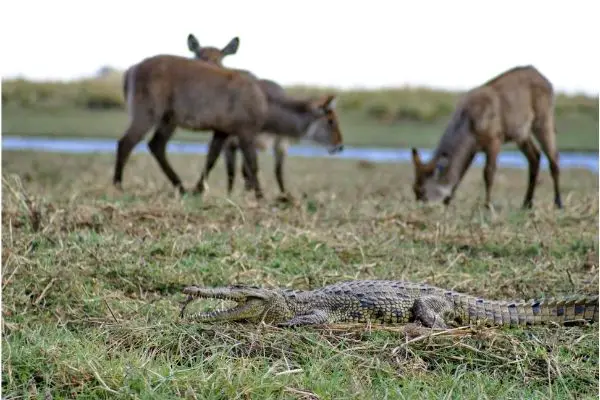
Why crocodiles swallow food whole
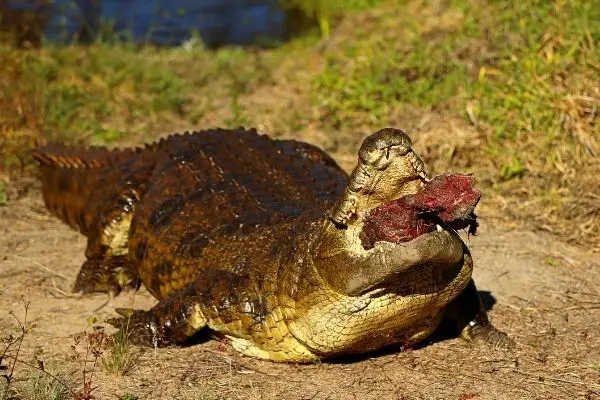
Crocodiles cannot chew their food. Their teeth grip and pierce, but they cannot grind food down. So a crocodile tosses its food in its mouth to line it up, then swallows.
Crocodiles also swallow small stones. These stones are called gastroliths, and they collect in the stomach. Scientists think they may help break up food. They may also work like ballast, helping the crocodile stay low in the water.
Do crocodiles eat fruit?
Surprisingly, the answer is yes. In 2013, a team led by Steven Platt gathered every record they could find of what crocodiles and alligators eat.
They found fruit-eating in 13 of the 18 species with good diet records. Some fruit is swallowed by accident along with prey. But sometimes crocodiles eat fruit on purpose, and a lot of it.
That may even help plants. The scientists think seeds can pass through a crocodile and be dropped somewhere new.
Crocodile tears are real
People say someone is crying “crocodile tears” when they only pretend to be sad. The saying comes from an old belief that crocodiles weep while they eat.
In 2007, zoologist Kent Vliet put it to the test. He filmed caimans and alligators, close relatives of crocodiles, while they ate. Five of the seven animals had tears in their eyes.
The tears are not sadness. The scientists think jaw movements push air through the sinuses, and that sets the tear glands working.
Nests, eggs and babies
A female saltwater crocodile builds a big nest mound, up to 2.5 metres long and 80 cm high. She lays up to 71 hard-shelled eggs, usually around 50.
The eggs take 2 to 3 months to hatch. The temperature inside the nest decides whether each baby will be male or female. Cooler nests tend to produce females, and warmer nests produce males.
The mother guards the nest from a muddy hollow close by. When the babies hatch, she carries them down to the water in her mouth, the same jaws that hold the bite record, and keeps protecting them for some time.
Even so, life is tough for a baby crocodile. Up to 75% of the eggs laid in a season never hatch. Hatchlings are eaten by birds of prey, large fish, freshwater turtles and other crocodiles. Very few make it to adulthood.
Staying safe around crocodiles
A big saltwater crocodile can take a buffalo, so a person is well within its reach. Attacks are rare, but they do happen.
Queensland’s Be Crocwise advice is simple: in crocodile country, stay more than 5 metres back from the water’s edge. Keep something solid between you and the water. Never lean over the side of a boat.
Three things people get wrong
Crocodiles do not only eat meat. Meat is their main food. But most species studied also eat fruit now and then.
Crocodile tears are not fake. Crocodile relatives really do shed tears while they eat. The cause is air in the sinuses, not sorrow.
The famous bite is not “3,700 psi”. It is about 3,700 pounds of force. Force and pressure are different things.
If you are looking for information on What Do Crocodiles Eat, you have just come to the right place.
Do not worry, if you need support, feel free to always request for that help, when you are to rewrite you essay https://eduwriter.ai/rewrite-my-essay.
You can find more pre written essay about crocodile here https://essayzoo.org/
Did you know? A saltwater crocodile’s bite was measured at 16,414 newtons. That is roughly the weight of a big car pressing down on its teeth, and it is the strongest bite ever recorded in any animal.
Try it
Measure 5 metres back from a wall, which is about five big steps for an adult. In crocodile country, that is the least distance Queensland’s safety advice says to keep from the water’s edge.
Knowledge check
What does a young crocodile mostly eat?
Show answer
Small prey such as insects and crabs. Young crocodiles eat often and hunt small animals. They only move on to big prey like birds, turtles and mammals as they grow.
Are crocodile tears real?
Show answer
Yes. In a 2007 study, five of seven caimans and alligators, close relatives of crocodiles, teared up while eating. Scientists think jaw movements push air through the sinuses and set the tear glands working.
Frequently asked questions
What do crocodiles eat?
Crocodiles eat meat. Young crocodiles eat insects, crabs and other small animals. Adult crocodiles eat fish, water birds, sea turtles and mammals, and the biggest saltwater crocodiles can take animals as large as a water buffalo.
How do crocodiles eat without chewing?
Crocodiles cannot chew. A crocodile crushes small prey and swallows it whole, and tears large prey into pieces by gripping it and spinning in the water, which people call the death roll. It tosses food in its mouth to line it up before swallowing.
How strong is a crocodile’s bite?
A saltwater crocodile has the strongest bite ever measured in any animal: 16,414 newtons, about 3,689 pounds of force. Scientists recorded it in a 2012 study that tested all 23 species of crocodile, alligator, caiman and gharial.
Do crocodiles eat fruit?
Yes, sometimes. A 2013 review found fruit-eating in 13 of the 18 crocodile and alligator species with good diet records, and scientists think crocodiles may even help spread plant seeds.
Why do crocodiles swallow stones?
Crocodiles swallow stones, called gastroliths, which collect in the stomach. Scientists think the stones may help break up food, since crocodiles cannot chew, and may also act as ballast that helps them stay low in the water.
Do crocodiles attack people?
Large saltwater crocodiles can attack people, because a person is well within the size of prey they take. Attacks are rare. In Queensland, Australia, the Be Crocwise advice is to stay more than 5 metres back from the water’s edge in crocodile country.
What does a gharial eat?
Young gharials eat insects, crabs and frogs, but adults eat almost nothing but fish. Their long, thin jaws slice through the water, which helps them snap up fish quickly.
Does a mother crocodile carry her babies?
Yes. A female saltwater crocodile guards her nest, and when the eggs hatch she carries the babies down to the water in her mouth, then keeps protecting them for some time.
Do Nile crocodiles eat a lot of wildebeest?
Not as much as you might think. A 2017 study found that about 6,200 wildebeest drown in the Mara River in Kenya each year, but Nile crocodiles ate only about 2% of them. Fish, vultures and storks ate much more.
Sources
- Australian Museum: estuarine crocodile — diet as crocodiles grow, size, range, nests, eggs, nest temperature and the mother’s care
- Erickson and others, PLOS ONE (2012) — the 16,414-newton saltwater crocodile bite, the highest measured in any animal
- ScienceDaily: Platt and others, Journal of Zoology (2013) — fruit-eating recorded in 13 of 18 crocodilian species
- University of Florida (2007): crocodile tears are real — caimans and alligators shedding tears while eating
- BBC Wildlife: why crocodiles swallow rocks — gastroliths and the two reasons scientists give for them
- Queensland Government: Be Crocwise top tips — safety distances around crocodile habitat
- Animal Diversity Web: Gavialis gangeticus (gharial) — what gharials eat, their snout, rivers, size and conservation status
- Cary Institute (2017): wildebeest drownings fuel the Mara River — wildebeest drownings and how little of them the crocodiles ate