

The accordion is a free-reed instrument. The player pushes and pulls the folding bellows to move air across thin metal reeds, which vibrate to make sound. The right hand plays the tune on keys or buttons, and the left hand plays bass notes and chords. The name was first used in an 1829 patent in Vienna.
the accordion quick facts
- The accordion is a free-reed instrument, sometimes called a squeezebox.
- Its sound comes from metal reeds that vibrate when air flows across them.
- The name “accordion” first appeared in an 1829 patent in Vienna.
- The right hand plays the tune; the left hand plays bass notes and chords.
- The bandoneón is the heart of tango music in Argentina.
What is an accordion?
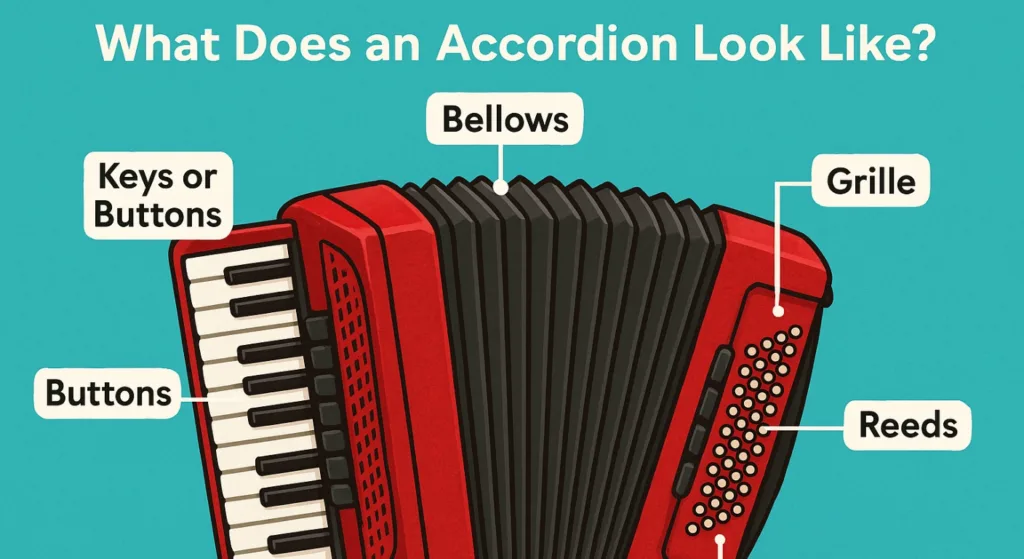
The accordion is a musical instrument that you squeeze in and out as you play. It is sometimes called a squeezebox.
An accordion has two boxes joined by a folding middle part, called the bellows. The player pushes and pulls the bellows to move air, and presses keys or buttons with both hands to make music.
The accordion can play a tune and its own accompaniment at the same time, so one player can sound almost like a small band. That is one reason it became so popular all over the world.
| Accordion at a glance | |
|---|---|
| Type of instrument | free-reed instrument |
| How sound is made | air makes metal reeds vibrate |
| Name first used | 1829, in Vienna |
| Right hand plays | the tune, on keys or buttons |
| Left hand plays | bass notes and chords |
| Famous styles | tango, polka, zydeco, folk, norteño |
How does an accordion make sound?
The accordion is a free-reed instrument. The American Accordionists’ Association says its sound comes from thin metal reeds that vibrate when air flows across them.
Physics Today explains that a free reed is a thin metal tongue that swings back and forth through a slot in a metal plate, a bit like a swinging door. As it swings, it lets out puffs of air, and these puffs make the sound we hear.
Each reed plays one note. Physics Today says a reed’s note depends mainly on how fast it naturally vibrates. Small, light reeds vibrate quickly and make high notes, while bigger reeds make low notes.
The bellows
The bellows are the folding middle part of the accordion. The American Accordionists’ Association says the player makes air flow by pushing and pulling them, usually with the left arm.
The bellows join the two boxes of reeds, one on the treble side for the high notes and one on the bass side for the low notes.
Physics Today says that in accordions and concertinas, each little chamber usually has two reeds. One sounds when you push the bellows in, and the other sounds when you pull them out.
Moving the bellows is also how the player makes music loud or soft. A strong squeeze gives a loud sound, and a gentle one gives a soft sound.
Two hands, two jobs
On an accordion, each hand has a different job. EBSCO Research Starters says the right hand plays the melody, or tune, on a keyboard or buttons. The left hand presses buttons that play bass notes and ready-made chords.
Most accordion players use a left-hand button system called the Stradella, or 120-bass, system. The American Accordionists’ Association says the two rows of buttons nearest the bellows play single bass notes. The other four rows play different kinds of chords, each with a single button.
The buttons are arranged in a clever order, called the circle of fifths, so the chords a song usually needs sit close together. In the mid-1900s, makers also added “free bass” systems, where every left-hand button plays a single note.
Changing the sound
An accordion can make different kinds of sounds. The American Accordionists’ Association says the right-hand side of a piano accordion has four sets of reeds, called ranks.
Switches called registers mix these sets of reeds in different ways. They have names like Clarinet, Oboe, Musette and Master, and each gives the accordion a different voice.
A short history of the accordion
The idea behind the accordion is very old. Physics Today says free-reed mouth organs were being played in Asia before 1000 BC.
Early Music America says that in 1777, a French missionary in China called Père Amiot introduced the Chinese sheng, a bowl-shaped mouth organ, to Europe. It inspired a wave of new free-reed instruments.
A German inventor, Christian Friedrich Ludwig Buschmann, invented the harmonica in 1821, when he was only 16, Physics Today says. In 1822, he patented a hand-held free-reed instrument that led towards the accordion.
The name “accordion” first appeared in 1829. Early Music America says it was used in a patent in Vienna by Cyrill Demian, an organ and piano maker. His idea was that pressing one or two keys could play a whole chord, and the name comes from a word meaning chord.
In the same year, Charles Wheatstone patented the English concertina in London, a small six-sided squeezebox.
Accordions everywhere
Accordions soon spread across Europe. Early Music America says Paris became a major centre for making accordions in the 1830s.
In 1857, Matthias Hohner started his harmonica and accordion company in Germany, Early Music America says. His factories made instruments by machine, in huge numbers.
By the 1920s, the free-reed industry was making more than 50 million instruments a year. EBSCO Research Starters says the accordion’s golden age was the early 1900s, when it was popular in jazz, dance and swing bands. It became less popular after the Second World War, when rock and roll arrived.
Kinds of accordion
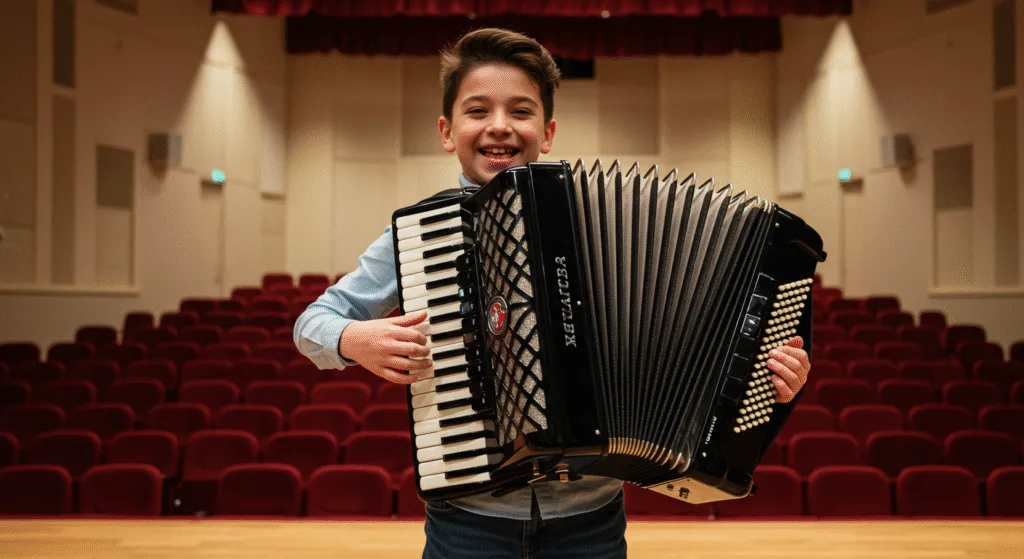
There are several kinds of accordion.
The piano accordion: it has a piano-style keyboard for the right hand. Smithsonian Magazine says it was the most popular kind in the 1940s and 1950s.
Button accordions: the chromatic button accordion and the Russian bayan use rows of buttons instead of piano keys for the right hand.
The bandoneón: a button instrument from Argentina. Early Music America says it is named after a German instrument dealer, Heinrich Band.
The one-row button accordion: A World of Accordions Museum says this simple, low-cost instrument was popular with ordinary families in the early 1900s.
The concertina: a small, many-sided relative of the accordion.
Music around the world
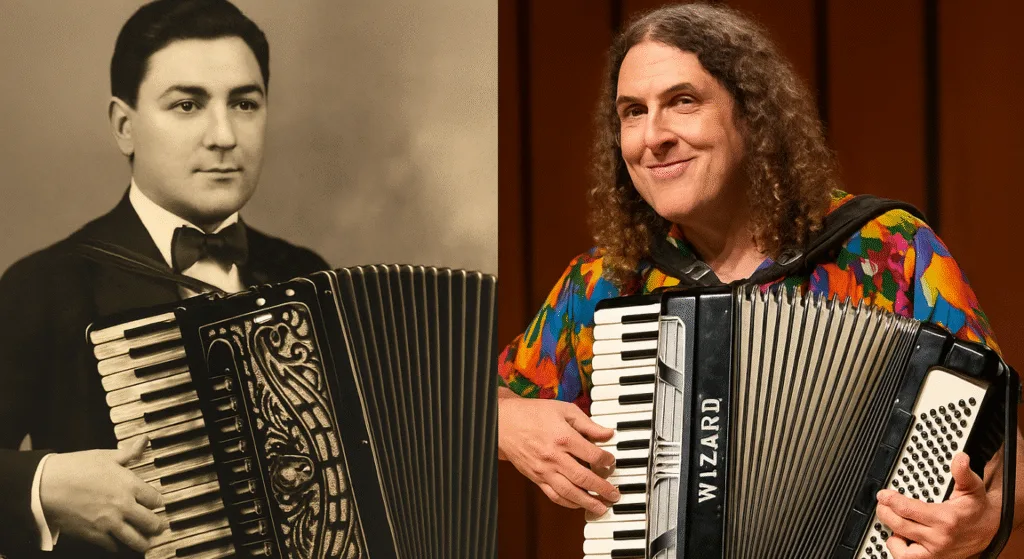
The accordion is played in many kinds of music. EBSCO Research Starters says it is a star of polka, Cajun and zydeco music, tango and folk music.
The bandoneón became the heart of tango music in Argentina. Early Music America says it reached Argentina around 1870, and by 1930 about 25,000 bandoneóns a year were being shipped there.
Button accordions are central to the Tejano, conjunto and norteño music of Texas and Mexico. Smithsonian Magazine says pioneers include Narciso Martínez and the Grammy-winning Flaco Jiménez.
Great classical composers wrote for the accordion too. EBSCO Research Starters says Tchaikovsky, Shostakovich and Alban Berg all wrote parts for it. You can read more about the instrument in Britannica’s accordion article.
A museum of accordions
If you love accordions, there is a whole museum for them. A World of Accordions Museum, in Superior, Wisconsin, was founded in 1993. It displays about 2,500 instruments from the accordion family.
Accordions are still made today. Smithsonian Magazine says the Hohner company sends out between about 1,000 and 2,000 accordions to buyers every month.
Accordion or piano?
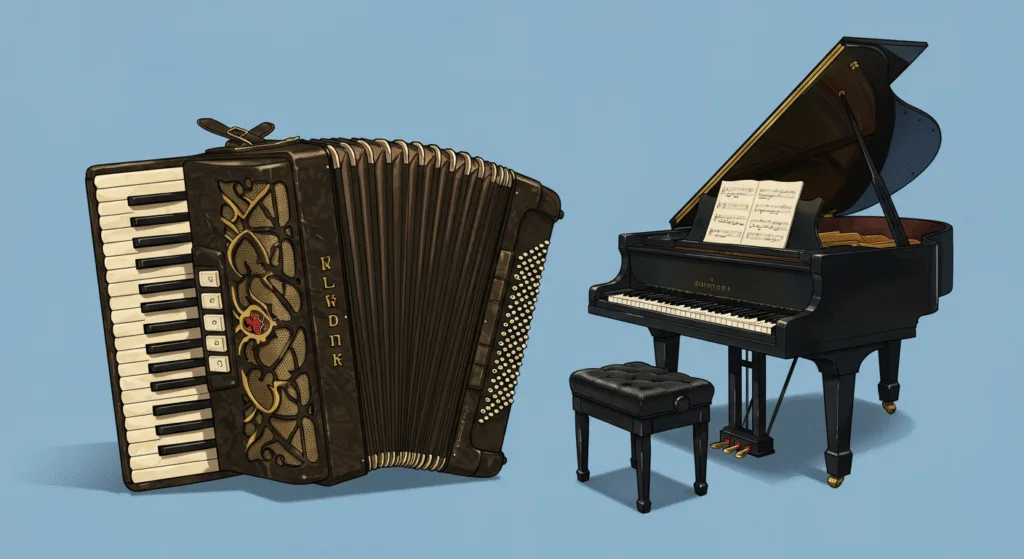
A piano accordion has a keyboard like a piano’s, but the two instruments are very different.
A piano makes sound when hammers hit strings inside it. An accordion makes sound when air makes metal reeds vibrate. And while a piano stays in one place, an accordion can be carried and played while walking.
The keyboards are different too. The American Accordionists’ Association says the right-hand keyboard of a piano accordion covers a little more than three octaves, and its keys are slightly narrower and lighter than piano keys.
Would you like to learn an instrument you can carry? The ukulele is another small instrument that many children enjoy learning.
Inside a reed
Accordion reeds are amazing little machines. Physics Today says the tip of a reed swings back and forth by about 15% of the length of its tongue.
Every time the reed makes one full swing, it lets out two quick puffs of air. Hundreds of these puffs every second blend together into the smooth note that we hear.
Some Asian mouth organs, like the sheng, have pipes that help shape each note. Physics Today says Western accordions have no pipes at all, so the sound comes straight from the reeds.
Accordions have close relatives. Early Music America says Charles Wheatstone’s English concertina, the small six-sided squeezebox, had 64 keys, spread across both of its ends.
Three things people get wrong
The accordion is not only for polka. It is played in tango, folk, zydeco, jazz and classical music.
The bellows do not make the sound. They move air, and the metal reeds make the sound.
An accordion does not need electricity. The player’s arms power it by moving the bellows.
Did you know? By the 1920s, factories were making more than 50 million free-reed instruments a year.
Try it
Stretch a blade of grass between your thumbs and blow across it. The buzzing sound works a bit like a vibrating reed.
Knowledge check
What are the bellows?
Show answer
The folding middle part that the player pushes and pulls to move air.
What makes the sound in an accordion?
Show answer
Thin metal reeds that vibrate when air flows across them.
Frequently asked questions
How does an accordion work?
The player pushes and pulls the bellows to move air. The air makes thin metal reeds vibrate, and each reed plays a note.
Who invented the accordion?
Many people helped. The name was first used in an 1829 patent by Cyrill Demian in Vienna, based on earlier free-reed instruments.
What does each hand do on an accordion?
The right hand plays the tune on a keyboard or buttons. The left hand presses buttons that play bass notes and ready-made chords.
What kinds of accordion are there?
The main kinds are the piano accordion, button accordions such as the bayan, the Argentine bandoneón and the concertina.
What music is the accordion used for?
The accordion is used in polka, Cajun and zydeco, tango, folk, Tejano and norteño music, and some classical music.
Why is it called an accordion?
The name comes from a word meaning chord, because Demian’s instrument could play a whole chord with one or two keys.
Sources
- Early Music America: according the accordion its historical due — history, the sheng, Demian’s patent, Paris makers, Hohner and the bandoneón
- Physics Today: acoustics of free-reed instruments — how free reeds work and key dates
- American Accordionists’ Association: composer’s guide to the piano accordion — bellows, reeds, keyboard range, registers and the Stradella bass system
- EBSCO Research Starters: accordion — how it works, its golden age and the music it plays
- Smithsonian Magazine: the remarkable rebirth of the button accordion — piano and button accordions, Hohner and Tejano and norteño music
- A World of Accordions Museum: about — the museum and the one-row button accordion