

Dogs are descended from ancient grey wolves and were tamed at least 15,000 years ago. A dog’s nose has up to 300 million smell receptors, compared with about 5 million in ours. Dogs hear higher sounds than we can, see blues and yellows but not reds and greens, and often live 12 years or more. The AKC recognises 205 breeds.
dogs quick facts
- Dogs are descended from ancient grey wolves.
- A dog’s sense of smell is at least 100,000 times more sensitive than ours.
- Adult dogs have 42 teeth; puppies have 28 baby teeth.
- All puppies are born deaf.
- The American Kennel Club recognises 205 dog breeds.
What is a dog?
Dogs are one of the most popular pets in the world. They are loyal, playful and clever, and they have lived alongside people for many thousands of years.
Pet dogs belong to the same family as wolves, foxes and jackals. In fact, dogs are descended from wolves that lived long ago.
Today there are hundreds of different kinds, or breeds, of dog, from tiny Chihuahuas to giant Great Danes. But they are all the same species.
| Dogs at a glance | |
|---|---|
| Descended from | ancient grey wolves |
| Tamed | at least 15,000 years ago, and perhaps about 23,000 |
| Breeds recognised by the AKC | 205 (January 2026) |
| Adult teeth | 42 |
| Smell receptors | up to about 300 million |
| Puppies per litter | usually 3 to 9 |
| Lifespan | often 12 years or more |
Where did dogs come from?
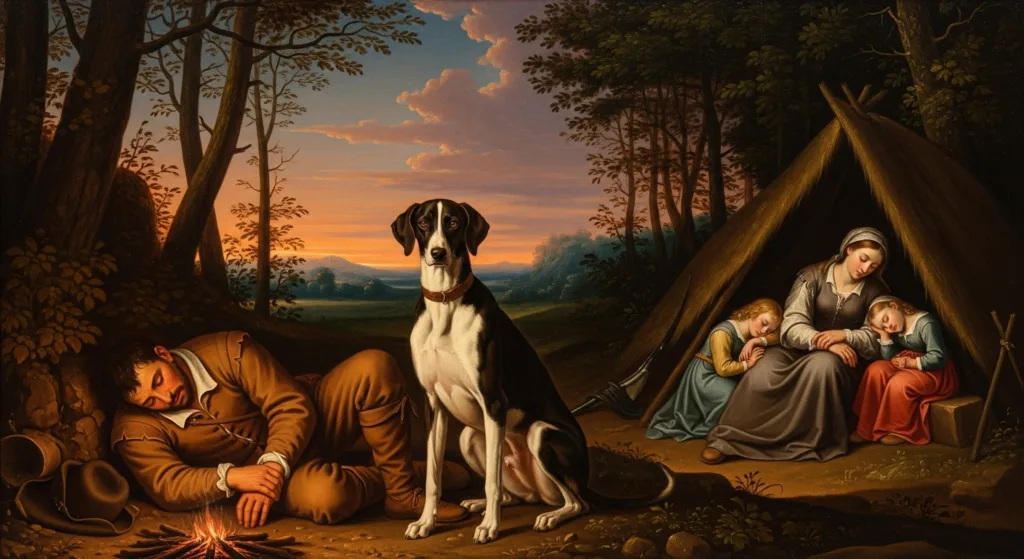
Dogs come from grey wolves. Smithsonian Magazine reports that people had dogs long before anyone started farming.
But dogs did not come from the wolves alive today. They come from ancient wolves that lived long ago. A 2022 study reported by Smithsonian Magazine found that at least two different groups of ancient wolves, one in eastern Asia and one in the Middle East, were probably ancestors of dogs.
Nobody knows exactly when wolves first became dogs. One study of 200 ancient dog skeletons, reported by Smithsonian Magazine, suggests it happened in Siberia about 23,000 years ago, during the last Ice Age.
Dogs then travelled with people across a land bridge that once joined Asia and North America. They reached the Americas about 15,000 years ago.
The oldest dog ever identified from its DNA lived about 15,800 years ago in what is now Turkey, Smithsonian Magazine reports. The earlier record holder, found in Switzerland, was about 14,200 years old.
Sometimes scientists get surprises. A famous frozen puppy, 18,000 years old, was found in Siberia and nicknamed Dogor. When scientists studied its DNA, it turned out to be a wolf, not a dog.
Dogs and families

Dogs are very social animals. The RSPCA says dogs form strong bonds with the people they live with, and many also enjoy the company of other dogs.
That is one reason dogs are such popular pets. The American Kennel Club says there are more than 75 million pet dogs in the United States, more than in any other country.
A dog can be a playmate, a walking buddy and a good friend. But looking after one is a big responsibility that lasts for many years.
A super sense of smell
A dog’s nose is its most amazing tool. The American Kennel Club says a dog’s nose has up to 300 million smell sensors, called receptors. A human nose has about 5 million.
The American Kennel Club says a dog’s sense of smell is at least 100,000 times more sensitive than ours. The part of a dog’s brain that handles smells is about seven times bigger than ours.
A dog’s nose is even built for sniffing. When a dog breathes out, the air leaves through slits at the side of its nose, so it does not blow away the faint smells it is trying to follow.
Trained dogs can find smells that are incredibly faint. The American Kennel Club says a dog can pick out a smell as weak as a teaspoon of sugar mixed into two Olympic swimming pools of water.
This is why dogs are used to help find missing people, and to sniff out explosives and even some diseases.
Hearing
Dogs can hear sounds that people cannot. The American Kennel Club says dogs can hear very high sounds, up to about 47,000 to 65,000 hertz. Most adults cannot hear anything above about 20,000 hertz.
Dogs hear best at higher sounds than we do, about 8,000 hertz, while people hear best at about 2,000 hertz. The RSPCA says dogs can hear sounds about four times quieter than people can.
But people are better at one thing. The American Kennel Club says we are better at working out exactly where a sound is coming from.
How do dogs see?
People used to think dogs saw only in black and white, but that is not true. The American Kennel Club explains that dogs have two kinds of colour-sensing cells, called cones, in their eyes. People have three.
So dogs can see blues and yellows well. But reds and greens probably look greyish or brownish to them. A red ball on green grass can be hard for a dog to spot.
Dogs do not see details as sharply as we do. The American Kennel Club says a dog’s eyesight is usually about 20/75. That means a dog has to be 20 feet from something to see it as clearly as a person can from 75 feet away.
But dogs see much better than we do in dim light. Their eyes have lots of light-sensitive cells, and a shiny layer at the back called the tapetum lucidum. This layer is why dogs’ eyes glow in photos taken with a flash.
Taste
Dogs have fewer taste buds than people. The American Kennel Club says a dog has about 1,700 taste buds, compared with roughly 2,000 to 10,000 in a person.
Dogs rely much more on smell than taste. That may be why many dogs gobble their food so quickly.
Teeth
Adult dogs have 42 teeth. The American Kennel Club says these are 12 incisors at the front, 4 long pointed canines, 16 premolars and 10 molars at the back.
Puppies have 28 baby teeth. They start to come through at about two weeks old, and they are replaced by adult teeth between about four and eight months old.
Dogs need their teeth cleaned, just like us. The American Kennel Club says owners should use toothpaste made for dogs, because some human toothpastes contain xylitol, which is poisonous to dogs.
Puppies
A mother dog is pregnant for about 63 days, or nine weeks. Animal Diversity Web says a litter usually has three to nine puppies.
Puppies are born helpless. The American Kennel Club says all puppies are born deaf, and their eyes are closed at first too.
Some puppies look very different from their parents at first. The American Kennel Club says Dalmatian puppies are born pure white. Their famous spots appear as they grow.
Animal Diversity Web says puppies stop drinking their mother’s milk at about 8 to 10 weeks old. Growing puppies need about twice as much protein as adult dogs, and about 50% more calories for their size.
How dogs talk

Dogs cannot use words, but they are great communicators. The RSPCA says dogs use smells, sounds and body language to talk to each other and to us.
They bark, whine, growl and howl. They also use their face, ears, tail and whole body to show how they feel.
A wagging tail often means a dog is excited, but it does not always mean the dog is happy. It is important to look at the whole dog, including its ears and body, before going near it.
Dogs can be very clever. The RSPCA tells the story of a border collie called Rico, who learned the names of 200 toys and could fetch the right one when asked.
Dogs even dream. The American Kennel Club says all dogs dream, and puppies and older dogs dream more often than others. You may see a sleeping dog twitch its paws, as if it is running.
Breeds and record breakers

There are many breeds of dog. The American Kennel Club recognises 205 breeds. The three newest, added on 1 January 2026, are the Russian Tsvetnaya Bolonka, the Basset Fauve de Bretagne and the Teddy Roosevelt Terrier.
Some breeds are especially popular. The American Kennel Club says the French Bulldog was the most popular breed in the United States in 2025, for the fourth year in a row. Before that, the Labrador Retriever was number one for 31 years.
Other favourites include the Golden Retriever, the Dachshund, the Poodle, the Beagle and the German Shepherd.
Dogs come in amazing sizes. Animal Diversity Web says pet dogs range from less than 1 kg to about 70 kg (154 pounds).
The American Kennel Club says the tallest dog on record was a Great Dane called Zeus, who stood 1.05 m (3 feet 5 inches) tall. The shortest was a Chihuahua called Pearl, just 9 cm (3.6 inches) tall.
Caring for a dog
Dogs need a lot of care. The RSPCA says vaccinations are one of the most important things to arrange in a new dog’s first few weeks. Owners should also think about microchipping, which helps a lost dog get home.
Every dog needs exercise, but the RSPCA says the right amount depends on the dog’s age, health and fitness. A young, energetic dog may need much more than an older one.
Dogs should never be left alone for so long that they get upset. The RSPCA says chewing and destroying things, toilet accidents and lots of barking can all be signs that a dog is unhappy on its own.
Training should always be kind. The RSPCA says owners should use reward-based methods, such as giving treats and praise when the dog does something right.
A healthy, well-cared-for dog often lives for 12 years or more, Animal Diversity Web says.
Dogs and humans

Dogs and people have worked together for thousands of years. Dogs have helped with hunting, herding sheep and guarding homes.
Today, many dogs have important jobs. Their powerful noses help them find people lost in snow or rubble, and detect explosives at airports. Some dogs are trained to notice signs of illness in people.
Other dogs guide people who cannot see, or help people with other disabilities. And millions of dogs simply do the job of being a loving family friend.
Three things people get wrong
Dogs are not completely colour-blind. They see blues and yellows, just not reds and greens.
Dogs did not come from today’s wolves. Dogs and modern wolves share ancient wolf ancestors.
Dogs do not see more sharply than people. Their eyes are better in dim light, not for details.
Did you know? A border collie called Rico learned the names of 200 toys and could fetch the right one when asked.
Try it
Hide a treat under one of three cups and watch a dog find it with its nose. Can you find it just by smelling?
Knowledge check
What animals are dogs descended from?
Show answer
Ancient grey wolves.
Which colours can dogs see well?
Show answer
Blues and yellows.
Frequently asked questions
Where did dogs come from?
Dogs are descended from ancient grey wolves. They were tamed at least 15,000 years ago, and one study suggests about 23,000 years ago in Siberia.
How good is a dog’s sense of smell?
Very good. A dog’s nose has up to 300 million smell receptors, and its sense of smell is at least 100,000 times more sensitive than ours.
Can dogs see colours?
Yes, but not all of them. Dogs see blues and yellows well, but reds and greens look greyish or brownish to them.
How many teeth does a dog have?
Adult dogs have 42 teeth. Puppies have 28 baby teeth, which are replaced by adult teeth between about four and eight months old.
How many puppies does a dog have?
A mother dog is pregnant for about 63 days, and a litter usually has three to nine puppies. All puppies are born deaf.
How long do dogs live?
A healthy, well-cared-for pet dog often lives for 12 years or more. Good food, exercise and vet care all help.
Sources
- Animal Diversity Web, University of Michigan: domestic dog — size range, pregnancy, litters, weaning, puppy food and lifespan
- American Kennel Club: dog facts — smell receptors, taste buds, deaf newborn puppies, Dalmatians, dreams, dog numbers and records
- American Kennel Club: the nose knows — how sensitive a dog’s nose is and detection work
- American Kennel Club: can dogs see colour? — colour vision, eyesight and night vision; the AKC’s hearing, teeth and breed pages were also used
- Smithsonian Magazine: dog domestication in Ice Age Siberia — when and where dogs were tamed; its reports on the two wolf populations and the oldest known dog were also used
- RSPCA: dogs — senses, communication, social needs, care, training and Rico the border collie