saber-toothed tiger vs lion quick facts
- Smilodon weighed 160 to 280 kg; male lions weigh 150 to 250 kg.
- Smilodon’s upper canines could reach 28 cm long.
- Smilodon was not a tiger but a separate kind of cat.
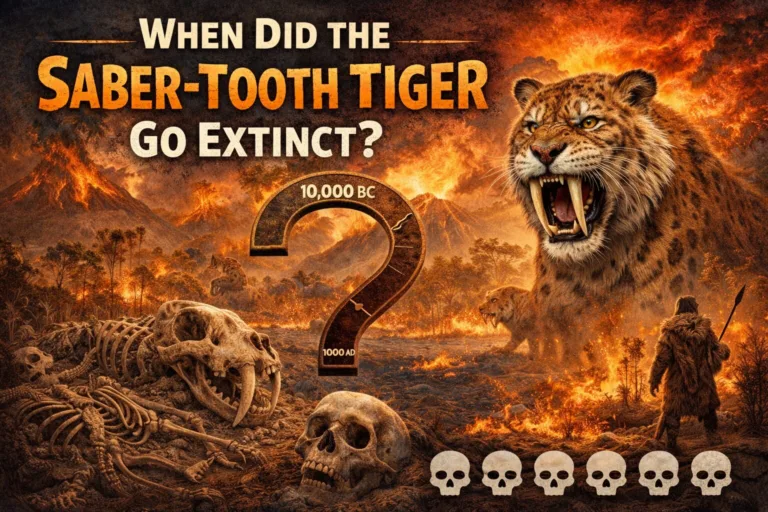
- Smilodon died out about 10,000 years ago.
- The American lion shared North America with Smilodon in the Ice Age.
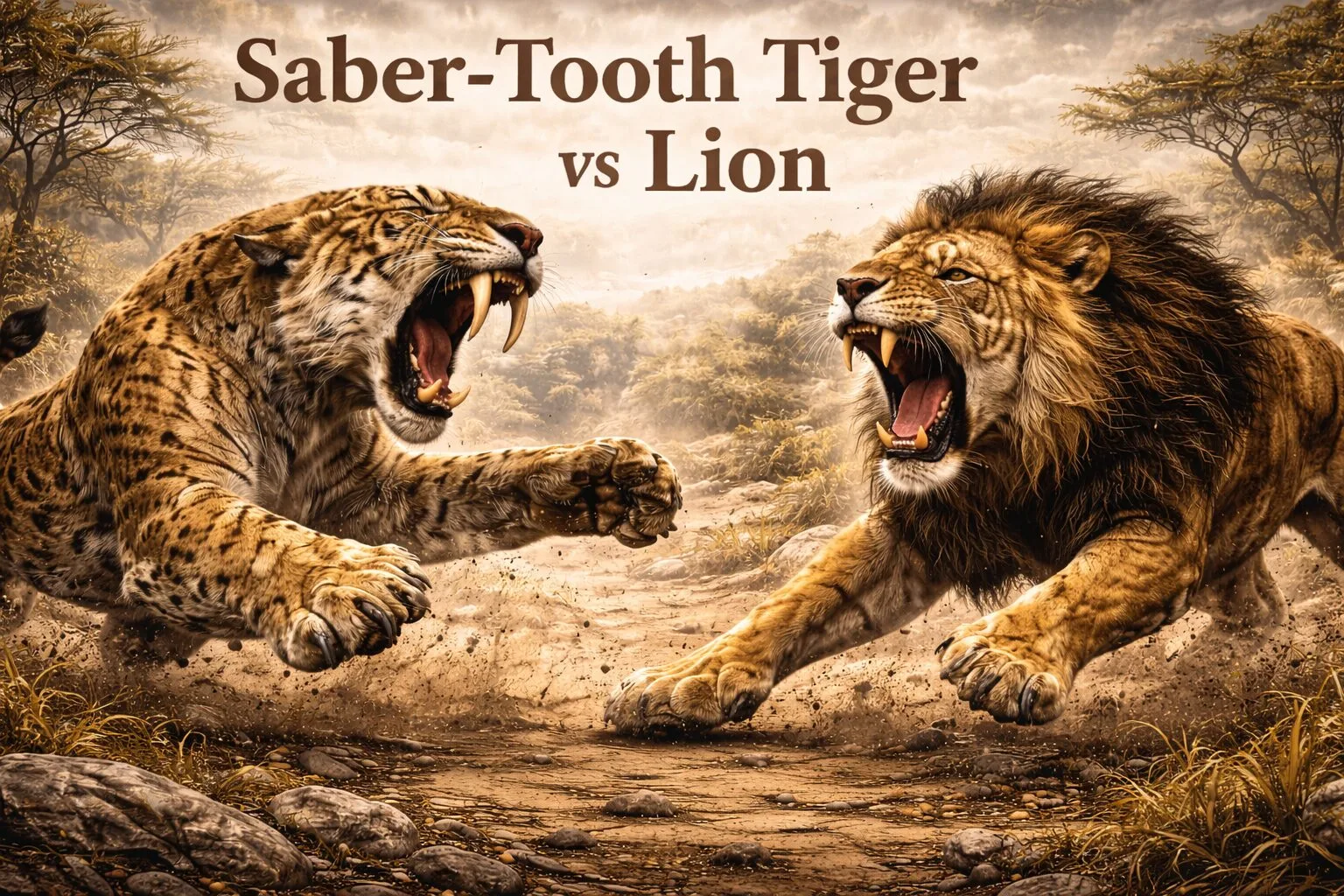
Saber-toothed tiger vs lion: who would win?
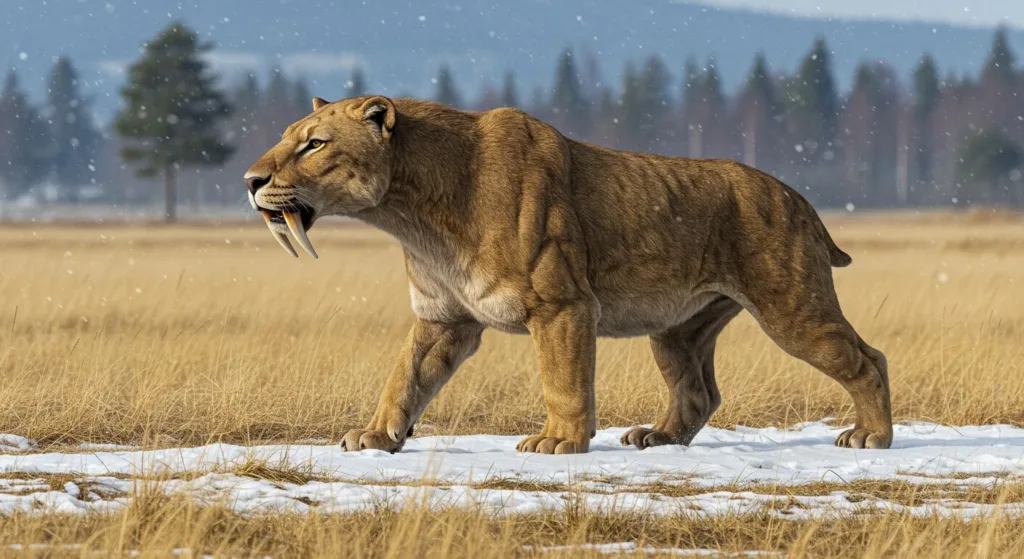
Nobody knows for sure who would win a fight between a saber tooth tiger and a lion, because the two never met. The saber-toothed tiger, Smilodon, lived in the Americas and died out about 10,000 years ago. African lions live in Africa today.
What scientists can do is compare their bodies and the way they hunted. On paper, Smilodon was stockier and more powerfully built than a lion, with far longer teeth. A lion is taller, longer and a team player.
If the two ever met, the result would depend on the animals themselves, where they met, and whether the lion had its pride with it. This guide looks at the evidence, round by round.
| Smilodon (saber-toothed cat) | African lion | |
|---|---|---|
| Weight | 160 to 280 kg (350 to 620 pounds) | males 150 to 250 kg (330 to 550 pounds) |
| Height at the shoulder | over 1 m (3 feet) | 1 to 1.2 m (3.5 to 4 feet) |
| Length | nearly 1.8 m (6 feet), body only | males up to 3 m (10 feet), with tail |
| Longest teeth | upper canines up to 28 cm (11 inches) | much shorter canines |
| How it hunted | ambush, using strong front legs | ambush and teamwork in a pride |
| When and where | the Americas; died out about 10,000 years ago | Africa and India today |
What this comparison can and cannot prove
A match-up like this is fun to think about, but it is not a real experiment. We only know Smilodon from its bones. We cannot watch how it moved, how bold it was or how it behaved in a fight.
Scientists can measure fossil bones and teeth, and compare them with living cats. That tells us a lot about size and strength, but it cannot tell us who would win a fight that never happened.
So think of the verdict here as a best guess based on evidence, not a certain answer.
Was it really a tiger?
Smilodon is often called a saber-toothed tiger, but it was not a tiger. The La Brea Tar Pits museum explains that tigers belong to the group of big cats that includes lions, leopards and jaguars.
Smilodon belonged to a separate group of cats that has completely died out, so scientists prefer to call it a saber-toothed cat. This is really a match between an extinct cat and a living one. Learn more in our saber-toothed tiger facts for kids.
Round one: size and strength
The US National Park Service says Smilodon stood over 1 m (3 feet) tall at the shoulder, was nearly 1.8 m (6 feet) long and weighed 160 to 280 kg (350 to 620 pounds).
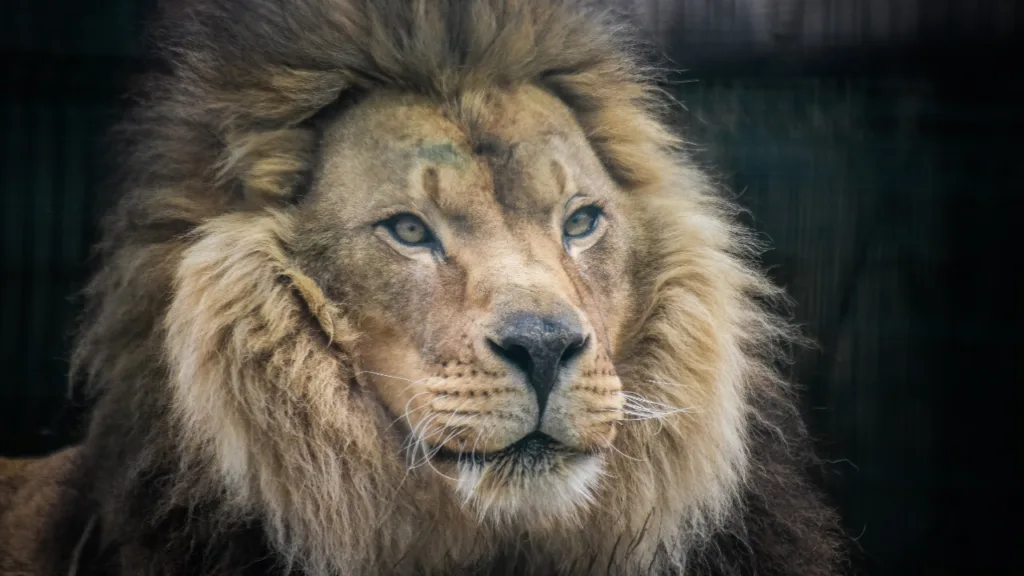
The Smithsonian’s National Zoo says a male lion stands 1 to 1.2 m (3.5 to 4 feet) tall at the shoulder and weighs 150 to 250 kg (330 to 550 pounds). With his tail, he can be 3 m (10 feet) long.
So the two were similar in weight, but they were built differently. A lion is long and athletic. Smilodon was shorter and stockier, with thick, muscular front legs and a short tail.
The National Park Service says Smilodon’s forearm bones were very sturdy, with powerful muscles for grabbing and holding prey. In a wrestling match, that strength would count for a lot.
Round one: Smilodon, for its heavy, powerful build.
Round two: teeth and bite
Smilodon’s famous upper teeth could reach 28 cm (11 inches) long, nearly the length of a school ruler. A lion’s canines are far shorter.
But long teeth are not always an advantage. Smilodon’s sabers were thin blades, and they could snap if they hit bone or if the prey struggled too much.
The San Diego Zoo Wildlife Alliance library says Smilodon probably did not use its canines to hold on to struggling prey, unlike modern lions. It pinned animals down first, then used its sabers for a precise bite.
A lion’s shorter, stronger teeth can grip and hold on. In a scrappy fight, that could be safer than long, fragile sabers.
Round two: a draw. Smilodon had the more deadly teeth; the lion had tougher ones.
Round three: speed and stamina
Neither cat was built for long chases. Lions are fast over a short distance, but they tire quickly and rely on getting close before they attack.
Smilodon’s short tail, heavy body and thick legs suggest it was not a fast runner either. It was built for power, not for speed.
Round three: probably the lion, whose longer legs make it the more athletic of the two.
Round four: hunting style
Both cats were ambush hunters. They hid, crept close to their prey and then attacked in a sudden rush.
Smilodon hunted large animals such as bison, camels, deer and tapirs, according to the National Park Service. It lived in open and mixed woodland, where trees and bushes gave it cover. Find out more in our guide to what saber-toothed cats ate.
Lions hunt zebras, wildebeest and antelope on the open grasslands of Africa. San Diego Zoo Wildlife Alliance says lionesses work together, with some chasing prey towards others waiting in ambush.
Round four: the lion, if it has its pride. Teamwork is the lion’s greatest weapon, and no single cat can match a whole pride.
Where each cat lived
The two cats lived in very different places. The National Park Service says Smilodon lived in open and mixed woodland, where trees and bushes gave it cover.
African lions live mainly on open grasslands and savannas. The Smithsonian’s National Zoo says lions now live only in Africa, apart from a small group of Asiatic lions in India’s Gir Forest.
A fight in thick woodland might favour Smilodon, while a fight on open grassland might favour a quick lion with its pride nearby.
Could they have met?
Modern African lions never met Smilodon. Smilodon lived in North and South America, from Alberta in Canada to north-western South America, and died out about 10,000 years ago.
But Smilodon did have a lion-like neighbour. The American lion lived in North America in the Ice Age too. The National Park Service says it was 1.5 to 2.4 m (5 to 8 feet) long and weighed 230 to 360 kg (500 to 800 pounds) or more, bigger than today’s lions.
The American lion hunted many of the same animals as Smilodon, including deer, horses, camels, tapirs, bison and mammoths. It died out about 11,000 years ago.
So the real Ice Age match-up was Smilodon against the American lion, and scientists do not know how often, if ever, the two fought.
The verdict
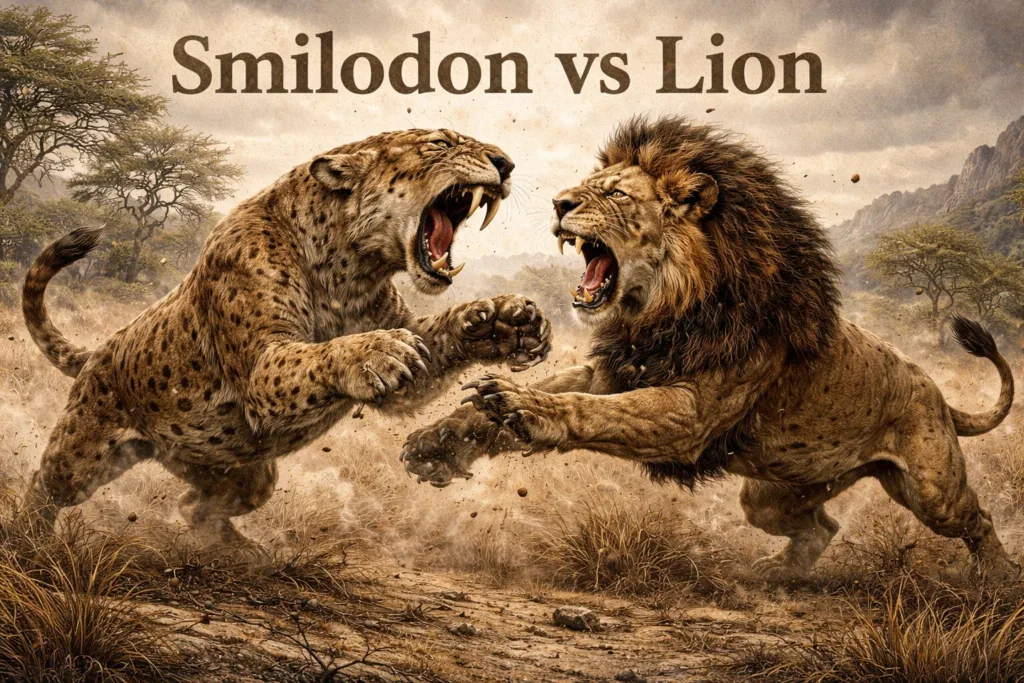
On the evidence of their bodies, Smilodon’s heavy build and powerful front legs might give it a slight edge in a one-on-one fight.
But a lion rarely fights alone. A lion with its pride behind it would very likely win, because the pride would outnumber a single saber-toothed cat.
Real predators also avoid fighting each other whenever they can. An injured wild cat may be unable to hunt and could starve, so a big fight is a huge risk for both.
The honest answer is that we cannot know for sure. Comparing the two cats is a good way to learn how each was built for its own world, not to crown a champion.
Why Smilodon is gone
Smilodon died out about 10,000 years ago, near the end of the last Ice Age, when many of the large animals it hunted also disappeared. Find out more in our guide to when Smilodon became extinct.
Lions survive today, but they are in trouble too. The National Zoo estimates that about 20,000 lions remain in the wild. San Diego Zoo Wildlife Alliance says there are only 22,000 to 25,000 lions left in Africa, and they are listed as Vulnerable.
What fossils tell us
Much of what we know about Smilodon comes from the La Brea Tar Pits in Los Angeles, where sticky asphalt trapped Ice Age animals. The museum says more than 2,500 Smilodon have been dug out of the asphalt there.
With so many skeletons, scientists can compare young and old cats and learn how Smilodon grew. You can follow that story in our guide to the saber-toothed tiger life cycle.
Three things people get wrong
Smilodon was not a tiger. It belonged to a separate group of cats that has died out.
Lions and Smilodon never met. Smilodon lived in the Americas and died out about 10,000 years ago.
Longer teeth did not make Smilodon unbeatable. Its sabers were fragile and could break.
Did you know? More than 2,500 Smilodon have been dug out of the La Brea Tar Pits in Los Angeles.
Try it
Make two fact cards, one for Smilodon and one for a lion. Compare weight, teeth and hunting style, then decide which card wins each round.
Knowledge check
Did saber-toothed tigers and African lions ever meet?
Show answer
No; Smilodon lived in the Americas and died out about 10,000 years ago.
What was the lion’s biggest advantage?
Show answer
Teamwork in a pride.
Frequently asked questions
Who would win, a saber-toothed tiger or a lion?
No one knows for sure. Smilodon’s heavy, powerful build might win one-on-one, but a lion with its pride would very likely win.
Was the saber-toothed tiger bigger than a lion?
They were similar in weight. Smilodon weighed 160 to 280 kg and was stockier, while a male lion weighs 150 to 250 kg and is longer.
Did saber-toothed tigers and lions live at the same time?
Smilodon never met African lions, but it shared Ice Age North America with the American lion, a bigger relative of today’s lions.
How long were saber-toothed tiger teeth?
The National Park Service says Smilodon’s upper canines could reach 28 cm (11 inches) long, nearly the length of a school ruler.
Was the saber-toothed tiger a real tiger?
No. Smilodon belonged to a separate group of cats that has died out. Tigers belong to the group that includes lions, leopards and jaguars.
When did saber-toothed tigers die out?
Smilodon died out about 10,000 years ago, near the end of the last Ice Age, when many of the big animals it hunted also disappeared.
Sources
- US National Park Service: the big cats — Smilodon’s size, teeth, forearms, prey, habitat, range and extinction, and the American lion
- Smithsonian’s National Zoo: lion — lion size and weight
- San Diego Zoo Wildlife Alliance: lion — team hunting and lion numbers
- La Brea Tar Pits and Museum: Smilodon, saber-tooths and tigers — why Smilodon was not a tiger and the number found at La Brea
- San Diego Zoo Wildlife Alliance Library: extinct saber-toothed cat, diet and feeding — how Smilodon used its canines compared with lions