
Elephants and People quick facts
- Elephants in Kenya reacted defensively to Maasai voices but not to Kamba voices, from the sound alone.
- They could still tell male from female speakers even when researchers altered the recordings to match pitch.
- An elephant brain holds about 257 billion neurons, roughly three times a human’s, though most handle movement.
- Elephants pass the mirror self-recognition test, which very few species do.
- The claim that elephants find humans cute is a researcher’s speculation, not a finding.

Nobody can ask an elephant what it thinks of us. Any page that tells you it knows is guessing. What scientists can do is watch what elephants do when people are around. The results are startling. Elephants can tell human groups apart by the sound of their voices. They change how they behave depending on who is talking.
So the honest answer to the question is that elephants do not think of humans as one thing. They sort us into categories, and they treat the categories differently.
Elephants can tell who is speaking
The clearest evidence comes from a study published in 2014 by Karen McComb and colleagues in Amboseli National Park, Kenya.
Two groups of people live near those elephants. Maasai men herd cattle. They have sometimes clashed with elephants over water and grazing, and have speared them. Kamba men are farmers, and elephants rarely have trouble with them.
The researchers played recordings to 48 elephant family groups. Each recording was a man saying the same ordinary sentence, in his own language: “Look, look over there, a group of elephants is coming.”
When the voice was Maasai, the elephants bunched together defensively, investigated the smell of the air, and moved away. When the voice was Kamba, they largely carried on. They also reacted less strongly to Maasai women. They reacted less strongly again to Maasai boys.
Then the researchers did something clever. They electronically altered the male recordings so the pitch matched a woman’s voice. The elephants still told them apart. So they were not simply responding to a deep voice. They were picking up something subtler in how the speaker sounded.
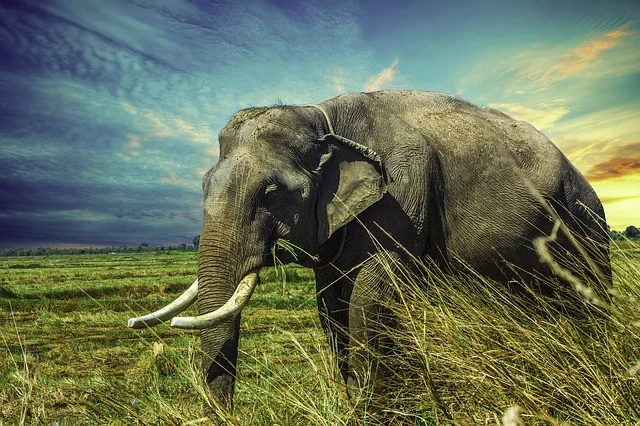
An elephant stands in long grass. It hears a human voice it cannot see. From that alone it can judge roughly how much danger it is in. That is a remarkable thing for an animal to be able to do.
What is going on in an elephant’s head

An elephant brain weighs about 5 kg, roughly four times a human brain, and contains around 257 billion neurons, about three times as many as ours. Most of those sit in the cerebellum. That part handles movement and coordination. An elephant has a great deal to coordinate, including a trunk with tens of thousands of muscle units and no bones at all.
Brain size on its own does not settle anything, so researchers test behaviour instead. Elephants pass the mirror self-recognition test. Give an elephant a mirror, and a mark on its head that it cannot see directly. It reaches up and touches the mark on its own body, not the reflection. Only a handful of species do this, including great apes, dolphins and magpies.
They also remember. Older matriarchs carry decades of knowledge. They know where water sits in a drought, and which threats are serious. Families led by older females do better in hard years. The saying about elephants never forgetting is an exaggeration, but the memory is real and it keeps families alive.
Do they recognise individual people?
There is good evidence they tell groups of people apart. There is reasonable evidence they know particular people they see often.
Earlier work in Amboseli tested smell instead of sound. Elephants were warier of clothing worn by Maasai men than of identical clothing worn by Kamba men. They also responded differently to the colour red, associated with Maasai dress.
Keepers and researchers work with the same elephants for years. Many describe being recognised after long absences. That is harder to test properly, so treat it as strong anecdote rather than settled science, but it fits everything else we know.
Working safely around elephants means understanding their health and behaviour. That is a research field in its own right. Specialists such as Leith Meyer at the Centre for Veterinary Wildlife Studies study exactly this kind of question.
“Elephants think humans are cute” — where that came from
You will find this claim all over the internet, usually phrased as elephants seeing us the way we see puppies or bunnies.
It traces back to a remark by the elephant researcher Joshua Plotnik. We are small and not very threatening next to an elephant. So perhaps, he suggested, they see us a little as we see small cute animals. It was offered as a possibility, an interesting way of flipping the question round.
It then travelled around the world as a stated fact, which it is not. No experiment has shown that elephants find humans cute, and it is not clear what evidence could show it. The Amboseli research points the other way. Elephants that have been hunted by a group treat that group as dangerous, not adorable.
The honest version is more interesting anyway. Elephants judge humans by experience, and different elephants have had very different experiences of us.
Elephants and feelings

Elephants behave in ways that are hard to describe without emotional language, while scientists stay careful about claiming to know what an animal feels.
They show real interest in the bones of dead elephants. They touch and turn skulls and tusks with their trunks. They do this far more with elephant bones than with the bones of other animals. Whether that is grief in the way we mean it is not something an experiment can settle.
They also comfort each other. When an elephant is distressed, others approach and touch it. They often put a trunk in its mouth. That is a strong gesture of reassurance. That behaviour is called consolation and very few animals do it.
Elephants talk to each other constantly. Some of it is infrasound, below the range of human hearing. Those low sounds travel for kilometres. There is more on this in our guide to elephant communication.
Why this matters
This is not a curiosity. If elephants learn which humans are dangerous and remember it, then how people behave around them changes how they behave back.
Conflict between elephants and farmers is one of the biggest problems in elephant conservation. An elephant that has been shot at treats every human as a threat afterwards. So does one that has watched its family shot at. Places that reduce that conflict get calmer elephants. Calmer elephants get killed less often.
Which means the question is not really what elephants think of humans. It is what we have taught them to think.
Things people get wrong
- “Elephants think humans are cute.” A researcher’s speculation that got repeated as fact. No study has shown it.
- “Elephants never forget.” Their memory is genuinely excellent and matters for survival, but it is not perfect or unlimited.
- “They are afraid of mice.” No evidence. Elephants startle at sudden movement near their feet, which is not the same thing.
- “A bigger brain means more intelligence.” Most of an elephant’s extra neurons handle movement, largely for the trunk.
- “Elephants see all humans the same way.” The Amboseli work shows the opposite. They distinguish groups by voice, smell and clothing, and respond differently to each.
Common questions
Can elephants tell humans apart?
They can tell human groups apart. In Kenya, elephants reacted defensively to Maasai voices but not to Kamba voices. They could also tell men from women, and adults from boys.
Do elephants like humans?
It depends on the elephant and its experience. Elephants that have been hunted or harassed treat people as dangerous. Elephants raised around trusted keepers behave very differently.
Are elephants intelligent?
By every measure researchers use, yes. They pass the mirror self-recognition test, use tools, remember locations for decades, and comfort distressed companions.
Do elephants mourn their dead?
They pay close attention to elephant bones, touching and examining them. They do this far more than with the bones of other animals. Whether that is grief as humans experience it is not something science can currently answer.
More animal guides
Did you know? Elephants can recognise danger by smell as well as sound. In Kenya they reacted more warily to clothing that had been worn by Maasai men than to identical clothing worn by Kamba men.
Try it
Listen to two people you know speaking from another room, without looking. Can you tell who is who? Now think about what an elephant is doing. It judges a human group from a voice alone, in long grass.
Knowledge check
How do scientists know elephants can tell human groups apart?
Show answer
Researchers played recordings of Maasai and Kamba men saying the same sentence to 48 elephant families in Kenya. The elephants bunched together defensively for Maasai voices but largely ignored Kamba voices.
Is it true that elephants think humans are cute?
Show answer
No, that is a myth. It began as a researcher’s speculation that elephants might see us the way we see small animals. It then got repeated as fact. No study has shown it, and elephants that have been hunted treat humans as dangerous.
Frequently Asked Questions About Elephants and People
What do elephants think of humans?
Nobody can ask an elephant, so the honest answer is that we cannot know directly. What research shows is that elephants do not treat all humans the same. They sort people into groups based on experience and behave differently towards each group.
Can elephants recognise different groups of people?
Yes, from voice alone. A 2014 study in Amboseli National Park, Kenya played recordings to 48 elephant family groups. When the voice was Maasai, whose men had sometimes speared elephants, the elephants bunched together defensively and moved away. When the voice was Kamba, who are farmers, they largely carried on.
Can elephants tell men from women by voice?
Yes. In the same study, elephants still distinguished male from female speakers even when researchers altered the recordings so the pitch matched. They also told adult men from boys, reacting far less to the boys.
How big is an elephant’s brain?
An elephant brain holds about 257 billion neurons, roughly three times as many as a human brain. Most of those are in the cerebellum and handle movement and body control. The number alone does not settle questions about intelligence.
Do elephants recognise themselves in a mirror?
Yes. Elephants pass the mirror self-recognition test, which very few species manage. Only great apes, dolphins, elephants and a small number of others have done so.
Do elephants think humans are cute?
There is no evidence for this. The claim comes from a researcher’s offhand speculation. He wondered whether elephants might see us the way we see puppies. It spread widely online. It is not a finding, and no study supports it.
Sources
- PNAS: elephants can determine ethnicity, gender and age from acoustic cues in human voices — the Amboseli voice-playback study, McComb et al. 2014.
- National Geographic: elephants hear age, gender and ethnicity in human voices — a plain-language summary of the research.
- ElephantVoices — elephant communication, including infrasound.
- Centre for Veterinary Wildlife Studies, University of Pretoria — research on elephant physiology and welfare.