Neptune is the eighth and farthest planet from the Sun, about 4.5 billion km away, and the only planet you cannot see without a telescope. It was found in 1846 using mathematics rather than by looking. It has 16 moons and the fastest winds in the solar system, around 2,000 km/h. One year on Neptune lasts 165 Earth years.
Neptune quick facts
- Neptune was found in 1846 by mathematics. Urbain Le Verrier worked out where it must be, and Johann Galle found it there that same night.
- It has 16 moons. Many websites still say 14; more were confirmed in 2024.
- Its winds reach about 2,000 km/h, the fastest known anywhere in the solar system.
- A year on Neptune lasts 165 Earth years. It completed its first orbit since discovery in 2011.
- Only one spacecraft has ever visited: Voyager 2, which flew past on 25 August 1989.
Neptune is the farthest planet from the Sun. It is also the only one you can never see with just your eyes, no matter how dark the night is.
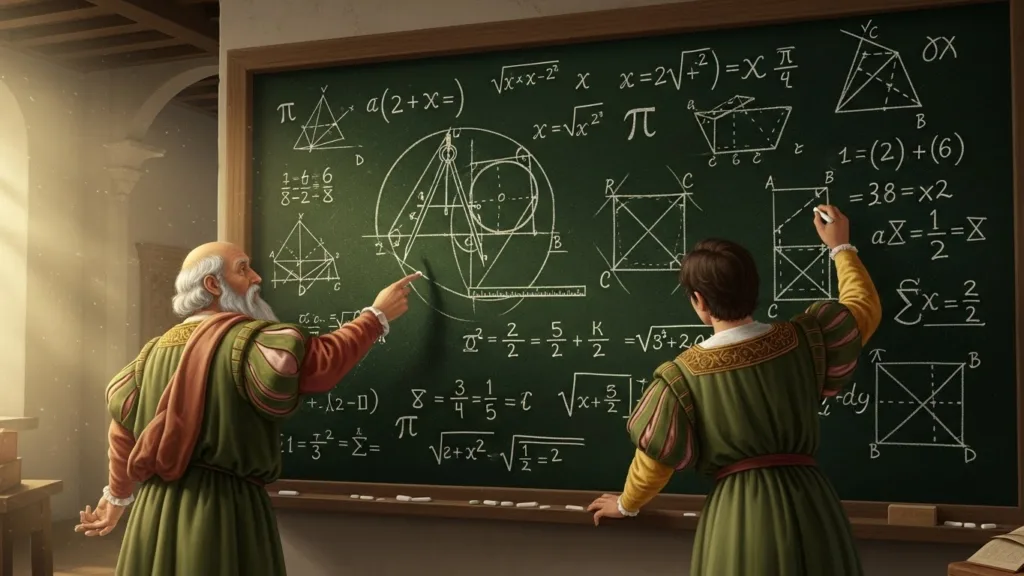
And here is the strangest part. Neptune was found using mathematics, before anyone pointed a telescope at it.
Found with a pencil, not a telescope
In the early 1800s, astronomers had a problem. Uranus was not moving the way it should. Something invisible seemed to be tugging on it.
A French mathematician called Urbain Le Verrier worked out where that something must be. He sent his numbers to an observatory in Berlin.
Johann Galle looked that same night, in 1846, and there it was. Neptune sat almost exactly where the maths said it would.
Galileo had actually seen Neptune more than 200 years earlier, in 1612. He wrote it down as a star and moved on.
Neptune in numbers
| Position | 8th planet from the Sun |
| Distance from the Sun | about 4.5 billion km, 30 times Earth’s |
| One year | 165 Earth years |
| One day | about 16 hours |
| Width | about 4 times Earth’s |
| Moons | 16 |
| Rings | 5, very faint |
| Type | ice giant |
A year on Neptune lasts 165 Earth years. Neptune finished its very first full orbit since being discovered in 2011. Nobody who saw it found in 1846 lived long enough to see it get back.
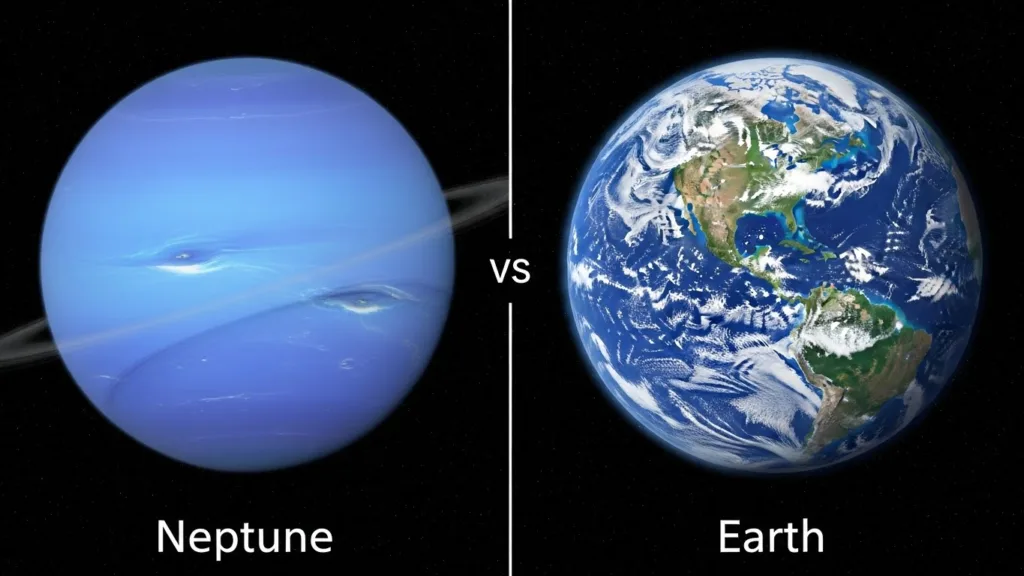
Neptune is about four times wider than Earth. If Earth were the size of a small coin, Neptune would be about as big as a baseball.
It is so far away that sunlight takes about 4 hours to get there. The same light reaches Earth in about 8 minutes.
What Neptune is made of
Most of Neptune, 80% or more of its mass, is a hot, thick fluid of “icy” materials: water, methane and ammonia. Deep inside is a solid core with about the same mass as the whole Earth.
Scientists think there may even be an ocean of super-hot water under Neptune’s freezing clouds. The crushing pressure down there stops it from boiling away.
Neptune’s blue colour comes from methane in its atmosphere. Methane soaks up the red part of sunlight and reflects the blue back out into space.
The famous blue photo is not quite true
You have almost certainly seen the picture: a deep, rich, almost glowing blue planet. Voyager 2 took it in 1989.
That image was brightened and boosted on purpose. Scientists wanted to bring out the clouds and storms, so they turned up the contrast.
In 2024 a team at Oxford went back to the original data and corrected it. The real Neptune is a much softer greenish blue, and it looks far more like Uranus than the old picture suggests.
Neptune is still slightly bluer than Uranus. That is because it has a thinner layer of haze above its clouds.
The windiest place we know
Neptune has the fastest winds in the whole solar system. They reach around 2,000 kilometres per hour.
That is faster than a fighter jet, and faster than the speed of sound on Earth. It is a genuine puzzle, because Neptune gets so little sunlight to power its weather.
Voyager 2 spotted a huge storm in 1989 and named it the Great Dark Spot. It was about as wide as Earth.
When Hubble looked again in 1994, the storm had vanished. Neptune’s dark spots come and go, unlike Jupiter’s Great Red Spot, which has lasted for centuries.
Seasons that last 40 years
Neptune is tilted over by 28 degrees, a little more than Earth is. So, like Earth, it has seasons.
But a year on Neptune lasts 165 Earth years, so each season lasts more than 40 years. A baby born at the start of a Neptune spring would be middle-aged before summer arrived.
Even its magnetic field is lopsided. It is tipped over by about 47 degrees compared with the way the planet spins.
Rings named after astronomers
Neptune has five main rings. They are named after astronomers who helped find Neptune or study it: Galle, Le Verrier, Lassell, Arago and Adams.
Part of one ring is lumpy, with thicker clumps of dust called arcs. They are named Liberté, Egalité, Fraternité and Courage, which is French for liberty, equality, brotherhood and courage.
On 21 September 2022, the James Webb Space Telescope took the clearest picture of Neptune’s rings in more than 30 years. Webb sees infrared light, so in its picture Neptune looks dark rather than blue, streaked with bright clouds of methane ice. It caught seven of Neptune’s moons in the same shot.
Triton, the moon that goes backwards
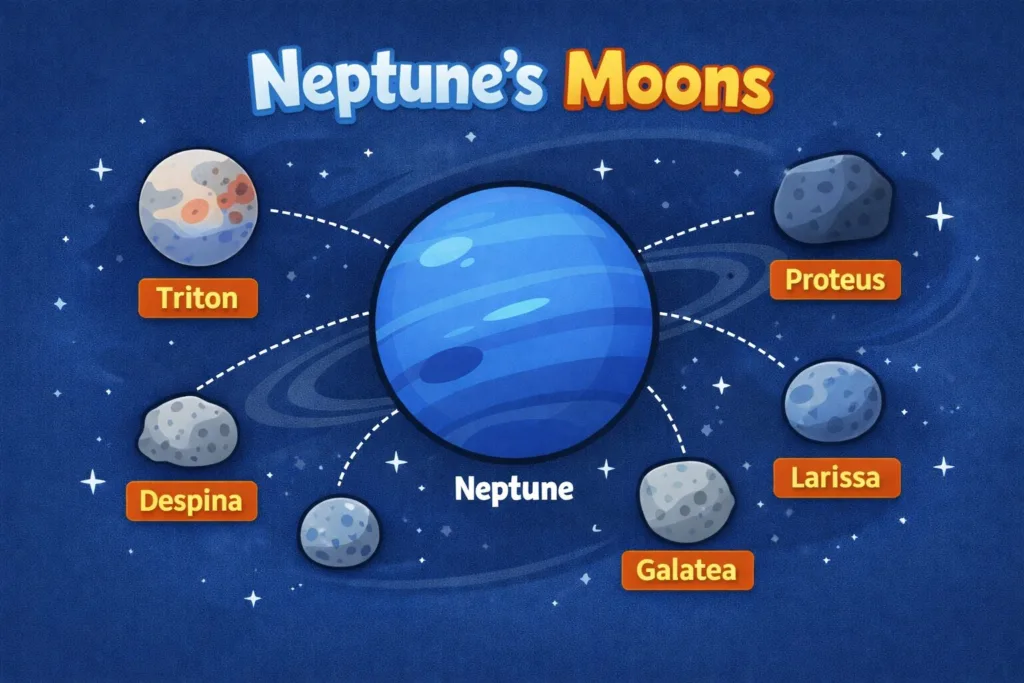
Neptune has 16 moons. The biggest by far is Triton, and it is one of the oddest objects in the solar system.
Triton orbits Neptune backwards. Every other large moon travels the same way its planet spins. Triton goes the other way.
That is a strong clue that Triton did not form around Neptune at all. It probably drifted in from the Kuiper Belt and got caught by Neptune’s gravity.
Triton is about 2,700 km across. It is coated in frozen nitrogen, which makes it very shiny: it reflects about 70% of the sunlight that hits it. In Webb’s infrared picture, Triton shines far brighter than Neptune itself.
Triton is also one of the coldest places we have ever measured, at about −235 °C. Even so, it is not still: geysers there spray icy material more than 8 km high.
Only one visit, ever
Just one spacecraft has ever been to Neptune. Voyager 2 flew past on 25 August 1989 and kept going.
Almost everything in this guide comes from those few hours, plus telescope work done since. No mission is on its way there now.
Sunlight at Neptune is about 900 times dimmer than here. Noon on Neptune would look like a dim twilight to you.
When Pluto was closer than Neptune
Pluto’s path around the Sun is a stretched-out oval. For 20 years in every 248, it swings inside Neptune’s orbit and comes closer to the Sun than Neptune does. The last time was from 1979 to 1999.
You might think the two could crash. They cannot. Pluto goes round the Sun twice for every three times Neptune does, and that steady rhythm keeps them far apart whenever Pluto crosses Neptune’s path.
Four things people get wrong
Neptune has 16 moons, not 14. Plenty of websites still say 14. More were confirmed in 2024.
It is an ice giant, not a gas giant. Jupiter and Saturn are mostly hydrogen and helium. Neptune has a thick, slushy layer of water, ammonia and methane under its atmosphere.
It is not solid. There is no surface to land on. A spacecraft would sink through thickening gas until the pressure crushed it.
Neptune is not the coldest planet. Uranus holds that record with the lowest measured temperature, even though it sits closer to the Sun.
Did you know? The famous deep-blue photograph of Neptune is not its true colour. Voyager 2’s images were deliberately contrast-boosted to bring out the clouds. When Oxford researchers corrected them in 2024, Neptune turned out to be a much softer greenish blue, and far more similar to Uranus than anyone had been showing.
Try it
A year on Neptune is 165 Earth years. Work out how old you would be in Neptune years by dividing your age by 165 — you will not even be a fifth of a year old. Then work out what Earth year it will be when Neptune finishes the orbit it started in 2011.
Knowledge check
How was Neptune discovered?
Show answer
By mathematics. Uranus was not moving as expected, so Urbain Le Verrier calculated where an unseen planet must be. Johann Galle pointed a telescope at that spot in 1846 and found Neptune almost exactly where the numbers predicted.
Why does Triton orbit backwards?
Show answer
Because it very likely did not form around Neptune. Every other large moon travels the same way its planet spins, but Triton goes the opposite way. Astronomers think it drifted in from the Kuiper Belt and was captured by Neptune’s gravity.
Frequently asked questions
How many moons does Neptune have?
Neptune has 16 moons. A lot of websites still say 14, because more were only confirmed in 2024. The largest by far is Triton, which is bigger than all the others put together.
How far is Neptune from the Sun?
About 4.5 billion kilometres, which is roughly 30 times as far as Earth. Sunlight there is about 900 times dimmer than it is here, so the middle of the day on Neptune would look like a dim twilight to you.
How long is a year on Neptune?
165 Earth years. Neptune was discovered in 1846 and did not finish its first complete orbit since then until 2011. A day, though, is short: Neptune spins round in about 16 hours.
What colour is Neptune really?
A soft greenish blue. The famous deep-blue picture from Voyager 2 was contrast-boosted on purpose to show the clouds and storms. Oxford researchers corrected the original data in 2024 and found Neptune looks much more like Uranus than that image suggests.
Why is Neptune so windy?
Nobody is completely sure. Neptune has the fastest winds in the solar system, around 2,000 kilometres per hour, which is faster than the speed of sound on Earth. What makes it puzzling is that Neptune receives very little sunlight to power its weather.
Has anyone been to Neptune?
No person has, and only one spacecraft ever has. Voyager 2 flew past on 25 August 1989 and carried on out of the solar system. Almost everything we know about Neptune comes from that single flyby and from telescopes since.
Is Neptune a gas giant?
No, it is an ice giant. Jupiter and Saturn are mostly hydrogen and helium, but Neptune has a thick, slushy layer of water, ammonia and methane beneath its atmosphere. It also has no solid surface to land on.
Why is Neptune blue?
Neptune looks blue because of methane gas in its atmosphere. Methane absorbs the red part of sunlight and reflects blue light back into space. The real colour is a softer greenish blue than the famous Voyager 2 photo suggests.
Does Neptune have rings?
Yes. Neptune has five main rings, named Galle, Le Verrier, Lassell, Arago and Adams after astronomers. They are faint and dusty, and the James Webb Space Telescope took the clearest picture of them in more than 30 years in 2022.
Does Neptune have seasons?
Yes. Neptune is tilted by 28 degrees, so it has seasons like Earth. Because one Neptune year lasts 165 Earth years, each season lasts more than 40 years.
Can Pluto crash into Neptune?
No. Pluto sometimes comes closer to the Sun than Neptune, most recently from 1979 to 1999, but it goes round the Sun twice for every three Neptune orbits. That rhythm keeps the two far apart.
Sources
- NASA: Neptune facts — distance, size, day and year, what Neptune is made of, colour, winds, seasons, magnetic field, rings and Pluto’s orbit
- NASA: Neptune’s moons — the count of 16 moons and Triton’s retrograde orbit.
- University of Oxford (January 2024): the true colours of Uranus and Neptune — why the Voyager 2 image is too blue, and what Neptune really looks like.
- Britannica: Neptune — the discovery story, rings and atmosphere.
- The Planetary Society: Neptune — the Voyager 2 flyby and what is still unknown.
- NASA: Triton — Triton’s size, backwards orbit, temperature and geysers
- NASA: Webb captures clearest view of Neptune’s rings in decades — the 2022 Webb image, Neptune in infrared and Triton’s shine