Theodore Roosevelt (1858 to 1919) was the 26th president of the United States, from 1901 to 1909, and the youngest person ever to become president. A sickly child who became a rancher and Rough Rider, he protected about 230 million acres of land, won the Nobel Peace Prize in 1906 and gave his name to the teddy bear.
Theodore Roosevelt quick facts
- Theodore Roosevelt was born in New York City on 27 October 1858.
- He had severe asthma as a child.
- He became president in 1901, aged 42, the youngest ever.
- He protected about 230 million acres of land.
- The teddy bear is named after him.
Who was Theodore Roosevelt?
Theodore Roosevelt was the 26th president of the United States. He led the country from 1901 to 1909, and the Miller Center says he was the youngest person ever to become president.
Roosevelt packed a lot into one life. He was a naturalist, a cowboy, a soldier, an explorer and the author of around 30 books. He also protected huge areas of wild land for everyone to enjoy.
And he gave his name to one of the world’s favourite toys: the teddy bear.
| Theodore Roosevelt at a glance | |
|---|---|
| Born | 27 October 1858, New York City |
| President | 26th, from 1901 to 1909 |
| Nickname | Teddy, and Teedie as a boy |
| Famous for | conservation, the Square Deal, the teddy bear |
| Prize | Nobel Peace Prize, 1906 |
| Died | 6 January 1919, aged 60 |
Birth and family
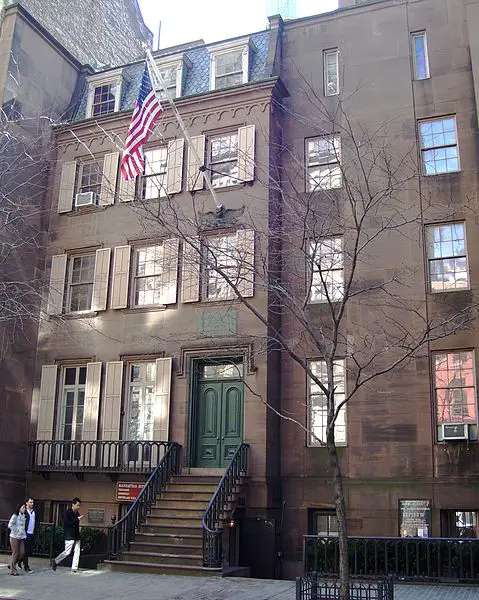
Theodore Roosevelt was born on 27 October 1858, in a townhouse at 28 East 20th Street in Manhattan, New York City. The Theodore Roosevelt Presidential Library says he was born at 7:45 in the evening.
He was the second of four children of Theodore Senior and Martha, known as Mittie. The Miller Center says his family called him “Teedie”.
A sickly child
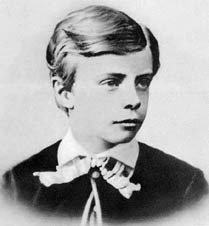
As a boy, Theodore was often ill. The National Park Service says he had severe asthma, which made it hard to breathe. His parents tried all sorts of remedies, including cigar smoke, strong black coffee and fast rides in a horse-drawn buggy.
His father told him to build up his body. The Miller Center says that as a teenager he took up gymnastics and weightlifting. For the rest of his life, he believed in what he called “the strenuous life”, full of hard work and outdoor activity.
A young naturalist
Theodore loved nature. The Theodore Roosevelt Presidential Library says he set up a natural history museum of animal specimens in his bedroom.
He even learned taxidermy, the skill of preserving animals, from a naturalist called John G. Bell. His father helped found the American Museum of Natural History in New York.
Harvard and a terrible loss
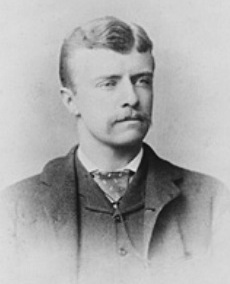
Roosevelt went to Harvard University from 1876 to 1880. The Presidential Library says he studied natural history and zoology, boxed and wrestled, and graduated with high honours. Sadly, his father died in 1878, while Theodore was still a student.
On his 22nd birthday, 27 October 1880, he married Alice Hathaway Lee.
Then tragedy struck. The National Park Service says that on 14 February 1884, both his wife Alice and his mother died, in the same house on the same day. Two days before, Alice had given birth to their daughter, also called Alice.
Cowboy in the Badlands
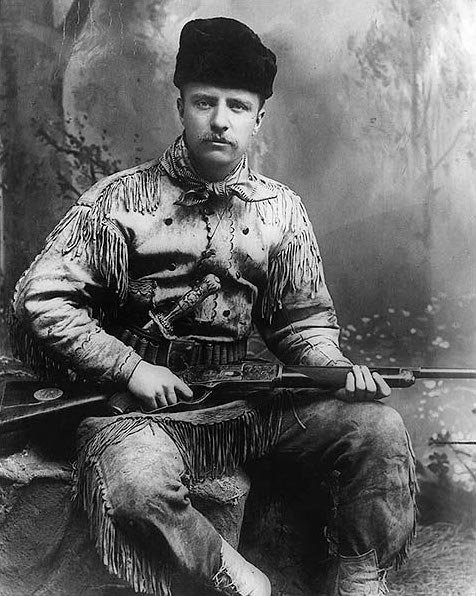
Heartbroken, Roosevelt went west. The National Park Service says he had first visited the Badlands of North Dakota in 1883. Now he worked as a cattle rancher on two ranches near Medora, called the Maltese Cross and the Elkhorn.
Ranch life was tough. The Miller Center says he bought about 1,000 cattle, but a terrible winter killed most of them.
His years in the West changed him. He wrote about ranching and hunting, and the National Park Service says he wrote around 30 books during his life.
A new family
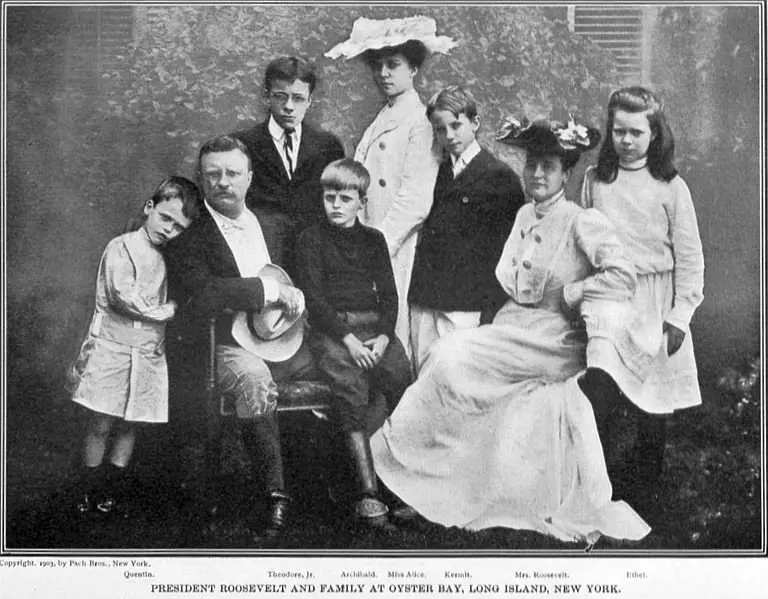
In 1886, Roosevelt married Edith Kermit Carow, a friend from his childhood, in London. The Miller Center says they had five children: Ted, Kermit, Ethel, Archie and Quentin.
The family made their home at Sagamore Hill, in Oyster Bay, New York. With young Alice too, it was a big, lively household, full of pets and games.
Climbing the ladder
Roosevelt was full of energy and ideas, and he rose quickly in public life. The Miller Center says he served as a New York state lawmaker, as a Civil Service commissioner, as head of the New York City police board in 1895, and as Assistant Secretary of the Navy in 1897.
The Rough Riders
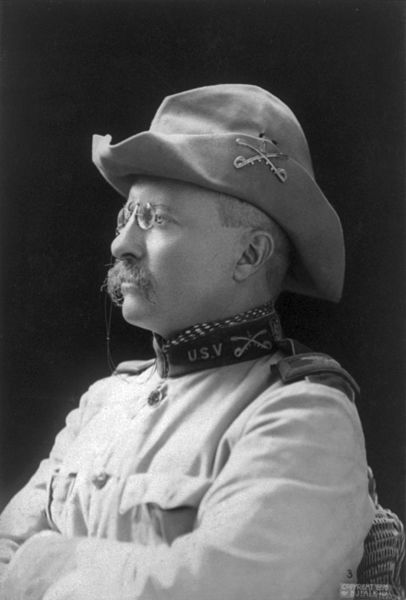
In 1898, the United States went to war with Spain. Roosevelt helped lead a volunteer cavalry group nicknamed the Rough Riders. The National Park Service says about 23,000 men applied to join, including cowboys, college athletes and Native Americans.
On 1 July 1898, in Cuba, he led a charge up Kettle Hill during the Battle of San Juan Heights. The National Park Service says he later called it “the great day of my life”.
The war made him a national hero. He was elected Governor of New York in 1898, and Vice President of the United States in 1900.
President Roosevelt
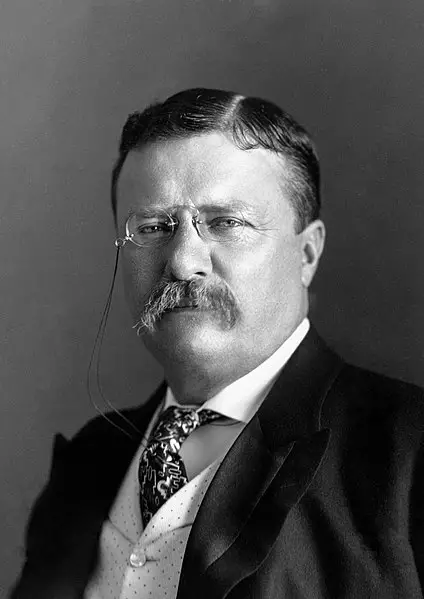
In September 1901, President William McKinley was shot in Buffalo, New York, and died. The National Park Service says Roosevelt was sworn in as the 26th president on 14 September 1901, at a friend’s house in Buffalo.
He was only 42. The Miller Center says he was the youngest person ever to become president.
The Square Deal
Roosevelt wanted fairness for everyone. The Miller Center says he called his plan the Square Deal, meaning a fair deal for workers, businesses and shoppers.
He stood up to giant companies. In 1902, he took a huge railway company called Northern Securities to court, and the Supreme Court broke it up in 1904.
In 1906, he signed laws to make food and medicine safer, the Pure Food and Drug Act and the Meat Inspection Act. Before these laws, some food and medicine sold in shops could be unsafe.
Protecting wild places
Roosevelt’s greatest legacy may be the land he protected. The National Park Service says he protected about 230 million acres, including 150 national forests, 51 bird reserves, 5 national parks and 18 national monuments.
He created the US Forest Service in 1905. On 8 June 1906, he signed the Antiquities Act, which lets presidents protect special places as national monuments.
The National Park Service says his first bird reserve was Pelican Island, in Florida. His national monuments included Devils Tower, Muir Woods and the Grand Canyon.
The teddy bear
On 14 November 1902, Roosevelt went on a bear hunt near Onward, Mississippi. The National Park Service says his hosts caught a bear and tied it to a tree for him to shoot. Roosevelt refused, because he thought it would be unfair.
Two days later, a cartoonist called Clifford Berryman drew the scene in the Washington Post. A shopkeeper in Brooklyn, Morris Michtom, then made a stuffed toy bear, called “Teddy’s Bear”, with the president’s permission.
The bears sold so well that Michtom started the Ideal Toy Company. Today, teddy bears are loved all over the world.
Roosevelt and the world
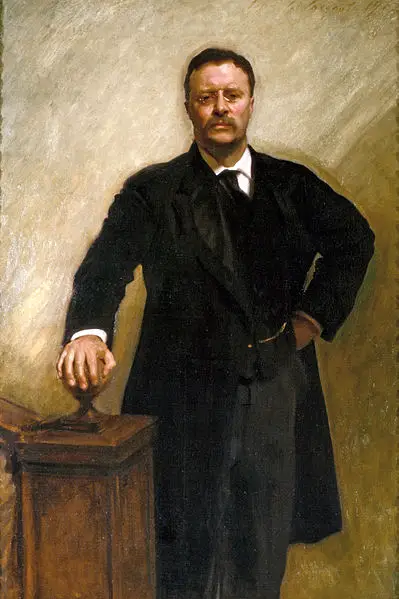
Roosevelt summed up his way of dealing with other countries in one famous phrase. The Miller Center says he believed in the saying “speak softly and carry a big stick”.
He started work on the Panama Canal, a waterway that cuts through Central America to link the Atlantic and Pacific oceans. The Miller Center says it opened in 1914, after about 30,000 workers had spent ten years building it. It cut the sea journey from New York to San Francisco by more than 13,000 km (8,000 miles).
The National Park Service says Roosevelt was the first US president to travel abroad while in office, when he visited the canal works.
He was also a peacemaker. In 1905, he helped end a war between Russia and Japan, and in 1906 he became the first US president to win the Nobel Peace Prize.
The Bull Moose campaign
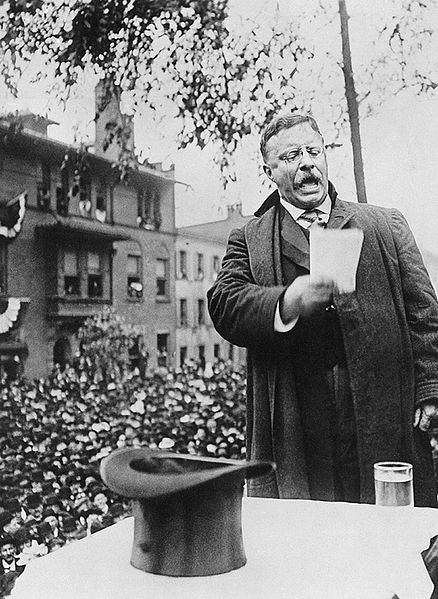
After leaving the White House in 1909, Roosevelt spent about a year travelling in Africa and Europe. Then, in 1912, he ran for president again, for a new Progressive Party, nicknamed the Bull Moose Party.
He came second, behind Woodrow Wilson, but ahead of President William Taft. The Miller Center says Roosevelt won 88 electoral votes to Wilson’s 435.
During the campaign, on 14 October 1912 in Milwaukee, a man shot Roosevelt in the chest. The Theodore Roosevelt Presidential Library says the bullet was slowed by his glasses case and the thick folded speech in his coat pocket.
Amazingly, he went on and gave his speech anyway, for more than an hour, to a crowd of about 9,000 people. He told them it took more than that to kill a Bull Moose. The bullet stayed in his chest for the rest of his life.
River of Doubt
Roosevelt never stopped seeking adventure. In 1913 and 1914, he explored the River of Doubt in the rainforest of Brazil, with his son Kermit and the Brazilian explorer Cândido Rondon.
The journey nearly killed him. The National Park Service says he caught malaria and hurt his leg. The river was renamed Rio Roosevelt in his honour.
War, loss and death
All four of Roosevelt’s sons fought in the First World War. His youngest, Quentin, was a pilot, and he was killed in July 1918.
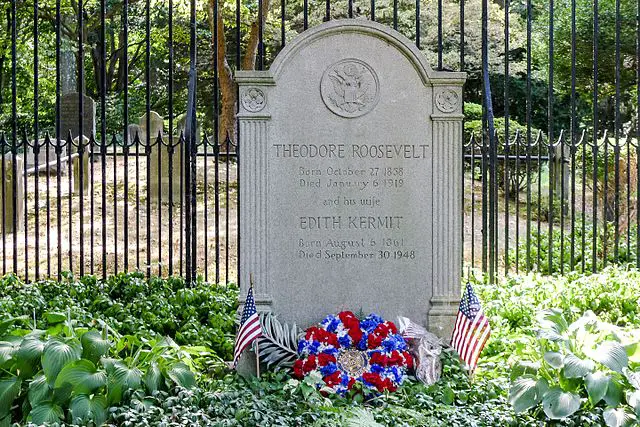
Theodore Roosevelt died in his sleep at Sagamore Hill on 6 January 1919, aged 60. The National Park Service says he is buried in Youngs Memorial Cemetery in Oyster Bay.
How he is remembered
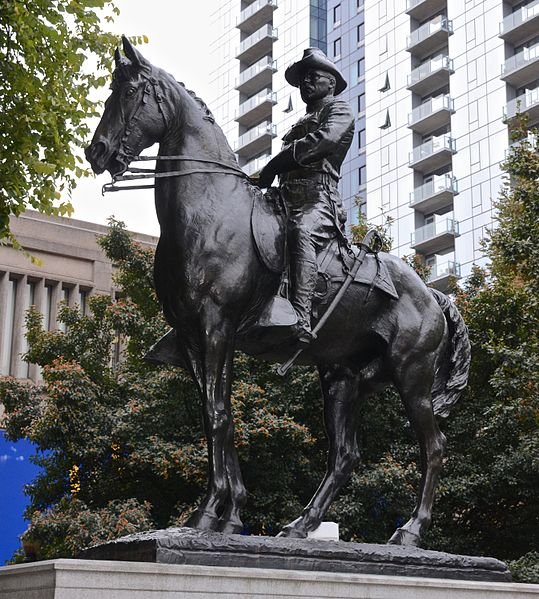
More than 100 years after his charge in Cuba, Roosevelt was honoured for his bravery. On 16 January 2001, President Bill Clinton awarded him the Medal of Honor.
His love of nature lives on too. The National Park Service says he helped create 23 of the 35 national park sites that existed when the National Park Service was founded in 1916.
His face is carved into Mount Rushmore, alongside George Washington, Thomas Jefferson and Abraham Lincoln. Learn more in our Mount Rushmore facts.
Three things people get wrong
Roosevelt’s famous charge was not up San Juan Hill. It was up Kettle Hill, part of the Battle of San Juan Heights.
The teddy bear is not named for a bear he shot. It is named for a bear he refused to shoot.
Roosevelt was not always strong and healthy. He had severe asthma as a child.
Did you know? In 1912, Roosevelt was shot in the chest, but he still gave his speech for more than an hour.
Try it
Find Mount Rushmore, the Grand Canyon and Devils Tower on a map of the United States. Roosevelt helped protect two of them.
Knowledge check
Why is the teddy bear named after Roosevelt?
Show answer
He refused to shoot a bear that had been tied to a tree.
What was the Square Deal?
Show answer
Roosevelt’s plan for fairness between workers, businesses and shoppers.
Frequently asked questions
Who was Theodore Roosevelt?
Theodore Roosevelt was the 26th president of the United States, from 1901 to 1909. He was also a naturalist, rancher, soldier, explorer and writer.
Why is the teddy bear named after Theodore Roosevelt?
In 1902, he refused to shoot a bear that had been tied to a tree. A cartoon showed the scene, and a toy maker made “Teddy’s Bear”.
What did Theodore Roosevelt do for nature?
He protected about 230 million acres of land, including national forests, bird reserves, national parks and monuments like the Grand Canyon.
Who were the Rough Riders?
The Rough Riders were a volunteer cavalry group Roosevelt helped lead in 1898. On 1 July 1898, he led a charge up Kettle Hill in Cuba.
How old was Roosevelt when he became president?
He was 42 when he was sworn in on 14 September 1901, making him the youngest person ever to become president.
When did Theodore Roosevelt die?
He died in his sleep at Sagamore Hill, his home in Oyster Bay, New York, on 6 January 1919, aged 60.
Sources
- Miller Center, University of Virginia: life before the presidency — birth, family, asthma, Harvard, ranching, early jobs and becoming president; its pages on his presidency, campaigns and later life were also used
- National Park Service: Theodore Roosevelt biography — ranches, books, family, swearing-in, travels, the River of Doubt and his death
- National Park Service: Theodore Roosevelt and conservation — land protected, the Forest Service and the Antiquities Act
- National Park Service: the story of the teddy bear — the 1902 hunt, the cartoon and the first teddy bears
- National Park Service: Theodore Roosevelt and the Rough Riders — the Rough Riders, Kettle Hill and the Medal of Honor
- Theodore Roosevelt Presidential Library: Roosevelt is shot — the 1912 Milwaukee shooting and speech; its early-life page was also used