
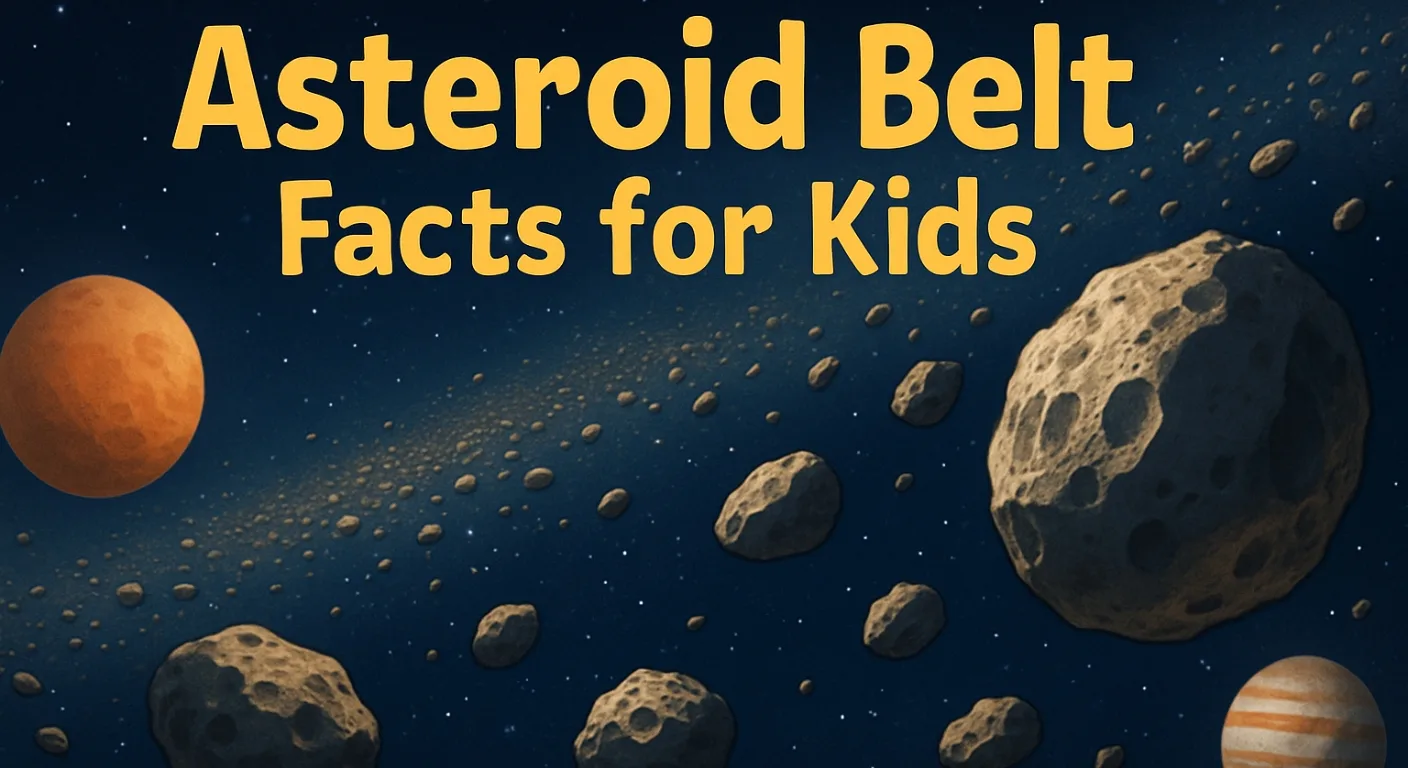
space quick facts
- All the asteroids in the belt together weigh less than Earth’s Moon.
- NASA estimates 1.1 to 1.9 million asteroids larger than 1 km across.
- Ceres holds 25 per cent of the belt’s mass all by itself.
- Ceres is a dwarf planet, so the largest true asteroid is Vesta.
- Jupiter’s gravity stopped a planet ever forming in the gap.
The asteroid belt at a glance
| The asteroid belt | |
|---|---|
| Where | Orbiting the Sun between Mars and Jupiter |
| Asteroids over 1 km wide | Between 1.1 and 1.9 million |
| Smaller ones | Millions more |
| Total mass | Less than the Moon |
| Largest asteroid | Vesta, about 530 km (329 miles) across |
| Largest object | Ceres, a dwarf planet |
| Smallest counted | Under 10 m across |
| Why no planet formed | Jupiter’s gravity got in the way |
Everything in the asteroid belt, added together, weighs less than our Moon.

Where the asteroid belt is
The main asteroid belt orbits the Sun in the gap between Mars and Jupiter.
That gap is enormous. It is not a thin ring, but a wide band of space that takes years to cross.
The belt is part of our solar system, going round the Sun in the same direction as the planets, just much more spread out.
How many asteroids are there?
More than you can picture, and still not very much.
NASA estimates the belt holds between 1.1 and 1.9 million asteroids larger than 1 kilometre across. Below that size, there are millions more.
They come in a huge range. The biggest are hundreds of kilometres wide. The smallest NASA counts are under 10 metres, which is about the length of a bus.
So the count is in the millions. The next fact is the one that surprises people.
The belt is almost entirely empty
Films show spaceships dodging through a thick swarm of tumbling rocks. Real life is nothing like that.
Here is the number that settles it. NASA says the total mass of all the asteroids combined is less than that of Earth’s Moon.
Take something smaller than the Moon. Break it into millions of pieces. Now spread those pieces through the entire space between Mars and Jupiter.
What you get is mostly nothing. The asteroids are usually so far apart that from one of them, you would probably not be able to see another.
The belt is better thought of as a very thinly scattered ring than as a wall of rocks.

Ceres, the one that is a dwarf planet
The largest object in the asteroid belt is Ceres, and it is unusual enough to have its own category.
Ceres has a radius of 476 km, about one thirteenth of Earth’s. On its own it makes up 25 per cent of the entire belt’s mass.
It was the first object in the belt ever found. Giuseppe Piazzi spotted it in 1801.
In 2006, scientists reclassified Ceres as a dwarf planet, because it is so much bigger and so different from its rocky neighbours.
Do not overdo it, though. Pluto is still 14 times more massive than Ceres.
Ceres sits 413 million km from the Sun, which is 2.8 astronomical units. It takes 1,682 Earth days, or 4.6 years, to go round once, and spins once every 9 hours.
The strangest thing about it is the water. Ceres is about 25 per cent water, possibly more than Earth has.

Vesta, the largest actual asteroid
If Ceres is a dwarf planet, which is the biggest asteroid?
Vesta, at about 530 kilometres, or 329 miles, across.
Put pictures of the two side by side and you can see the difference immediately. Ceres is round. Vesta is lumpy, with a great chunk missing from one end.
That roundness is the point. An object becomes round when it is heavy enough for its own gravity to pull it into a ball. Vesta never quite got there.

Why there is no planet here
There is a gap between Mars and Jupiter where you might expect a planet. So why is there rubble instead?
The answer, as with a surprising amount of the solar system, is Jupiter.
NASA explains that early in the history of the solar system, the gravity of the newly formed Jupiter brought an end to planet-building in this region.
Instead of sticking together, the small bodies were stirred up and made to crash into one another, breaking into the asteroids we see today.
So the asteroid belt is not a planet that exploded. It is a planet that never got the chance to form.
How we know: the Dawn mission
Most of what this guide says about Ceres and Vesta comes from one spacecraft.
NASA’s Dawn mission visited both. It reached Ceres in 2015, which made Ceres the first dwarf planet ever visited by a spacecraft.
Dawn found signs of water ice hidden in craters that never see sunlight, and evidence of water vapour. That may come from ice volcanoes, or from ice near the surface turning straight into gas.
Ice volcanoes are exactly what they sound like. Instead of molten rock, they erupt water.
Could an asteroid hit Earth?
This is the question everybody wants answered, and the answer is reassuring.
NASA set up a Planetary Defense Coordination Office in 2016 to find and track asteroids and comets that could come near Earth. Its Center for Near Earth Object Studies keeps the running list.
No known asteroid poses a significant threat to Earth for the next hundred years.
One recent case shows the system working. Asteroid 2024 YR4 was found to have a very small chance of hitting Earth in 2032. More observations were made, and that chance was ruled out entirely.
NASA has also tested a way to move one. Its DART mission was the world’s first demonstration of asteroid deflection technology.
A future mission, NEO Surveyor, is designed to find most of the potentially hazardous asteroids and comets that come within 30 million miles of Earth.
Finding them early is the whole strategy. An asteroid spotted decades ahead can be nudged. One spotted next week cannot.
What happened over Chelyabinsk
Small objects do reach us, and one recent case shows what that looks like.
On 15 February 2013, a house-sized asteroid entered the atmosphere above Chelyabinsk in Russia.
It was travelling at over 11 miles a second. It never reached the ground in one piece. It broke apart in the air, releasing energy equivalent to about 440,000 tons of TNT.
The shock wave broke windows across 200 square miles. More than 1,600 people were hurt, almost all of them by flying glass rather than by the rock itself.
Nobody saw it coming.
NASA’s Planetary Defense Officer called it a cosmic wake-up call. Within days, the United Nations backed two new international groups to watch for asteroids and plan what to do about them.
That is the honest shape of the risk. A large impact is very unlikely. A small one is survivable but startling, and the answer to both is to look earlier and look harder.
What an asteroid actually is
An asteroid is a lump of rock, or rock and metal, left over from when the solar system formed.
They are not small planets, and they are not comets.
A comet is mostly ice and dust, and grows a bright tail when it comes near the Sun. An asteroid is rocky, and does not.
Asteroids also come in different kinds. Some are dark and rich in carbon. Some are stony. Some are largely metal, mainly iron and nickel.
That matters more than it sounds. Those differences are a record of where in the young solar system each one formed, and how hot it got.
In a sense the belt is a scrapyard, and scrapyards are useful. The pieces were never melted together into a planet, so they still carry information that Earth’s rocks lost billions of years ago.
Three things people get wrong
“The asteroid belt is packed with rocks.” All the asteroids together weigh less than the Moon, spread across the whole gap between Mars and Jupiter. It is mostly empty space.
“The belt is a planet that blew up.” It is the opposite. Jupiter’s gravity stopped a planet forming there, and made the pieces smash into each other instead.
“Ceres is the biggest asteroid.” Ceres is the biggest object in the belt, but it was reclassified as a dwarf planet in 2006. The largest actual asteroid is Vesta.
Did you know? Ceres is about 25 per cent water, which may be more water than Earth has.
Try it
Ceres takes 4.6 Earth years to orbit the Sun once. Work out how old you would be in Ceres years.
Knowledge check
Why is the asteroid belt emptier than it looks in films?
Show answer
Because all the asteroids together weigh less than the Moon, and they are spread across the whole enormous gap between Mars and Jupiter.
Why is there no planet between Mars and Jupiter?
Show answer
Jupiter’s gravity ended planet-building in that region early in the solar system’s history, making the small bodies collide and break up instead of sticking together.
Frequently asked questions
Where is the asteroid belt?
Orbiting the Sun in the gap between Mars and Jupiter. It is a wide band rather than a thin ring.
How many asteroids are in the asteroid belt?
NASA estimates between 1.1 and 1.9 million larger than 1 kilometre across, and millions more that are smaller, down to under 10 metres.
Is the asteroid belt dangerous to fly through?
Far less than films suggest. The total mass of every asteroid combined is less than the Moon, spread across a vast region, so the asteroids are usually very far apart.
What is the biggest thing in the asteroid belt?
Ceres, which has a radius of 476 km and holds about 25 per cent of the belt’s mass. It was reclassified as a dwarf planet in 2006, so the largest true asteroid is Vesta at about 530 km across.
Why did a planet never form in the asteroid belt?
NASA explains that the gravity of the newly formed Jupiter ended planet-building there, and made the small bodies collide and fragment instead.
Could an asteroid hit Earth?
No known asteroid poses a significant threat for the next hundred years. NASA’s Planetary Defense Coordination Office, set up in 2016, finds and tracks them, and the DART mission showed an asteroid can be deflected.
Sources
- NASA: asteroid facts — the 1.1 to 1.9 million count, the total mass being less than the Moon, Vesta as the largest asteroid, the 10 m lower limit and why Jupiter stopped a planet forming
- NASA: Ceres facts — Ceres’ radius, its 25 per cent share of the belt’s mass, the 1801 discovery by Giuseppe Piazzi, the 2006 dwarf planet reclassification, its orbit and day, its water, and the Dawn mission findings
- NASA: asteroids — the location of the main belt and the range of asteroid sizes
- NASA: planetary defense — the Planetary Defense Coordination Office, the 2024 YR4 reassessment, the DART deflection test and the NEO Surveyor mission


