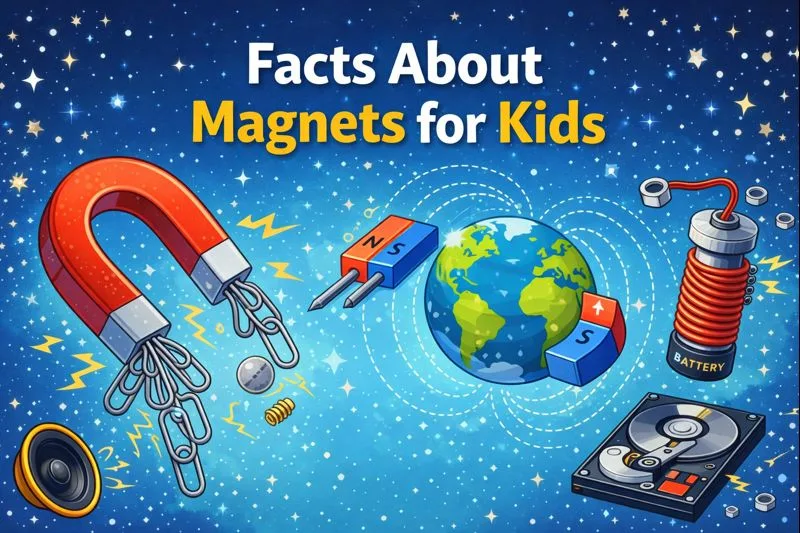
A magnet is an object that attracts iron and makes a magnetic field around itself. Every magnet has a north and a south pole: opposite poles attract and like poles repel. Only iron, nickel and cobalt can be permanently magnetised. The Earth acts like a giant magnet, which is why a compass needle points north.
magnets quick facts
- Every magnet has a north pole and a south pole.
- Opposite poles attract; like poles repel.
- Only iron, nickel and cobalt can be permanently magnetised.
- Sailors in China and Europe used lodestone compasses in the 12th century.
- Earth’s north magnetic pole moves about 55 km a year.
What is a magnet?
A magnet is an object that can pull iron towards it without touching it. Britannica defines a magnet as any material that attracts iron and produces a magnetic field outside itself.
A magnetic field is the space around a magnet where its pull can be felt. You cannot see it, but you can see what it does when a paper clip jumps across a gap to stick to a magnet.
You probably use magnets every single day without noticing. They hold notes on the fridge, keep cupboard doors shut, and are hidden inside headphones, phones and computers.
| Magnets at a glance | |
|---|---|
| Metals magnets pull strongly | iron, nickel and cobalt |
| The two ends | north pole and south pole |
| Like poles | push each other away |
| Opposite poles | pull each other together |
| Natural magnet | lodestone |
| Earth | acts like a giant magnet |
North and south poles

Every magnet has two ends, called poles: a north pole and a south pole. The pull of a magnet is strongest at its poles.
If you hold two magnets close together, you will feel something surprising. Opposite poles, north and south, pull towards each other. Like poles, north and north or south and south, push each other away.
Scientists sum this up in a short rule: opposites attract, and likes repel.
Here is another strange fact. If you break a bar magnet in half, you do not get one north piece and one south piece. You get two smaller magnets, and each one has its own north and south pole.
How do magnets work?
Everything around you is made of tiny particles called atoms. In most materials, the atoms act like very weak magnets pointing in all different directions, so their pulls cancel out.
In a magnet, huge numbers of these tiny magnets line up and point the same way. Their pulls add together to make one strong magnet.
In iron, the tiny magnets are grouped into small regions called domains. When a piece of iron is near a strong magnet, many of its domains swing round to line up, and the iron is pulled towards the magnet.
What do magnets attract?
Magnets do not attract all metals. Britannica says that only three elements, iron, nickel and cobalt, can become permanently magnetised.
Steel is made mostly of iron, so it sticks to magnets too. That is why a magnet will stick to many fridges, tins and paper clips.
But magnets will not pull aluminium drink cans, copper wire, gold, silver, plastic, wood or glass.
In fact, Britannica says scientists have found that every element has some magnetic behaviour. Most materials are pushed away from a magnet very, very weakly, far too weakly for you to notice.
Types of magnets
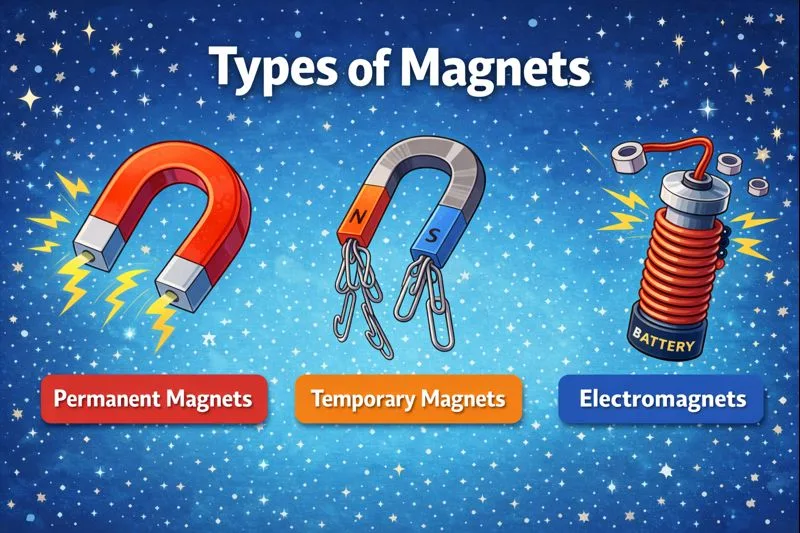
Permanent magnets: these stay magnetic for a long time. Fridge magnets, bar magnets and horseshoe magnets are all permanent magnets.
Temporary magnets: some objects, like an iron nail, act as a magnet only while they are touching or near a strong magnet. Take the magnet away and the effect soon fades.
Electromagnets: when electricity flows through a coil of wire, the coil becomes a magnet. Switch off the electricity and the magnetism stops. Giant electromagnets on cranes can lift whole cars in scrapyards, then drop them at the flick of a switch.
Natural magnets: lodestone is a rock that is naturally magnetic. Britannica describes it as a naturally occurring magnetic ore.
The history of magnets
People have known about lodestone for thousands of years. The word magnet is thought to come from Magnesia, a region of ancient Greece where magnetic stones were found.
Britannica says that in the 12th century, sailors in China and in Europe made the same discovery, apparently separately. A piece of lodestone floated on a stick in water turns to point towards the north.
Soon after, people found that an iron or steel needle rubbed with lodestone would also point north and south. This was the first compass, and it changed how people explored the world.
By the 13th century, compass needles were mounted on a pin so they could spin freely. In the 15th century, navigators began to realise that their needles did not point exactly at the North Pole.
Earth is a giant magnet
A compass works because the Earth itself acts like an enormous bar magnet. Its magnetic field spreads out into space all around the planet.
The NOAA National Centers for Environmental Information say that more than 90% of Earth’s magnetic field comes from its outer core, deep underground, where liquid metal is always moving.
Magnetic north is not quite in the same place as the North Pole at the top of the globe. The difference between the two directions is called declination, and it changes depending on where you are. Learn more about our planet in our Earth facts.
A pole on the move
Earth’s north magnetic pole does not stay still. NOAA says it is moving towards the north-north-west at about 55 km a year.
Over very long periods, Earth’s magnetic field can even flip, so that a compass would point south instead of north. NOAA says the last time this happened was about 750,000 to 780,000 years ago.
These flips do not happen on a regular timetable. They have been anywhere from about 5,000 years to 50 million years apart.
Animals with a built-in compass
People are not the only ones who use Earth’s magnetism. NOAA says many animals that travel long distances use the magnetic field to find their way.
These include birds, bats, butterflies, lobsters, dolphins and whales. Scientists are still working out exactly how their bodies sense the field.
Magnets through time and today
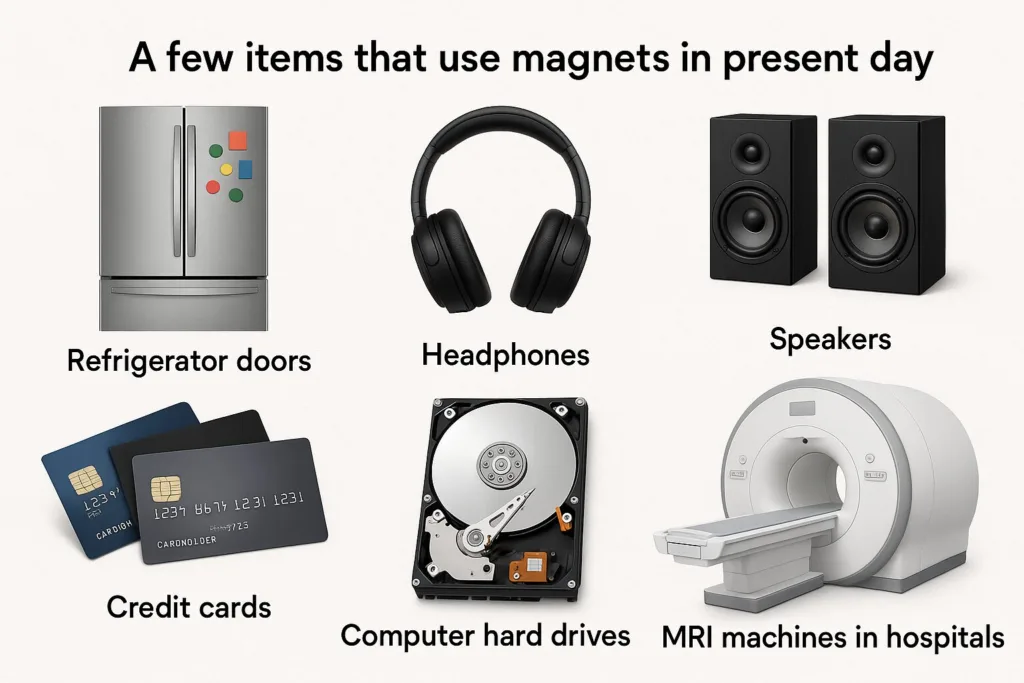
From the first compasses to modern machines, magnets have been useful for hundreds of years. Here are just a few of the places they are hiding today.
Speakers and headphones: magnets and electricity work together to make parts vibrate and create sound.
Electric motors: magnets make the motors spin in fans, washing machines, electric cars and toys.
Computers: some computer hard drives store information as tiny magnetic patterns.
Hospitals: MRI scanners use very powerful magnets to take detailed pictures of the inside of the body.
Magnet experiments for kids

What sticks? Collect small objects, such as a coin, a spoon, a paper clip, a key and a pencil. Guess which ones a magnet will pick up, then test your guesses.
Paper clip chain: hang a paper clip from a magnet, then touch another clip to the bottom of it. How long a chain can you make? Each clip becomes a temporary magnet.
Through the barrier: put a paper clip on a sheet of card and move a magnet underneath. Does it still work through paper, a plastic lid or water?
Magnet fishing: cut out paper fish and slide a paper clip onto each one. Tie a small magnet to a piece of string on a stick, and see how many fish you can catch.
Make a compass: with an adult’s help, stroke a needle with a magnet about 50 times, always in the same direction. Lay it on a small piece of cork floating in water, and watch it turn to point north and south, just like the first compasses.
Magnet safety
Small, strong magnets can be very dangerous if they are swallowed, because they can pull together inside the body and cause serious harm. Keep them away from young children and pets, and tell an adult straight away if anyone swallows one.
Keep strong magnets away from bank cards and electronic devices too, as they can damage them or wipe the information stored on them.
Three things people get wrong
Magnets do not attract all metals. Iron, nickel and cobalt are pulled strongly, but aluminium, copper and gold are not.
A compass does not point exactly to the North Pole. It points to magnetic north, which is in a slightly different place and is moving.
Breaking a magnet does not separate its poles. Each piece becomes a new magnet with its own north and south pole.
Did you know? Earth’s magnetic field last flipped about 750,000 to 780,000 years ago, when a compass would have pointed south.
Try it
Make a paper clip chain hanging from a magnet. Count how many clips you can add before the chain falls.
Knowledge check
What happens when two north poles are pushed together?
Show answer
They push each other away.
Why does a compass point north?
Show answer
Because Earth acts like a giant magnet.
Frequently asked questions
What is a magnet?
A magnet is any material that attracts iron and produces a magnetic field around itself. Every magnet has a north pole and a south pole.
What do magnets attract?
Magnets strongly attract iron, nickel and cobalt, and steel, which is mostly iron. They do not attract aluminium, copper, gold, plastic, wood or glass.
How does a compass work?
A compass needle is a small magnet. Because Earth acts like a giant magnet, the needle lines up with Earth’s magnetic field and points north and south.
What are the types of magnets?
The main types are permanent magnets, temporary magnets and electromagnets, which work only while electricity flows. Lodestone is a natural magnet.
Why do magnets repel each other?
Magnets repel when like poles, north and north or south and south, face each other. Opposite poles, north and south, pull together.
Is the Earth a magnet?
Yes. Earth acts like an enormous bar magnet. More than 90% of its magnetic field comes from moving liquid metal in its outer core.
Sources
- Encyclopaedia Britannica: magnet — definition, iron, nickel and cobalt, and the weak magnetism of other materials
- Encyclopaedia Britannica: compass — lodestone, the first compasses in China and Europe, Earth as a bar magnet, declination and later improvements
- NOAA National Centers for Environmental Information: geomagnetism FAQ — Earth’s magnetic field, the outer core, compasses, the moving north magnetic pole, reversals and animal navigation