Zero is the number that means none, written as 0. To teach it to young children, use real objects and stories: count biscuits in a tin down to none, sing counting-down rhymes, and play games with empty cups. Show that zero is a real number, that it comes before 1, and that adding zero changes nothing.
the concept of zero quick facts
- Zero is a number meaning none, written with the numeral 0.
- On a number line, zero comes just before 1.
- Adding zero to a number leaves it unchanged.
- In 102, the zero shows there are no tens.
- The modern zero began in ancient India.
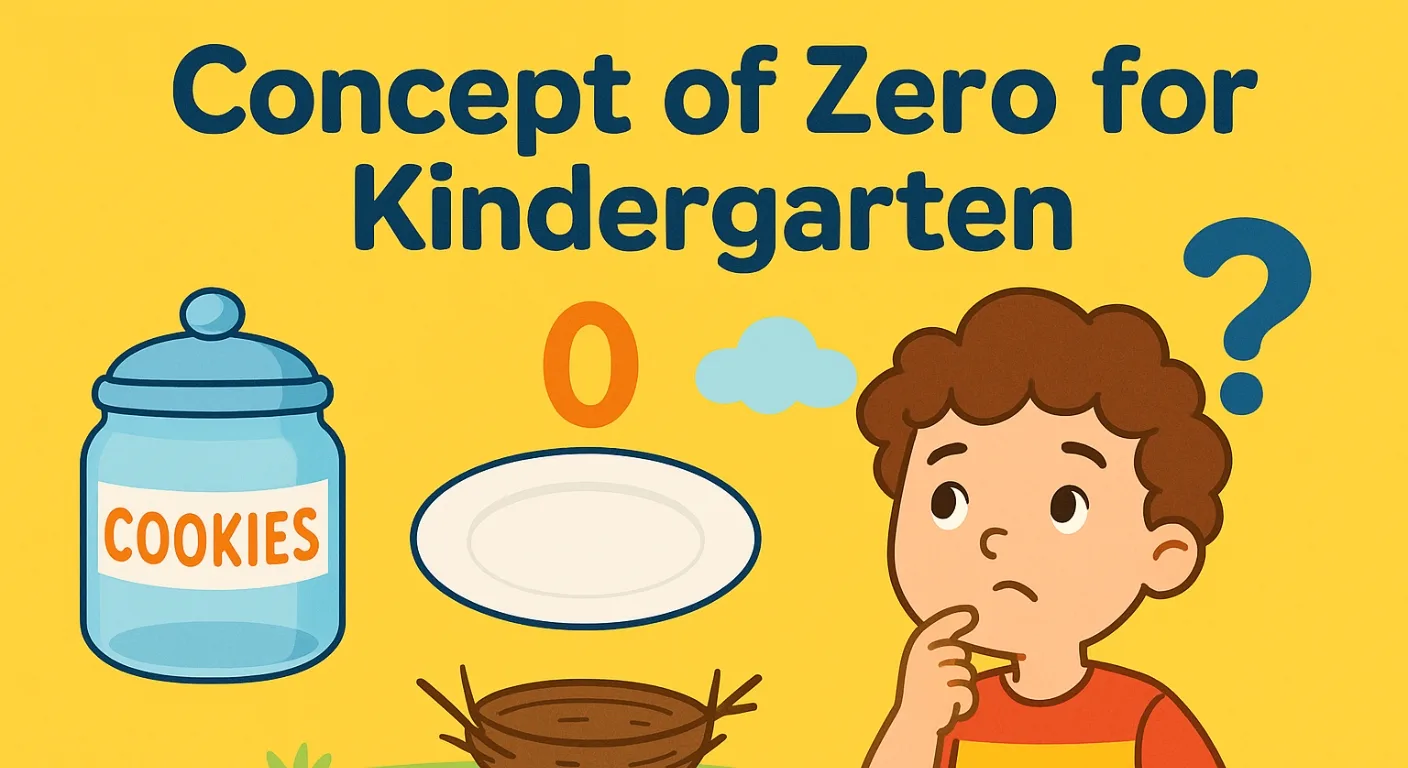
Sarah had been looking forward to a biscuit all day. When she got home and lifted the lid of the biscuit tin, she found it empty. There were no biscuits left at all. Sarah had just met the number zero.
What is zero?
Zero is the number that means none, or nothing at all. It is written with the numeral 0.
An empty plate has zero sandwiches on it. An empty road has zero cars. If you have three balloons and they all float away, you have zero balloons left.
Encyclopaedia Britannica describes zero as the number that shows the absence of quantity. For a young child, a simple way to say it is: zero means there are none.
Zero is a real number
Some children think zero is not really a number, because it stands for nothing. But zero is a number, just like 1, 2 and 3. It has its own name, its own symbol and its own place in the counting sequence.
On a number line, zero sits just before 1. It is the only number that is neither positive nor negative, and it is an even number too. It is where counting starts when we count up, and where we finish when we count down: 3, 2, 1, zero!
Teachers in England, using lessons from Oak National Academy, aim for children in Year 1 to understand that zero is a number showing that there is no amount, and to know both the numeral 0 and the word zero.
Why zero matters in early maths
Early maths matters a great deal. The National Centre for Excellence in the Teaching of Mathematics (NCETM) points out that what children know about maths when they are young helps predict how well they do later, even in reading. Children who start behind in maths often stay behind.
Understanding zero helps with several of the big ideas of early maths. Every new idea a child learns builds fresh connections in their brain, and number ideas are no exception.
Counting and how many: the NCETM calls this cardinality, knowing that a number tells you how many things there are. Zero is the number for when there are no things.
Comparing: zero is less than any other counting number. If one plate has two grapes and another has none, the empty plate has fewer.
Taking away: zero is where subtraction can end. If you have two apples and eat both, you have zero apples left.
| Activity | What it teaches |
|---|---|
| Counting-down rhymes | zero comes at the end when we count down |
| Filling and emptying a cup | zero means there are none |
| A floor number line | zero comes just before 1 |
| Adding zero with toys | adding zero changes nothing |
| Spotting the 0 in 10 or 102 | zero can hold a place in bigger numbers |
Stories that explain zero
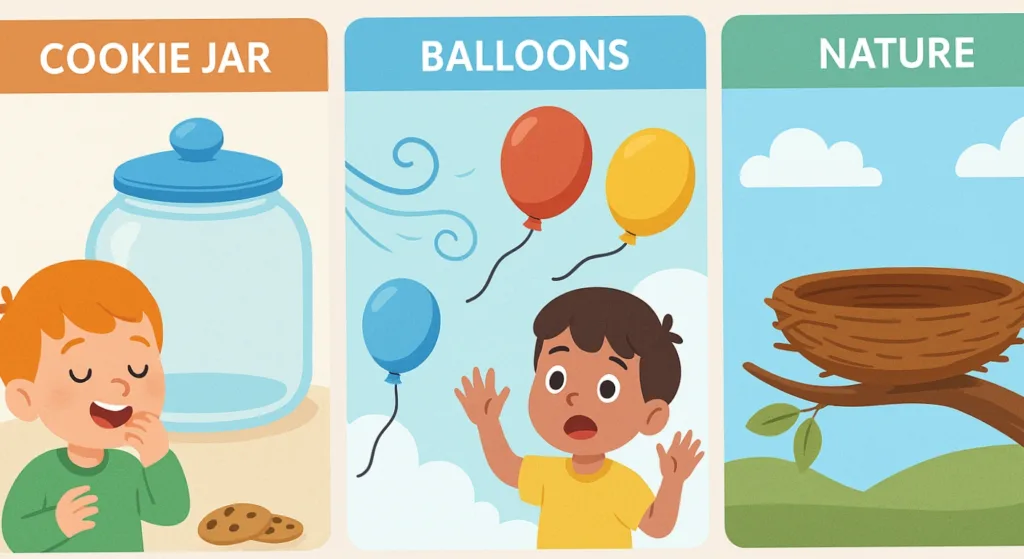
Young children understand ideas best through stories and real things. Here are a few simple stories that show zero.
The biscuit tin: a tin starts with three biscuits. One by one, they get eaten. Now there are zero biscuits in the tin.
The balloons: a child holds four balloons. A gust of wind carries them away, one after another. How many are left? Zero.
The bird’s nest: a nest has two baby birds. They grow up and fly away. Now the nest has zero birds in it.
After each story, ask the child to show zero with their fingers. Closing their hand into a fist, with no fingers up, is a lovely way to show it.
Counting-down rhymes
Counting-down songs are brilliant for teaching zero, because they end with nothing left.
In “Five Little Speckled Frogs”, one frog after another jumps into the pool, until there are no frogs left on the log. Oak National Academy suggests acting the song out with toy frogs, so that children can see exactly what zero frogs on the log looks like.
Other favourites, such as “Five Little Ducks” and “Ten Green Bottles”, work in the same way. Pause at the end and ask: how many are left now?
Teaching zero in the classroom
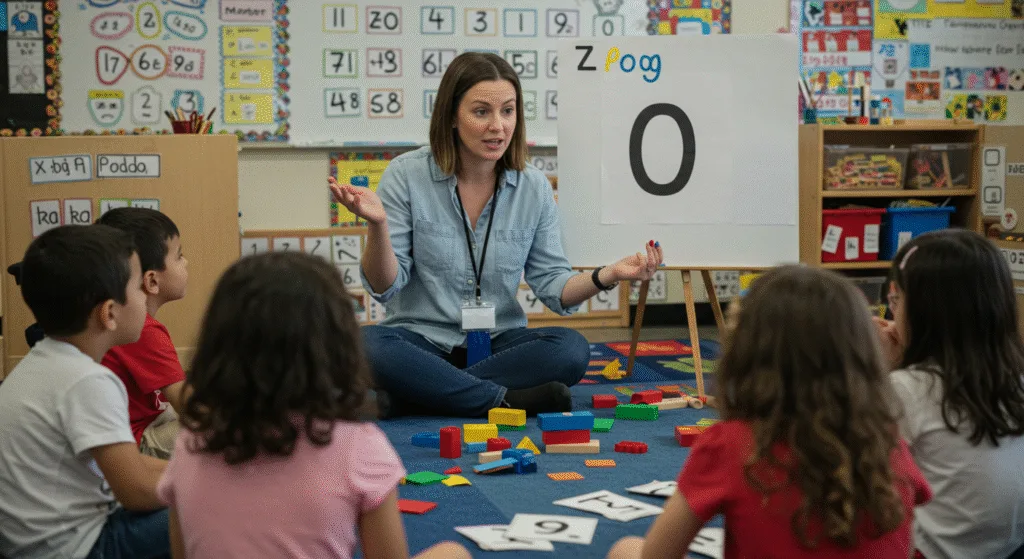
In the classroom, teachers help children see, touch and move real objects before they work with numbers on paper.
Empty and full: give each child a cup and some counters. Ask them to put in three, then take them all out. How many are in the cup now?
Number lines: put a number line on the floor, starting at 0. Children can jump along it, counting up from zero and back down to it.
Zero hunt: ask children to look around the room for things there are zero of. Are there any elephants in the classroom? Zero!
Writing zero: practise writing the numeral 0 and the word zero, and match them to pictures of empty boxes, plates and nests.
Tips for parents

You do not need special equipment to teach zero at home. Everyday life is full of it.
At snack time, count the pieces of fruit on a plate as your child eats them, all the way down to zero. At bath time, count the bath toys as you take them out of the water.
When tidying up, count the toys still on the floor until there are none left. In the car or on a walk, count red buses or dogs, and notice when you see zero.
Keep it playful and short. A few minutes of counting down to zero, often, is better than one long lesson.
Adding and taking away zero
Once children are comfortable counting, they can explore what happens when zero is added or taken away.
Adding zero does not change a number. If you have four sweets and someone gives you zero more, you still have four.
This is a common mistake. Oak National Academy notes that some children think adding zero makes the answer zero. Showing it with real objects, again and again, helps them see that nothing has been added, so nothing has changed.
Taking away zero does not change a number either. Four take away zero is still four.
Zero as a placeholder
Older children meet another important job that zero does. It holds a place in bigger numbers.
In the number 10, the 0 shows there are no ones, just one ten. In 102, the 0 shows there are no tens. Without zero, 102 and 12 would look the same.
That is why zero is so important in the number system we use every day.
Zero in everyday life
Once children start looking, they find zero everywhere.
On a football scoreboard, a team that has not scored has zero goals. In Britain, people often call this “nil”.
At a rocket launch, the countdown goes 3, 2, 1, zero, and then lift-off! Many children love counting down like this.
On a thermometer, 0°C is the temperature at which water freezes into ice. So zero on a thermometer does not mean there is no temperature at all. It is simply the point where the scale starts.
Telephone keypads, clocks and calculators all have a 0 on them too. Ask your child to spot as many zeros as they can on a walk or a trip to the shops.
A very short history of zero
Zero was not always part of maths. About 5,000 years ago, people in ancient Mesopotamia used a mark to show that a place in a number was empty. But they did not treat it as a number of its own.
The ancient Romans had no symbol for zero at all, which is one reason Roman numerals can be tricky. You can find out more in our Roman numerals facts.
The Maya of Central America invented their own zero, and the modern zero, a number with its own value, began in ancient India before spreading to the rest of the world. Read the full story in our guide to when zero was created.
Three things people get wrong
Zero is not “not a number”. It is a real number, meaning none, with its own symbol, 0.
Adding zero does not make a number zero. Adding zero leaves a number unchanged: 5 + 0 = 5.
Counting does not have to start at 1. When we count down, and on a number line, zero comes just before 1.
Did you know? A common mistake is thinking that adding zero makes the answer zero. In fact, 5 + 0 is still 5.
Try it
Put five toys on a table and sing a counting-down song, taking one away each time. When the table is empty, shout “Zero!” together.
Knowledge check
What does zero mean?
Show answer
None, or no amount at all.
What is 4 + 0?
Show answer
4, because adding zero changes nothing.
Frequently asked questions
How do you explain zero to a young child?
Explain zero as the number for none. Use real examples, such as an empty biscuit tin or a plate with no fruit left, and show zero with a closed fist.
Is zero a number?
Yes. Zero is a real number meaning none. It has its own numeral, 0, and on a number line it comes just before 1.
What are good activities for teaching zero?
Good activities include counting-down rhymes such as Five Little Speckled Frogs, filling and emptying cups of counters, jumping along a floor number line from 0, and hunting for things there are zero of.
What happens when you add zero to a number?
Adding zero to a number leaves it unchanged. If you have four sweets and get zero more, you still have four. Some children wrongly think the answer becomes zero.
Why is zero important in maths?
Zero shows when there is none of something, helps children compare and subtract, and holds places in bigger numbers, such as the 0 in 102 showing there are no tens.
Who invented zero?
Early peoples used marks for empty places, but the modern zero, a number with its own value, began in ancient India. The Maya of Central America also invented their own zero.
Sources
- Encyclopaedia Britannica: zero — what zero means, zero as a placeholder and its history in Mesopotamia, Rome, the Maya world and India
- Oak National Academy: introducing zero (Year 1) — key learning points, the meaning of zero, the adding-zero misconception and the Five Little Speckled Frogs activity
- NCETM: early years maths — why early maths matters and the key ideas of cardinality, comparison and composition