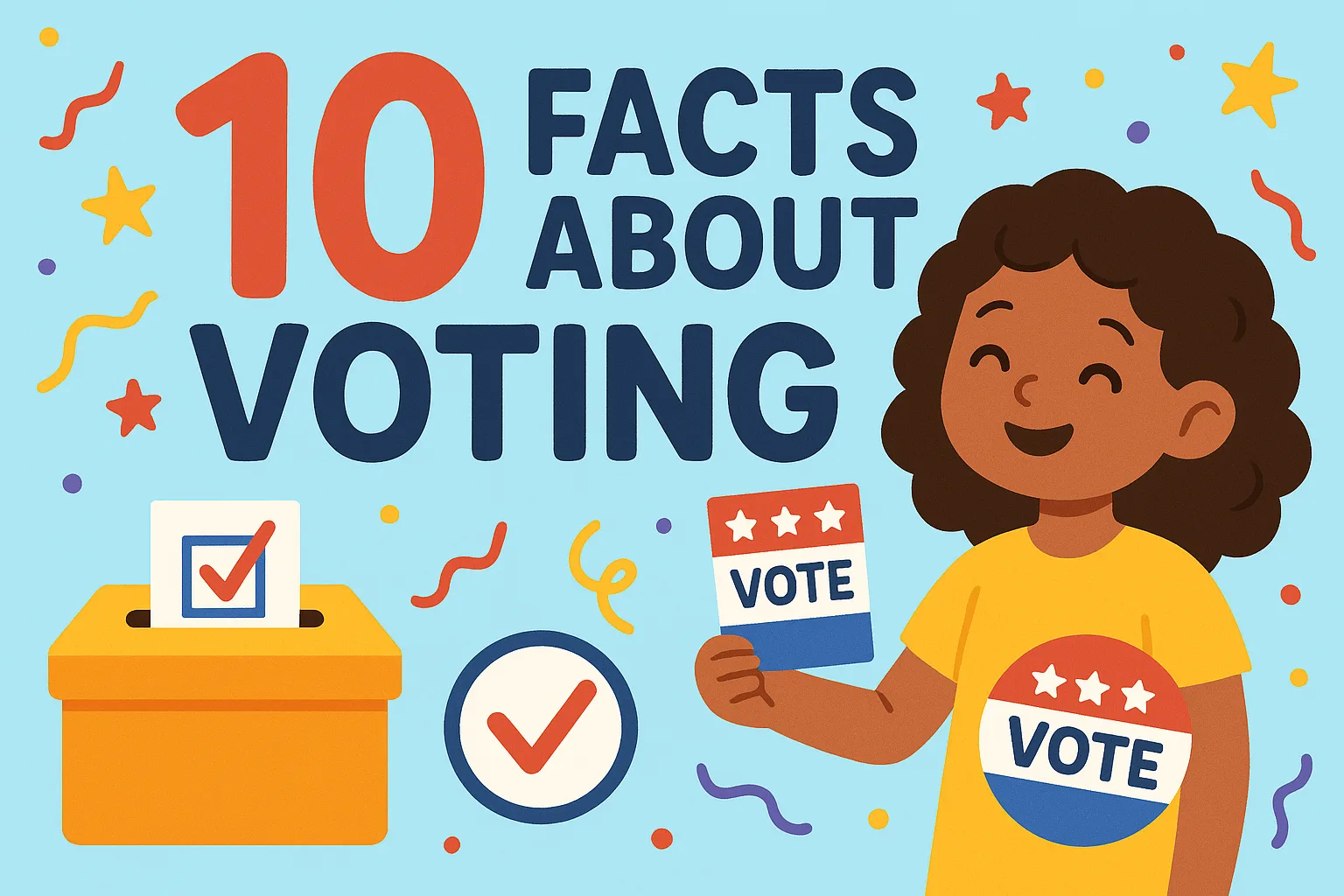
Voting is how people in a democracy make choices together, such as choosing their leaders. The right to vote, called suffrage, slowly spread from a few wealthy men to almost all adults. Women first won the national vote in New Zealand in 1893. Today most countries use a secret ballot, and in the United States citizens can vote from age 18.
voting quick facts
- The right to vote is called suffrage.
- New Zealand was the first country to give women the national vote, in 1893.
- The secret ballot was first used in Australia in 1856.
- The 26th Amendment lowered the US voting age to 18 in 1971.
- North Dakota is the only US state with no voter registration.
What is voting?
Voting is a way for a group of people to make a choice together. Each person says what they want, and the choice with the most support wins.
In a country, people vote to choose their leaders, such as a president, a prime minister or members of a parliament. Britannica says the right to vote is called suffrage. It can also include voting to accept or reject new laws.
Voting is at the heart of democracy. In a democracy, the people decide who runs the country, and they can vote those leaders out at the next election if they are unhappy with them.
| Voting at a glance | |
|---|---|
| Right to vote | called suffrage |
| Voting age in most countries | 18 (some countries use a different age) |
| First country where women voted nationally | New Zealand, 1893 |
| Secret ballot first used | Victoria and South Australia, 1856 |
| US voting age lowered to 18 | 1971, by the 26th Amendment |
| Ways to vote in the US | on Election Day, early in person, or by mail |
Why does voting matter?
Leaders make decisions that affect everyone. They decide about schools, roads, hospitals, taxes and much more.
When people vote, they have a say in those decisions. Voting lets citizens choose leaders who share their ideas, and it gives everyone an equal voice: one person, one vote.
Voting also keeps leaders honest. Because they have to face another election, leaders need to listen to the people they serve.
Not everyone could vote in the past
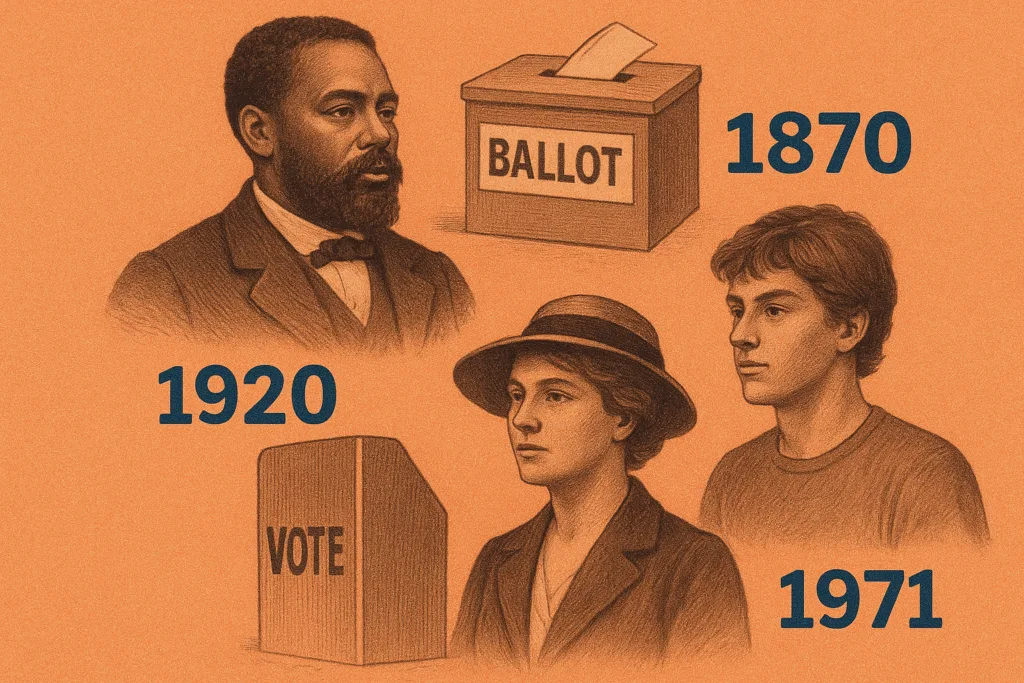
Today, most adults in most countries can vote. But that was not always true. Britannica says the history of voting is a story of the right slowly spreading from small, privileged groups to the whole adult population.
For a long time, only some men could vote. Britannica says that in Britain in the 1700s and 1800s, people needed to own property or earn a certain income before they were allowed to vote.
Women were left out for centuries. Britannica says women could not vote in ancient Greece or in republican Rome, or in the few democracies that existed in Europe by the end of the 1700s.
Many people were also kept from voting because of their race. Britannica says South Africa at one time, and the southern United States, did not let their Black citizens vote.
Some newly independent countries in Asia and Africa had reading tests for voters, according to Britannica. People who could not read were not allowed to vote.
Women win the vote
In the 1800s, many women began to campaign for the right to vote. Britannica says the struggle was especially fierce in Britain and the United States.
But those were not the first countries to give women the vote. Britannica says New Zealand did so in 1893, followed by Australia in 1902, Finland in 1906 and Norway in 1913.
After the First World War, many more countries followed. Britannica says women in 28 more countries won the vote between 1914 and 1939, including Canada and Germany in 1918, and the United States in 1920.
In Britain, some women won the vote in 1918, and all women won it on the same terms as men in 1928. Britannica says women in India gained full voting rights under the constitution of 1949.
The right is still spreading. Britannica says women in Saudi Arabia voted in local elections for the first time in 2015.
How the right to vote grew in the United States
In the United States, the right to vote has grown through amendments, which are changes to the US Constitution. The National Archives keeps the official text of each one.
The 15th Amendment (1870): this said that no one could be stopped from voting because of their race or colour, or because they had once been enslaved.
The 19th Amendment (1920): this said that no one could be stopped from voting because of their sex. It gave women across the country the right to vote.
The 24th Amendment (1964): this banned poll taxes in elections for national leaders. A poll tax was a fee people had to pay before they could vote, and it kept many poor people from voting.
The 26th Amendment (1971): this lowered the voting age to 18 for all elections.
Another amendment, the 17th, changed how US senators are chosen. The National Archives says that since 1913, senators have been elected directly by the people of each state.
The Voting Rights Act
Even after the 15th Amendment, many Black Americans were still stopped from voting, especially in the South. Some states used unfair tests and rules to keep them away from the polls.
Britannica says the Voting Rights Act of 1965 was passed to break down these barriers. It greatly reduced the gap between the numbers of white and Black Americans registered to vote.
Secret ballots keep choices private
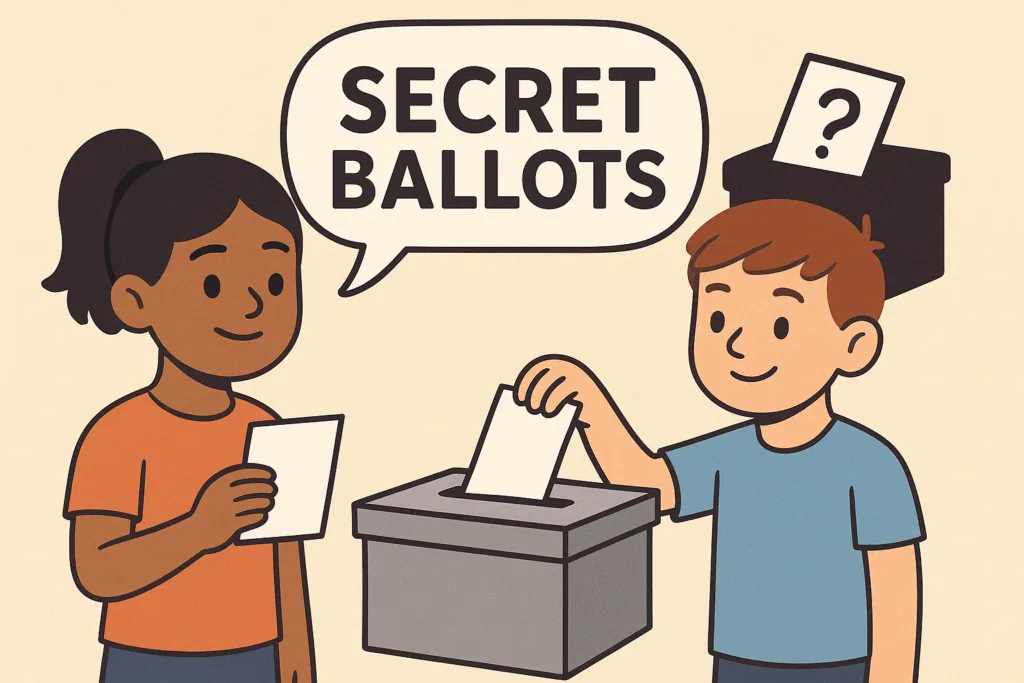
A ballot is the paper, or screen, where a voter marks their choice. Today, most ballots are secret, so no one else can see how you voted.
It was not always like this. In the past, people sometimes voted out loud, or on coloured papers that others could see. This meant people could be bullied or bribed into voting a certain way.
Britannica says Victoria and South Australia were the first places to use a secret ballot, in 1856. That is why the secret ballot is sometimes called the Australian ballot.
The idea spread around the world. Britannica says Britain brought in the secret ballot for all its elections in 1872, and it was widely adopted in the United States after 1884.
With a secret ballot, voters mark their choice in private, often in a small booth. Britannica says the ballot then goes into a closed box with only a small slot at the top, which stays locked until the votes are counted.
Who can vote in the United States?
USAGov, the US government’s information website, explains who can vote in national elections. You must be a US citizen, and you must be 18 years old on or before Election Day.
You also have to meet your state’s rules about where you live. USAGov says people who are homeless can still meet these rules and vote.
Some people cannot vote in national elections. USAGov says people who are not US citizens cannot vote in national or state elections, although a few places let them vote in local elections. Rules for people convicted of serious crimes are different from state to state.
Registering to vote
In most of the United States, you have to register before you can vote. This means putting your name on the official list of voters.
USAGov says that in almost every state, you can register before you turn 18, as long as you will be 18 by Election Day. Some states even let 17-year-olds vote in primary elections, if they will be 18 by the main election.
Every state has its own deadline for registering. USAGov says North Dakota is the only state where people do not need to register at all.
Ways to vote
There is more than one way to vote in the United States. USAGov lists three.
On Election Day: voters go to a polling place, such as a school or community centre, and vote in person.
Early in person: in many places, voters can go to a polling place and vote before Election Day.
By mail: voters can ask for an absentee ballot, fill it in at home and send it back by post. This helps people who are away or cannot get to a polling place.
Voting symbols
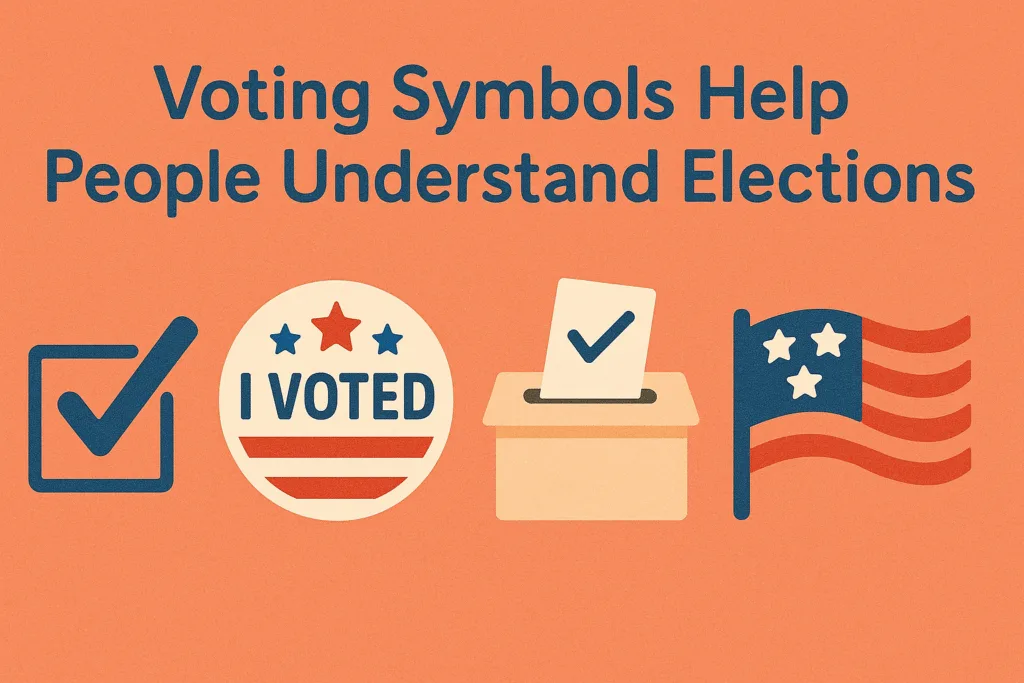
Elections use lots of symbols. A ballot box, a tick or a cross in a box, and an “I voted” sticker all help people recognise voting.
In some countries, each party or candidate has a picture symbol printed on the ballot. This helps people who cannot read to find the choice they want.
Symbols help make sure that everyone who has the right to vote can use it, whatever language they speak and however well they read.
How votes are counted
After the polls close, the votes are counted carefully. Officials check that each ballot is real and that no one has voted twice.
In many elections, the person with the most votes wins. In others, a winner needs more than half of all the votes, which is called a majority.
Counting can take hours, or even days, in a big country. People from different parties are often allowed to watch the count, to make sure it is fair.
Voting around the world
Britannica says nearly all modern governments now allow every adult citizen to vote, which is called universal adult suffrage.
The basic rules are similar everywhere. Britannica says that usually only adult citizens can vote, and the minimum voting age varies from 18 to 25 years, depending on the country.
In 1952, the United Nations agreed that women should be able to vote in all elections on equal terms with men. Britannica says this was set out in the Convention on the Political Rights of Women.
Try voting at school
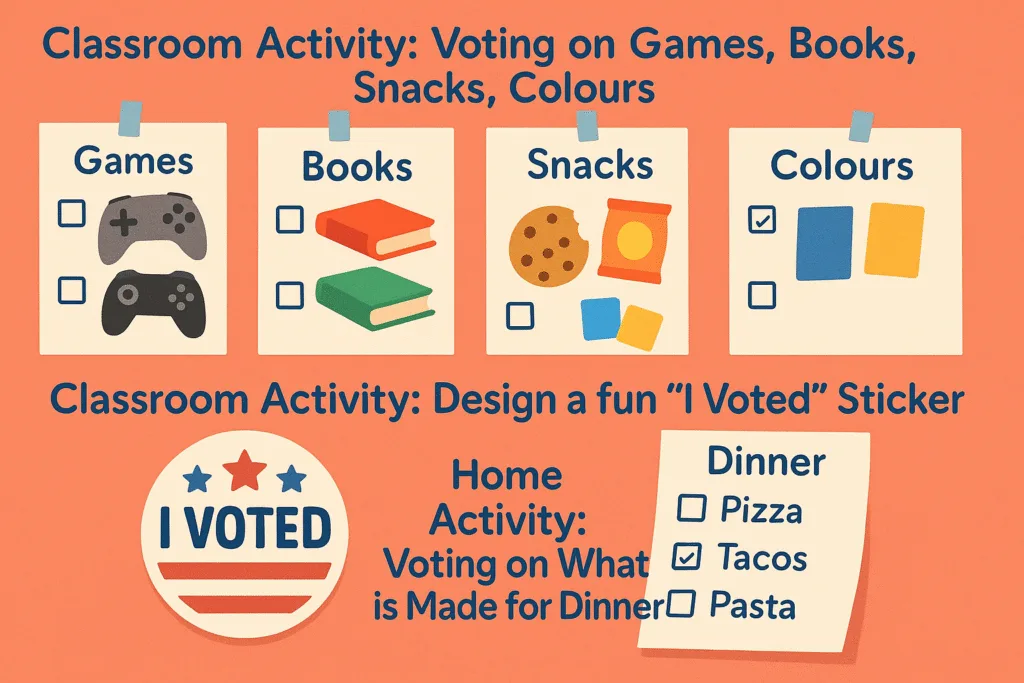
You do not have to wait until you are 18 to learn about voting. Many schools hold class elections for a school council or a class representative.
You can try a vote at home or in class too. Choose a question, such as which book to read next. Make paper ballots, put up a private voting spot, and use a box with a slot for the votes.
Then count the votes together. You will see how elections work, and why every single vote counts.
Three things people get wrong
Voting is not only for choosing presidents. People also vote for local leaders and sometimes on new laws.
Women have not always been able to vote. In many countries, they won the right only about 100 years ago.
Nobody can see your ballot. The secret ballot keeps your choice private.
Did you know? The secret ballot is sometimes called the Australian ballot, because it was first used in Victoria and South Australia.
Try it
Hold a secret-ballot vote at home or in class on a fun question. Make ballots, a private voting spot and a box with a slot, then count the votes.
Knowledge check
What is a secret ballot?
Show answer
A way of voting where no one else can see your choice.
Which US amendment gave women the right to vote?
Show answer
The 19th Amendment, in 1920.
Frequently asked questions
What is voting?
Voting is a way for people to make a choice together. In a democracy, citizens vote to choose their leaders and sometimes to decide on new laws.
How old do you have to be to vote?
In the United States you must be 18 on or before Election Day. Around the world, voting ages vary from 18 to 25.
When did women get the right to vote?
New Zealand gave women the national vote in 1893. American women won it in 1920, and British women won equal voting rights in 1928.
What is a secret ballot?
A secret ballot lets you mark your choice in private, so no one can see how you voted. It was first used in Australia in 1856.
Who can vote in the United States?
US citizens who are 18 by Election Day and meet their state’s residency rules can vote. Most states also require voters to register.
Why is voting important?
Voting gives every citizen an equal say in who leads the country. Leaders must listen to the people, because they face another election.
Sources
- Encyclopaedia Britannica: suffrage — the history of the right to vote, qualifications, women’s suffrage dates and the UN convention
- Encyclopaedia Britannica: Australian ballot — the secret ballot, its spread to Britain and the United States, and the Voting Rights Act
- National Archives: Constitution amendments 11 to 27 — the 15th, 17th, 19th, 24th and 26th Amendments
- USAGov: who can and cannot vote — US voting age, citizenship, residency, registration and ways to vote