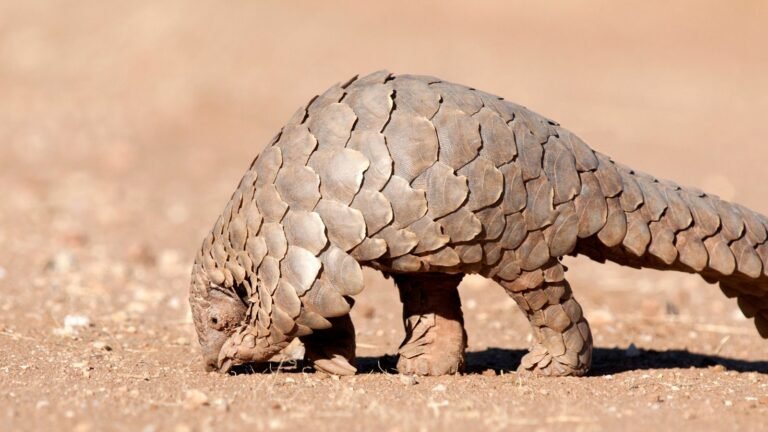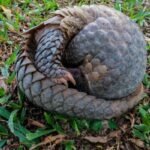
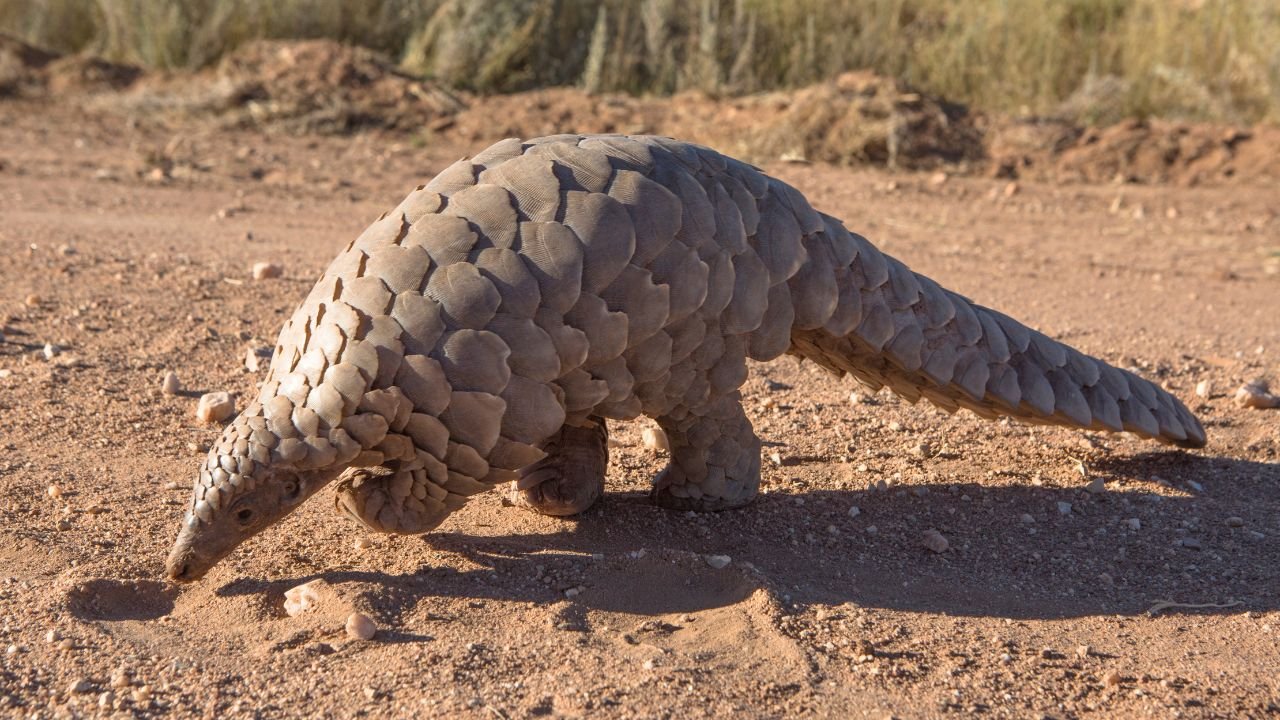
Pangolin scales are used first by the pangolin, as armour. It rolls into a ball so its hard scales face any attacker. People use the scales too, mainly in traditional medicine in Asia and Africa, although there is no scientific evidence that they cure anything. Scales made up 99% of the pangolin parts seized between 2016 and 2024.
Pangolin scales quick facts
- Scales make up about 20% of a pangolin’s weight.
- Asian pangolins have hair growing between their scales, but African pangolins do not.
- A baby pangolin is born with soft scales that start to harden soon after birth.
- Scales made up 99% of the pangolin parts seized between 2016 and 2024.
- In 1876, an Indian maharaja gave the future King Edward VII a coat of armour covered in pangolin scales.
What pangolin scales are
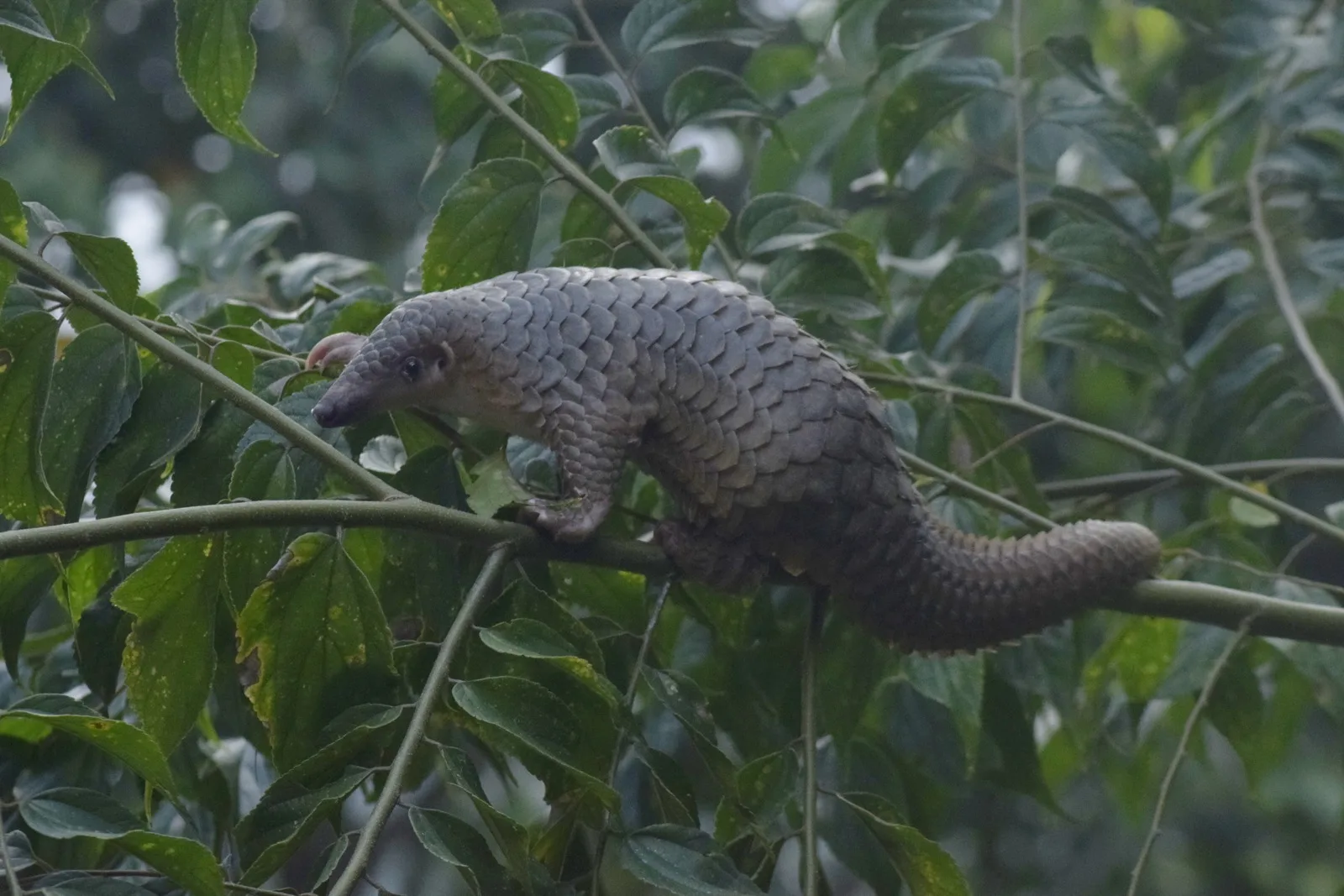
Pangolins are covered in scales from head to tail. ZSL, the Zoological Society of London, says they are the only mammals covered this way. People have called them walking pine cones and artichokes with tails.
The scales are made of keratin. That is the same material as your fingernails. The IUCN pangolin experts add that it is the same material as a rhino‘s horn.
The scales overlap, like tiles on a roof. Each one is hard, with a sharp edge. Together they make a suit of armour that the pangolin carries everywhere.
That armour is heavy. The African Wildlife Foundation says the scales make up about 20% of a pangolin’s weight. For a child weighing 35 kg, that would be 7 kg of armour, about as heavy as a big bag of shopping.
Not all pangolin skin looks the same. ZSL says Asian pangolins have hair growing between their scales. African pangolins do not.
Some scales are a mystery. ZSL says the Sunda pangolin has mostly dark brown scales, but many have white scales on their tails. Nobody yet knows why.
The scales fool some people into thinking pangolins are reptiles. They are not. ZSL points out that female pangolins do not lay eggs. They give birth to live young, most often a single baby, and feed it milk like any other mammal.
How a pangolin uses its own scales
For the pangolin, scales have one main job. They keep it alive.
WWF says a startled pangolin first covers its head with its front legs. That leaves only its scales facing the danger. If it is touched or grabbed, it rolls up completely into a tight ball.
The tail is armed too. WWF says the sharp scales on a pangolin’s tail can be used to lash out at an attacker.
Babies need protecting as well. ZSL says a baby pangolin is born with soft scales, which start to harden soon after birth. If a baby is startled, it rolls into a ball, and its mother rolls up around it.
Picture it. A ball of scales inside another ball of scales. Few hungry animals can get through that.
Why the armour fails against people
Rolling into a ball works against leopards and hyenas. It does not work against people.
ZSL puts it simply. Curling up is useless against human hunters, who can just pick the pangolin up. The animal that is so hard for a predator to open is easy for a person to carry away.
That is one reason pangolins are caught in such large numbers. Our guide to why pangolins are the most trafficked animals in the world explains the rest of the story.
Scales in traditional medicine
The biggest human use of pangolin scales is in traditional medicine. Traditional medicine means ways of treating illness that are passed down over many years, often without being tested.
The IUCN pangolin experts say scales are used in traditional Asian medicine, especially in China and Vietnam. They have been claimed to help with problems ranging from heart disease to cancer, and to help new mothers make milk. WWF lists uses from asthma to rheumatism and arthritis.
Scales are used in Africa too. The IUCN pangolin experts say they are used to treat many conditions in traditional African medicine, especially in West and Central Africa, where it is known as muti or juju.
None of these uses has been shown to work. The IUCN pangolin experts say there is no scientific evidence that the scales are effective as medicine. Our guide to what diseases pangolin scales are said to cure looks at the claims one by one.
Think about it this way. Keratin is what your nails are made of. Grinding it into powder does not turn it into a drug.
Why China changed its rules
China has been one of the biggest markets for pangolin scales. That is starting to change.
WWF says that since 2020, China has given the Chinese pangolin its highest level of protection. It also says the government no longer allows pangolin scales to be used in traditional medicine.
The change matters because the numbers were so large. WWF says that in 2019, an estimated 195,000 pangolins were trafficked for their scales alone. That is more than 500 pangolins a day.
Leather, meat and other uses
Scales are not the only part of a pangolin that people want.
WWF says there is demand for pangolin products even in the United States, particularly for their leather. It is used to make boots, bags and belts.
Meat is a big part of the trade as well. The IUCN pangolin experts say that in parts of Asia pangolin meat is eaten as an expensive luxury, to show off wealth. In West and Central Africa, pangolins are eaten as wild meat.
| Who uses the scales | What for | What we know |
|---|---|---|
| The pangolin | Armour against predators | Works well against animals, but not against people |
| Traditional medicine in Asia | Claimed to treat illnesses from arthritis to cancer | No scientific evidence that it works |
| Traditional medicine in Africa | Muti or juju, especially in West and Central Africa | No scientific evidence that it works |
| Leather makers | Boots, bags and belts from pangolin skin | Sold even in the United States |
| A maharaja in India | A decorated coat of armour, given as a gift in 1876 | Now kept in the Royal Collection |
A royal coat of pangolin scales
One of the strangest uses of pangolin scales hangs in a royal collection.
In 1876, a coat of armour was made in India from pangolin scales. The Royal Collection Trust describes it as a padded green velvet coat with short, wide sleeves, covered all over with scales. Each scale is painted with a gold-edged flower design.
Around the edge, smaller scales are set with rubies and turquoises in gold. The coat measures about 90 by 123 cm.
The Royal Collection Trust lists everything that went into it. Besides the pangolin scales, there is gilt copper, velvet, gold and gold paint. There are turquoises, rubies, ivory, glass beads and pearls. It was built to impress, not to fight in.
It was a gift. The Royal Collection Trust says Bhavani Singh, the Maharaja of Datia, gave it to the Prince of Wales during his tour of India in 1875 and 1876. The prince later became King Edward VII. The coat is still in the Royal Collection today.
Pangolins were still common enough then for their scales to become a royal present. Today the same scales are seized from smugglers by the tonne.
What the law says about pangolin scales
Selling pangolin scales across borders is now against international law. It took a long time to get there.
The IUCN pangolin experts explain the steps. Every pangolin species was added to CITES Appendix II in 1995. CITES is an agreement between countries that controls trade in wild animals and plants. Appendix II meant trade in pangolins and their scales had to be closely controlled.
In 2000, countries agreed that no wild Asian pangolins would be exported for trade. That was close to a ban, but only for Asian species.
In 2016, at a CITES meeting in Johannesburg, all eight species were moved to Appendix I. The IUCN says this is the highest level of protection in international trade. Buying and selling wild pangolin scales between countries for profit is banned.
Laws on paper are not the end of the story. The IUCN says pangolin products were still being seized in 75 countries in the years after the ban.
What happens to seized scales
When customs officers find smuggled goods, they seize them. For pangolins, what they find is almost always scales.
In August 2025, the IUCN reported that seizures between 2016 and 2024 involved more than half a million pangolins. They happened in 75 countries, along 178 trade routes. Scales made up 99% of the pangolin parts that were confiscated.
Those numbers only show what was caught. The IUCN says reporting has been inconsistent, and that the full size of the problem is not yet understood.
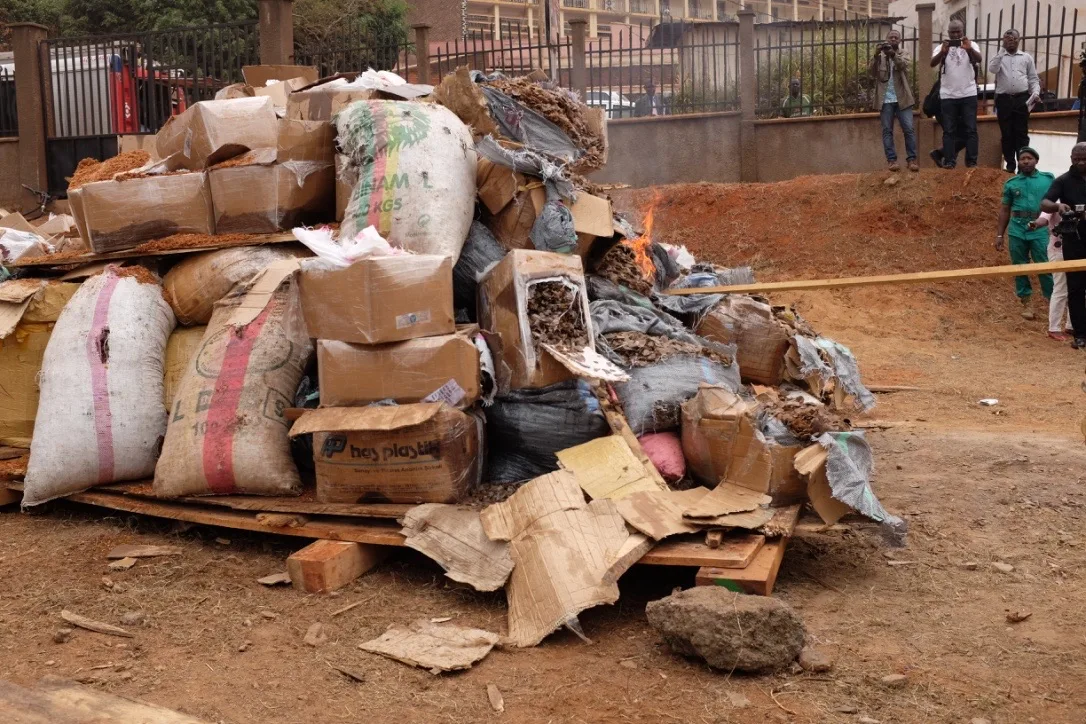
Some countries destroy what they seize, so the scales can never be sold. Burning them in public also sends a message that the trade will not be tolerated.
Three things people get wrong
Pangolin scales are not bone or teeth. They are keratin, the same material as your fingernails.
Pangolin scales do not cure illness. The IUCN pangolin experts say there is no scientific evidence that they work as medicine.
Rolling into a ball does not protect a pangolin from people. It stops most predators, but a person can simply pick the pangolin up.
Did you know? Many Sunda pangolins have white scales on their tails, and nobody yet knows why.
Try it
Look at one of your fingernails. It is made of keratin, just like a pangolin’s scales. Press it gently: it bends a little but does not break. Now imagine a whole body covered in them, overlapping like tiles on a roof.
Knowledge check
About how much of a pangolin’s weight is its scales?
Show answer
About 20%, according to the African Wildlife Foundation.
Do Asian and African pangolins have the same skin between their scales?
Show answer
No. Asian pangolins have hair growing between their scales, and African pangolins do not.
Frequently asked questions
What are pangolin scales used for?
Pangolins use their scales as armour, rolling into a ball so the scales face any attacker. People use pangolin scales in traditional medicine in Asia and Africa, although there is no scientific evidence that they work.
What are pangolin scales made of?
Pangolin scales are made of keratin, the same material as human fingernails and rhino horn. The scales overlap like roof tiles and make up about 20% of a pangolin’s weight.
Can pangolin scales cure illness?
Pangolin scales cannot cure illness. The IUCN Pangolin Specialist Group says there is no scientific evidence that they are effective as medicine.
Is it legal to sell pangolin scales?
International commercial trade in wild pangolins and their parts has been banned since 2016, when all eight species were moved to CITES Appendix I. The IUCN says illegal trade has carried on.
Do baby pangolins have scales?
Baby pangolins are born with soft scales that start to harden soon after birth. A startled baby rolls into a ball, and its mother rolls up around it.
Why do pangolin scales not protect them from poachers?
Pangolins roll into a ball instead of running away. That stops most predators, but ZSL says human hunters can just pick them up.
Sources
- ZSL (Zoological Society of London): pangolins — scales from head to tail, keratin, rolling into a ball and why it fails against people, hair between Asian pangolins’ scales, white tail scales, and babies’ soft scales
- IUCN SSC Pangolin Specialist Group: pangolins — keratin like rhino horn, scales in traditional Asian and African medicine, the lack of scientific evidence, and meat as a luxury food
- African Wildlife Foundation: pangolin — scales making up about 20% of a pangolin’s weight
- WWF: pangolin — how a pangolin defends itself, claimed medicinal uses, leather sold in the United States, 195,000 pangolins trafficked for scales in 2019, and China’s changes since 2020
- IUCN press release, 27 August 2025: lack of data and reporting gaps hamper global efforts to protect pangolins — seizures of more than half a million pangolins in 75 countries from 2016 to 2024, 99% of them scales, the 2016 CITES listing, and gaps in reporting
- Royal Collection Trust: coat of scale armour, India, 1876 (RCIN 38059) — the pangolin-scale coat given to the Prince of Wales during his 1875 to 1876 tour of India