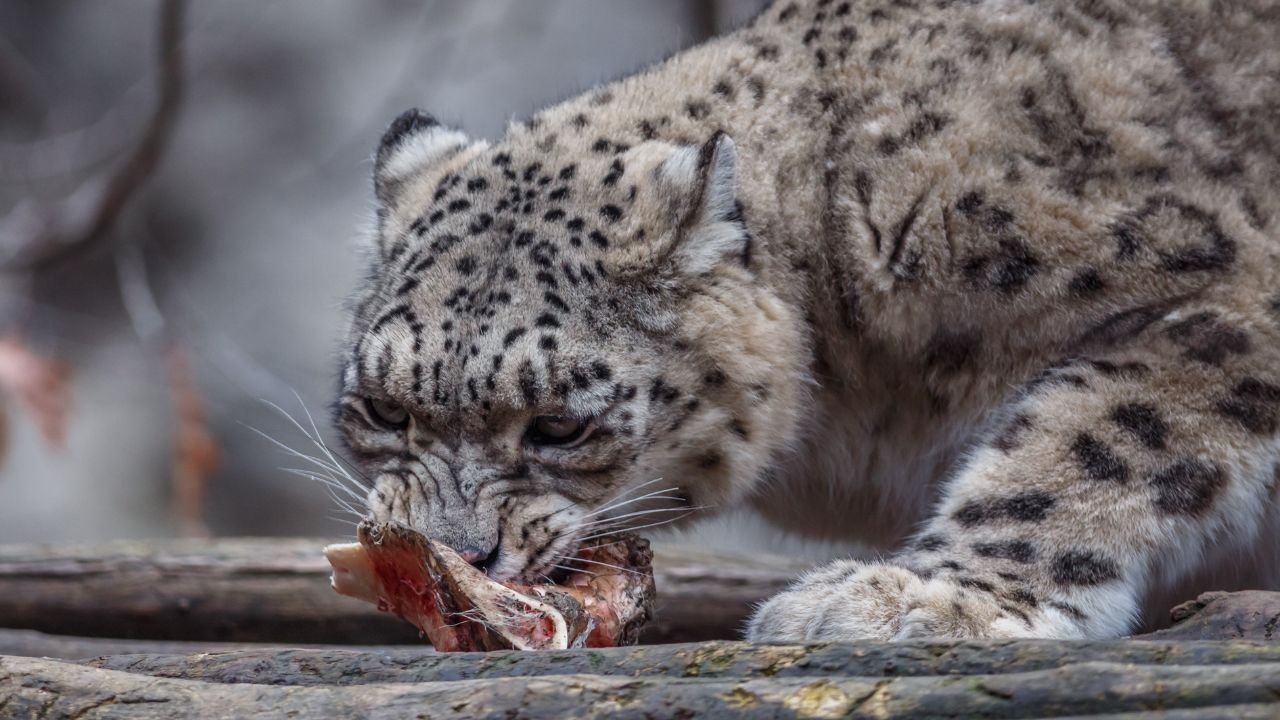
Snow leopards eat meat. Their main prey are wild mountain sheep and goats: blue sheep, ibex and argali. They also catch marmots, birds and small rodents, and sometimes take farmers’ livestock. A snow leopard can kill an animal two to three times its own weight, and it usually makes a big kill only every 10 to 15 days.
Snow leopard diet quick facts
- Main prey: blue sheep, ibex and argali, which are wild mountain sheep and goats.
- A snow leopard makes a big kill about every 10 to 15 days, not every day.
- It can kill prey two to three times its own weight.
- It can pounce up to six times its own body length.
- Between 3,920 and 6,390 snow leopards are thought to be left in the wild.
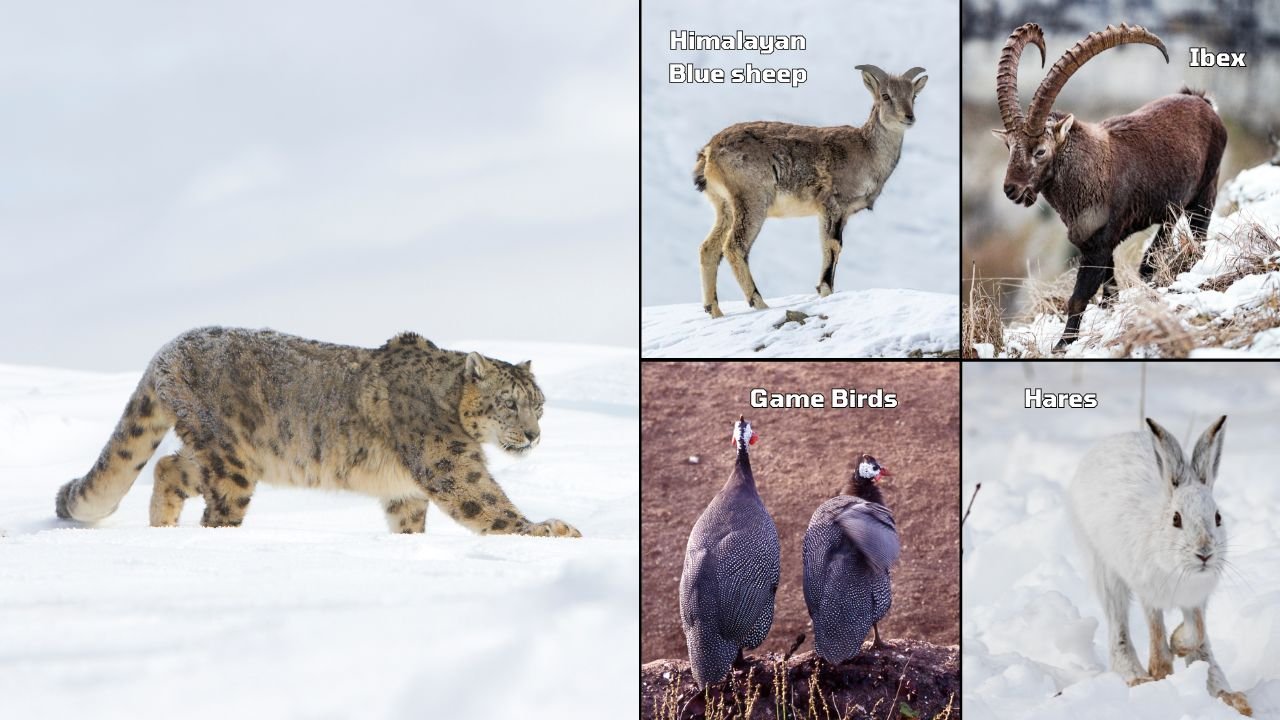
A snow leopard can go more than a week without making a kill. When it does hunt, it often brings down an animal much bigger than itself, high on a rocky mountainside.
What snow leopards eat
Snow leopards are carnivores. That means they eat meat. Most of it comes from wild sheep and goats that share their mountains.
| Prey | What it is | How much it matters |
|---|---|---|
| Blue sheep | A wild mountain sheep, also called bharal | Main prey |
| Ibex | A wild mountain goat with long, curved horns | Main prey |
| Argali | A wild sheep with huge, curling horns | Main prey |
| Marmots | Large ground squirrels that live in burrows | Smaller meals |
| Birds and small rodents | Game birds, voles and pikas | Smaller meals |
| Livestock | Sheep and goats kept by herders | Sometimes |
The Snow Leopard Trust names ibex, argali and blue sheep as the cat’s main prey. Smaller animals fill the gaps between big meals.
How often a snow leopard eats
A snow leopard does not eat every day. It usually brings down a large animal every 10 to 15 days.
That animal can weigh two to three times as much as the leopard. A male snow leopard weighs about 45 to 55 kg. So a fully grown ibex is a very big catch indeed.
Winter is the hungriest time. Marmots spend it asleep in their burrows, so an easy snack disappears. That is when snow leopards are most likely to turn to herders’ sheep and goats instead.
How a snow leopard hunts
Snow leopards hunt by stealth. They creep up close, using rocks for cover. Then they spring and grab.
That spring can be enormous. A snow leopard can pounce up to six times its own body length. Its body is about 1 to 1.3 metres long, so one leap can cover 6 to 8 metres.
Its thick tail helps it balance on narrow ledges. The tail can be almost as long as the rest of its body.
A quiet hunter of the half-light
Snow leopards are most active at dawn and dusk. Scientists call animals like this crepuscular, from the Latin word for twilight. The low light helps a pale, spotted cat melt into grey rock.
They usually live and hunt alone. You are only likely to see more than one together when a mother has cubs, or a pair meets in the breeding season. To leave messages for other snow leopards, they scrape the ground with their back feet and spray urine on rocks.
A snow leopard cannot roar. The shape of its throat will not let it. Instead it makes a soft, friendly puffing sound called a chuff.
How cubs learn to hunt
Almost all wild snow leopard cubs are born in June or July. Their eyes stay shut until they are about seven days old.
At about two months old, cubs start eating solid food. By three months, they begin following their mother further from the den and learning how to hunt for themselves.
Those lessons last a long time. Young snow leopards only set off on their own when they are 19 to 24 months old, so they get almost two years of practice before they have to feed themselves.
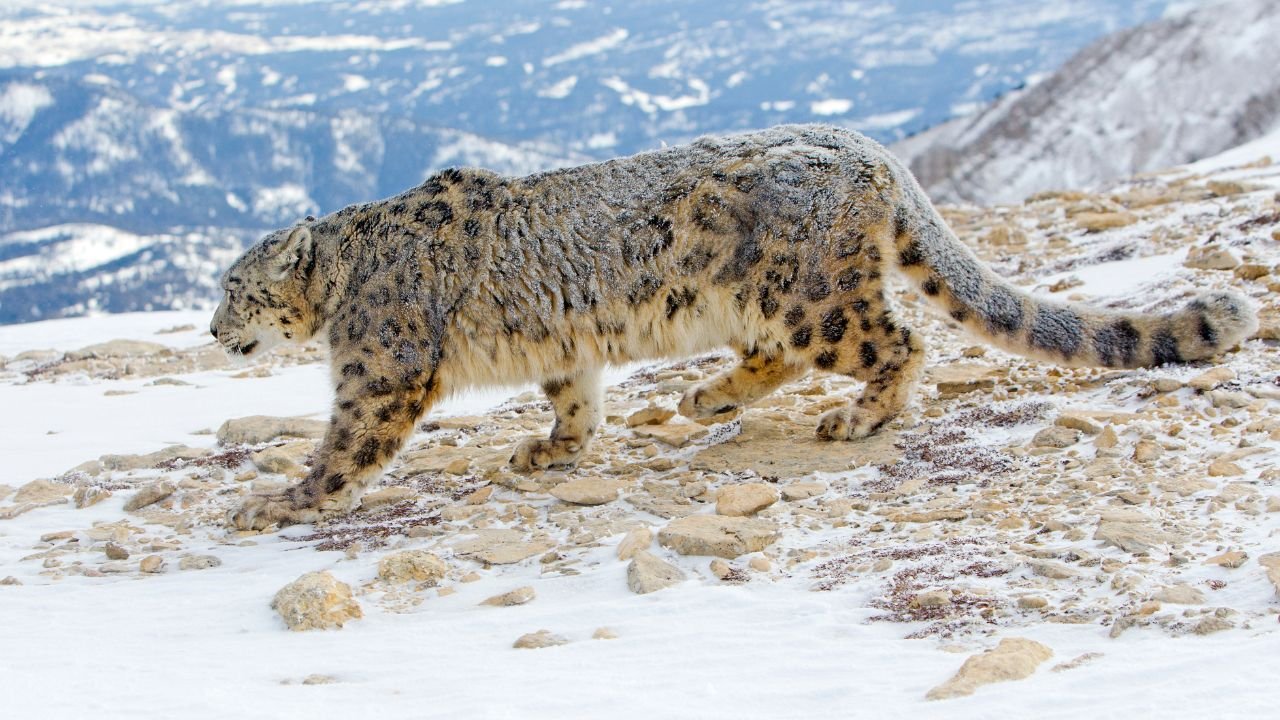
Built for cold, high mountains
Snow leopards live high in the mountains of Asia. In summer they have been seen as high as 6,000 metres. Food is scarce up there, and the cold is fierce, so their bodies are built for it.
- Furry paws. Big paws with fur underneath cushion the feet and grip snow and rock.
- A warming nose. A short, wide nose warms freezing air before it reaches the lungs.
- Thick fur. The coat grows much thicker in winter.
- A tail like a scarf. When it rests, a snow leopard wraps its tail round its body to keep warm.
Where snow leopards live
Snow leopards live in 12 countries: Afghanistan, Bhutan, China, India, Kazakhstan, Kyrgyzstan, Mongolia, Nepal, Pakistan, Russia, Tajikistan and Uzbekistan. Together, their range covers about 2 million square kilometres, roughly the size of Mexico. China alone holds as much as 60% of it.
In the Himalayas they are usually found between 3,000 and 5,400 metres above sea level. In Mongolia and Russia they can live much lower, down to about 1,000 metres. Wherever they are, they like broken ground full of cliffs, rocky outcrops and ravines, where it is easy to hide while creeping up on prey.
How far a snow leopard roams depends on food. Where prey is plentiful, its home range can be as small as 30 to 65 square kilometres. Where food is scarce, it can be more than 1,000 square kilometres.
Snow leopards and herders
Snow leopards share their mountains with families who keep sheep and goats. Now and then, a snow leopard kills some of those animals.
For a family that lives off its herd, that loss is serious. Some herders kill snow leopards in return. The Snow Leopard Trust lists this, along with fewer wild prey and poaching, among the biggest threats to the cats.
The losses are real. The Snow Leopard Trust says an average herding family loses roughly one animal a year, which can cost about as much as a month’s income. And if a snow leopard gets inside a pen at night, it may kill several animals in one go.
Revenge killings may be behind more than half of all the snow leopards killed by people. Poaching is the other big danger. Between 2008 and 2016, about one snow leopard a day was reportedly killed and traded, somewhere between 220 and 450 a year.
Climate change adds to the pressure. The Tibetan Plateau has got about 3 degrees warmer in the last 20 years, and the Trust warns that warming could make up to a third of the snow leopard’s habitat unusable.
How herders and snow leopards share the mountains
Stronger pens. In Pakistan and the Indian Himalayas, families have fitted their animal pens with metal window grates, solid wooden doors, and roofs of poles and wire mesh. In India, predator-proof pens have led to up to 90% fewer attacks. In Mongolia’s South Gobi, none of the 10 families in a 2014 trial have lost any more animals since their pens were made safe.
Insurance. Around 2008, in the Tost mountains of Mongolia, a local herder told conservationists that people would not harm snow leopards if they were paid back for the animals they lost. A Mongolian conservationist, Bayara Agvaantseren, suggested copying an insurance scheme already used in India. The community keeps a shared fund, and it pays families back when a snow leopard kills their animals. The herder who first raised the idea became one of the scheme’s leaders.
Today the Snow Leopard Trust works with 159 communities. Between them, they protect between 70,000 and 150,000 square kilometres of snow leopard habitat.
Nobody knows exactly how many are left. The Trust estimates between 3,920 and 6,390 in the wild.
What snow leopards eat in zoos
Zoos cannot give a snow leopard a wild ibex, so they copy its diet as closely as they can. At San Diego Zoo, the snow leopards get a ground meat made for zoo carnivores on most days, large bones twice a week and a thawed rabbit once a week.
Three things people get wrong
Snow leopards do not hunt every day. A big kill every 10 to 15 days is normal. Between those, they can go days without a meal.
They are not small-game hunters. People picture a cat chasing mice. In fact, their main meals are wild sheep and goats, often heavier than the leopard itself.
“Vulnerable” does not mean safe. In 2017 the snow leopard was moved from Endangered to Vulnerable. The Snow Leopard Trust argued against that change. It says numbers are still falling.
For more about how they live and raise their cubs, read our full guide to snow leopards.
Did you know? A snow leopard’s nose is short and wide, with a big space inside. Freezing mountain air warms up as it passes through, before it ever reaches the lungs.
Try it
Lie on the floor and ask someone to mark where your head and your feet are. That is your body length. Now measure out six of those in a line. That is how far a snow leopard can pounce, compared with its size.
Knowledge check
How often does a snow leopard usually make a big kill?
Show answer
About every 10 to 15 days. A snow leopard does not need to eat every day, and one large animal can weigh two to three times as much as the cat.
What does a snow leopard use its long tail for?
Show answer
Balance and warmth. The thick tail helps it balance on narrow ledges, and it wraps the tail round its body like a scarf when it rests.
Frequently asked questions
What do snow leopards eat?
Snow leopards eat meat. Their main prey are wild mountain sheep and goats such as blue sheep, ibex and argali. They also catch marmots, game birds and small rodents, and sometimes kill livestock kept by herders.
How often do snow leopards eat?
A snow leopard usually brings down a large animal every 10 to 15 days, according to San Diego Zoo Wildlife Alliance. Snow leopards do not need to eat every day, because one big kill provides a lot of meat.
How big an animal can a snow leopard kill?
A snow leopard can kill prey two to three times its own weight. Male snow leopards weigh about 45 to 55 kg, so a fully grown ibex or blue sheep is within reach.
Do snow leopards eat livestock?
Yes, sometimes. Snow leopards share their mountains with herders’ sheep and goats and occasionally kill them. Some herders kill snow leopards in return, which is one of the main threats to the species.
How far can a snow leopard jump?
A snow leopard can pounce up to six times its own body length. With a body about 1 to 1.3 metres long, one leap can cover roughly 6 to 8 metres.
How many snow leopards are left in the wild?
The Snow Leopard Trust estimates there are between 3,920 and 6,390 snow leopards in the wild. The IUCN lists the species as Vulnerable, a change the Trust opposed because it says numbers are still falling.
What do snow leopards eat in winter?
In winter, marmots are hibernating, so snow leopards lose an easy source of food. They still hunt wild sheep and goats, but this is when they are most likely to kill herders’ livestock.
Can snow leopards roar?
No. The shape of a snow leopard’s throat means it cannot roar. Instead it makes a soft, friendly puffing sound called a chuff.
What do snow leopards eat in zoos?
At San Diego Zoo, snow leopards are fed a ground meat made for zoo carnivores on most days, large bones twice a week and a thawed rabbit once a week.
When do snow leopard cubs start eating meat?
Snow leopard cubs start eating solid food at about two months old. At around three months they start following their mother and learning to hunt, and they leave her at 19 to 24 months.
Sources
- Snow Leopard Trust: snow leopard facts — main prey, wild population estimate and home range size
- San Diego Zoo Wildlife Alliance: snow leopard — prey, hunting, how often they kill, winter diet, cubs learning to hunt and the zoo diet
- Snow Leopard Trust: statement on the IUCN Red List status change — the 2017 move from Endangered to Vulnerable and why the Trust opposed it
- Snow Leopard Trust: habitat — the 12 range countries, elevations, terrain and home range sizes
- Snow Leopard Trust: behaviour — activity at dawn and dusk, living alone, scent marking and the chuff
- Snow Leopard Trust: facts about snow leopard cubs — when cubs are born, open their eyes, eat solid food, follow their mother and leave her
- Snow Leopard Trust: the threats — revenge killing, poaching numbers and climate change
- Snow Leopard Trust: predation prevention — livestock losses and predator-proof pens
- Snow Leopard Trust: living with snow leopards takes time and trust — how the livestock insurance scheme began in Tost
- Snow Leopard Trust: conservation programmes — the number of partner communities and the habitat they protect