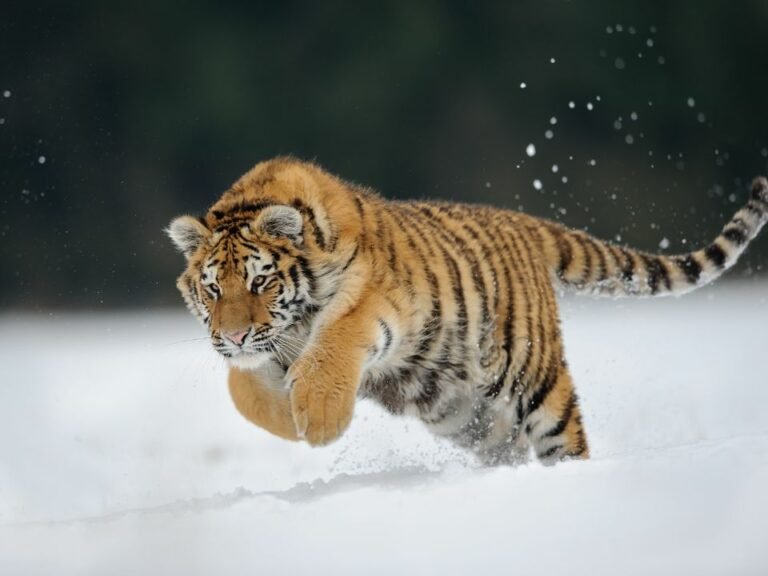
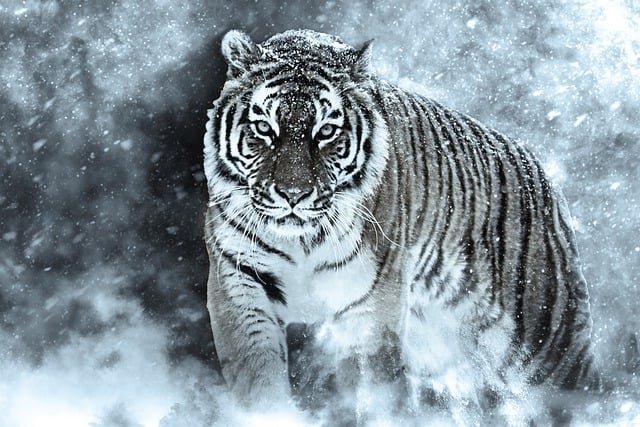
Tigers are the largest cats on Earth, and about 5,574 survive in the wild, up from roughly 3,200 in 2010. Six subspecies remain and three are already extinct. Their stripes grow on the skin as well as the fur and are unique to each animal, they swim happily unlike most cats, and their roars carry about three kilometres.
Tigers quick facts
- A tiger’s stripes are on its skin as well as its fur, and the pattern is unique to each animal like a fingerprint.
- About 5,574 tigers remain in the wild, roughly three quarters of them in India.
- The Amur (Siberian) tiger is the largest cat species alive, with big males over 300 kg.
- Tigers are strong swimmers and will cross rivers several kilometres wide.
- White tigers are not a separate species: they are Bengal tigers with a rare gene, and breeding them causes serious health problems.
Most tiger facts you meet are the same six or seven, repeated. Biggest cat, orange with black stripes, endangered, lives in the jungle. All true, all fine, and none of it tells you much about what a tiger actually is.
Here are ten that are less well known, and that hold up when you check them.
1. A tiger’s stripes are on its skin, not just its fur
Shave a tiger and the pattern is still there. The stripes go all the way down into the skin, like a tattoo, because the pigment is in the skin itself as well as in each hair.
The pattern is also unique to each animal, the way fingerprints are unique to each person. Conservationists rely on this: camera traps photograph both flanks of a tiger, and researchers identify individuals from the stripe pattern alone. That is how national tiger counts are actually done.
The stripes help in the wild too. They break up a tiger’s outline, so it is hard to spot as it waits for prey. Tigers also leave messages for each other. They spray urine, leave droppings where others will see them, and claw trees.
2. There are about 5,574 left in the wild, and the number is going up
In 2010 the wild population had fallen to roughly 3,200 and the species looked close to finished. Thirteen countries then signed up to a plan to double the number by 2022.
They did not quite double it, but the latest figure from the Global Tiger Forum is about 5,574 wild tigers, an increase of roughly 74%. India alone holds around three quarters of them. Nepal, Bhutan, Russia and China have all seen numbers climb.
Tigers remain Endangered and the recovery is fragile, but it is one of the few big-animal conservation stories genuinely heading the right way.
3. There are more tigers in American back gardens than in the wild
This is the fact that surprises people most. Estimates for the number of captive tigers in the United States, in private hands, roadside attractions and unaccredited facilities, have long run to several thousand, comparable to or exceeding the entire wild population worldwide.
Nobody knows the exact number, which is precisely the problem: for years these animals were not consistently tracked. The Big Cat Public Safety Act, signed in 2022, banned private ownership of big cats in the US, but the animals already in private hands are still there.
4. Tigers love water, which makes them odd among cats
Most cats avoid getting wet. Tigers swim for pleasure, cool off in rivers on hot days, and will happily cross water several kilometres wide. In the mangrove forests of the Sundarbans, tigers swim between islands as a matter of routine.
They will also hunt in water, and there are records of tigers taking prey while swimming. A house cat would be horrified.
Just how far can they swim? The Smithsonian’s National Zoo says tigers can cross rivers and lakes up to 8 km wide. That is a long way for any cat.
5. A tiger’s roar can be heard three kilometres away
Tigers are among the four cats that can roar, along with lions, leopards and jaguars, and the roar carries about three kilometres through forest.
There is a stranger part. Tiger calls contain infrasound, frequencies too low for human ears to register. You feel it before you hear it, which is why keepers sometimes describe a tiger’s roar as something that goes through your chest. Those low frequencies travel further and bend around obstacles better than high ones, which is exactly what you want in dense forest.
6. They miss far more often than they catch
A tiger is an ambush hunter, and ambush hunting fails most of the time. Studies suggest something like one hunt in ten or twenty ends in a kill. A tiger may need to try dozens of times to eat properly in a week.
That failure rate explains a lot about tiger behaviour: why they are so careful about stalking, why they will drag a carcass a long way and guard it for days, and why an injured tiger is in serious trouble very quickly.
To give itself the best chance, a tiger may stalk its prey slowly and quietly for 20 or 30 minutes before it attacks. It usually makes a kill only once or twice a week, then eats as much as it can. Its night vision, about six times better than ours, helps it hunt in the dark.
When a hunt does work, the tiger feasts. Deer and wild pigs are its usual prey. It can eat as much as 34 kg of meat in one night. That is about the weight of a ten-year-old child.
7. Six subspecies survive and three are already gone
| Still alive | Where |
|---|---|
| Bengal | India, Nepal, Bhutan, Bangladesh |
| Amur (Siberian) | Russian Far East and north-east China |
| Indochinese | Thailand, Myanmar, Laos |
| Malayan | Peninsular Malaysia |
| Sumatran | Sumatra, Indonesia |
| South China | Not seen in the wild for decades; survives only in captivity |
The Bali, Javan and Caspian tigers are extinct. The Bali tiger was gone by the 1940s, the Javan by the 1970s. These are not ancient losses; they happened within living memory.
8. The Amur tiger is the biggest cat on Earth
A large male Amur tiger can exceed 300 kg and reach over three metres from nose to tail tip. No lion comes close.
Amur tigers even hunt bears. In the Russian Far East, bears make up about 3% of their diet. Most of their food is wild boar and deer.
They need a lot of space, too. A female Amur tiger’s home range can be 20 by 20 km. Some males patrol an area 40 by 40 km.
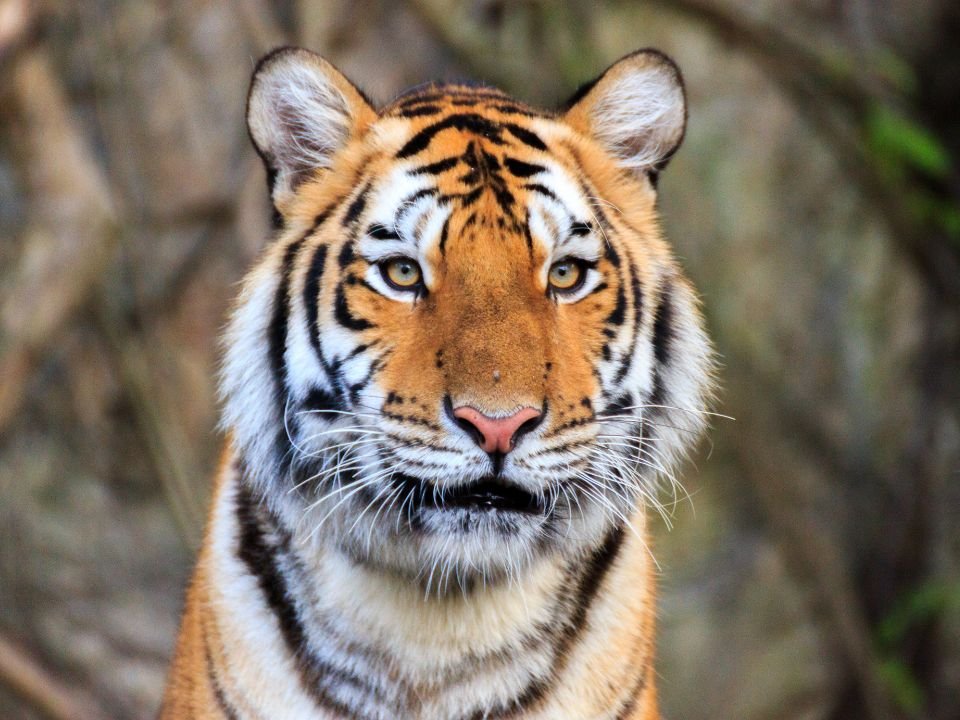
It also lives somewhere no big cat has any business living. Amur tigers survive Russian winters at minus 30 °C, padding through snow, which is why they carry thicker fur and a heavier layer of fat than their tropical cousins. The image of the tiger as a jungle animal is only half right.
9. White tigers are not a species, and breeding them causes harm
A white tiger is a Bengal tiger carrying a rare recessive gene. It is not a subspecies, it is not albino, and there is no wild population. Every white tiger in captivity today descends from a handful of animals, which means producing them requires breeding close relatives together.
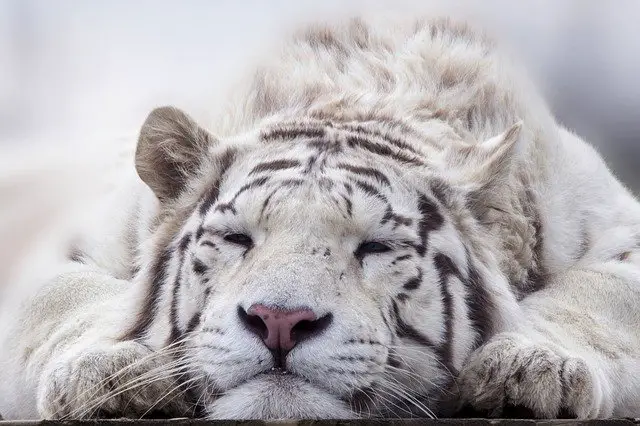
That inbreeding brings crossed eyes, spinal defects, cleft palates, immune problems and high infant mortality. Accredited zoos have largely stopped breeding white tigers for exactly this reason. They look spectacular, which is the whole problem.
10. Cubs stay with their mother for about two years
A tigress usually has two or three cubs, born blind and helpless at around a kilogram. She raises them entirely alone; the male has no part in it.
Her cubs face a tough start. Up to half of all tiger cubs die in their first year. Those that survive are grown up at about four years old. In the wild, they may live 10 to 15 years.
They stay with her for roughly two years while she teaches them to hunt, which is a long apprenticeship. Everything a tiger needs to know has to be learned in that time, and cubs that lose their mother early rarely survive. Once they leave, tigers live alone for the rest of their lives, meeting others mainly to mate or to fight over territory.
Why tigers are still in danger
Three problems, and they feed each other. Forests are cleared, so tiger habitat shrinks and breaks into isolated fragments. Poachers kill tigers for skins and for body parts used in traditional medicine. And as forest disappears, tigers and people are pushed into the same space, livestock gets taken, and tigers get killed in response.
What has worked, where it has worked, is unglamorous: protected reserves, paid rangers on patrol, removing snares, and compensating farmers who lose animals so that killing a tiger is not the obvious answer.
Common questions
How many tigers are left in the world?
About 5,574 in the wild according to the most recent Global Tiger Forum estimate, up from roughly 3,200 in 2010. Around three quarters of them live in India.
What is the biggest tiger?
The Amur, also called the Siberian tiger. Large males can pass 300 kg, making it the biggest cat species alive.
Are white tigers a separate species?
No. They are Bengal tigers with a rare recessive gene. There is no wild white tiger population, and breeding them requires inbreeding that causes serious health problems.
Can tigers swim?
Very well, and they enjoy it, which makes them unusual among cats. They will cross rivers several kilometres wide and sometimes hunt in the water.
Do tigers live in groups?
No, adult tigers live alone. The only lasting group is a mother with her cubs, and that lasts about two years.
More animal guides
Did you know? A tiger’s roar contains infrasound, frequencies too low for human ears to hear. You feel it in your chest before you register the sound, and those low frequencies travel further through dense forest.
Try it
Tigers succeed in roughly one hunt out of every ten to twenty. Count to twenty, and imagine failing nineteen times before eating. Then write down what that means for how carefully a tiger has to hunt.
Knowledge check
Why can researchers identify individual wild tigers from photographs?
Show answer
Because every tiger’s stripe pattern is unique, like a human fingerprint. Camera traps photograph both flanks and researchers match the patterns to count individuals.
Are white tigers a separate kind of tiger?
Show answer
No. A white tiger is a Bengal tiger carrying a rare recessive gene. There is no wild population, and producing them means breeding close relatives, which causes crossed eyes, spinal defects and other health problems.
Sources
- WWF: tiger — population figures, subspecies and threats.
- Global Tiger Forum estimate of 5,574 wild tigers — the current wild population.
- IUCN Red List: Panthera tigris — conservation status and subspecies.
- Smithsonian’s National Zoo: tiger — biology, cubs and behaviour.
- San Diego Zoo Wildlife Alliance: tiger — how often tigers kill, how long they stalk, and their night vision
- WildCats Conservation Alliance: Amur tiger facts — bears in the Amur tiger’s diet, home ranges and age at maturity