The Bronze Age is when people first made tools and weapons from metal. Bronze is copper mixed with a little tin, and the mixture is far harder than either metal alone. Making it meant trading over long distances, because tin is rare. In Britain the Bronze Age ran from about 2500 BC to about 800 BC.
Bronze Age for Kids quick facts
- Bronze is roughly nine parts copper to one part tin. Change the recipe and you get a worse metal.
- Tin is found in very few places, so bronze forced people who lived far apart to trade.
- A ship that sank off Turkey around 1320 BC carried about ten tonnes of copper and one tonne of tin.
- A man buried near Stonehenge about 2300 BC grew up in the Alps, hundreds of miles away.
- A village at Must Farm burned down within a year of being built, and the fire is why we know so much about it.
A mixture that beats both its parts
Bronze is roughly nine parts copper to one part tin. A mixture of metals like this is called an alloy.
Copper on its own is soft. A copper blade bends and goes blunt quickly. Add a little tin and the metal becomes much harder, and it holds a sharp edge.
Two weak metals, mixed, make a strong one. That idea is worth more than either metal.
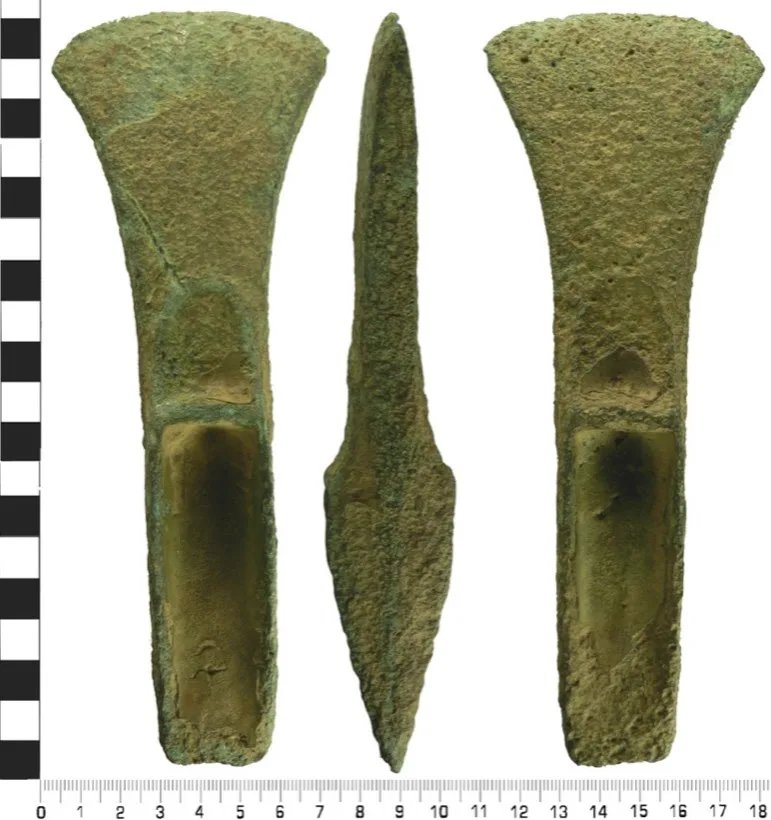
Bronze also melts at a lower temperature than copper, which made it easier to pour into moulds. A smith could cast the same axe head again and again, and each one came out the same.
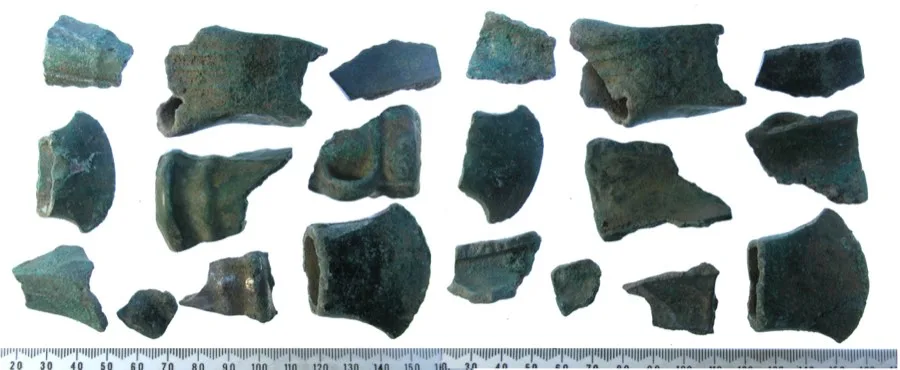
Broken bronze was worth keeping. A snapped axe was not rubbish, because the metal could be melted down and cast again. Archaeologists find buried hoards of scrap like this all over Britain. Nobody is certain why they were put in the ground. Some may be a smith’s store, hidden and never collected. Others look like gifts to a river or a god.
Stone did not vanish when metal arrived. Flint was cheap, sharp and everywhere, and a good arrowhead is still easiest to make from it. People used stone and metal side by side for centuries, choosing whichever suited the job. Our guide to Stone Age tools and weapons shows what stone was still doing best.
Bronze Age words
- Alloy — a mixture of two or more metals
- Casting — pouring melted metal into a mould
- Palstave — a type of Bronze Age axe head
- Hoard — a group of objects buried together
- Round barrow — a low circular mound raised over a burial
| Metal | Hardness | Problem |
|---|---|---|
| Copper | Soft | Bends and blunts quickly |
| Tin | Very soft | Useless on its own for tools |
| Bronze | Hard | Needs both metals, and tin is rare |
Tin made people travel
Tin is found in only a few places on Earth. If your village had copper but no tin, you had to trade for it.
So tin travelled hundreds of miles by boat and on foot. Cornwall, in south-west England, became known for it.
This is one of the biggest changes of the whole period, and it is not about metal at all. Making bronze forced people who lived far apart to deal with one another.
There is hard proof. A ship that sank off the coast of Turkey around 1320 BC was found by a sponge diver in 1982. It is called the Uluburun shipwreck. It carried about ten tonnes of copper and one tonne of tin, plus goods from at least seven different cultures.
One wreck, seven cultures. That is a trading world, not a set of isolated villages.
Think about what a trade route needs before any cargo moves. Somebody has to know the way. Somebody has to speak enough of another language to strike a deal. And both sides have to believe the other will keep it.
None of that leaves an object behind, so archaeologists read it from the cargo instead. The tools that bronze replaced are in Stone Age tools and weapons, and the metal that replaced bronze in Iron Age tools and weapons.
Put these in order
- The Archer A man who grew up in the Alps is buried near Stonehenge
- The sky disc A bronze disc showing the Sun, Moon and stars is made in Germany
- The wreck A ship carrying copper and tin sinks off the coast of Turkey
- Must Farm A village on stilts burns down in the Fens of eastern England
- Iron arrives Iron comes into everyday use in Britain and the Bronze Age ends
Farmers, in round houses
Most Bronze Age people were farmers. They grew wheat and barley and kept cattle, sheep and pigs.
In Britain, families lived in round houses with wooden walls and thatched roofs. Fields were marked out with banks and ditches, and some of those boundaries can still be seen in the landscape today.
Writing began during this period, though not in Britain. Scribes in Mesopotamia pressed marks into wet clay, a script called cuneiform. In Egypt people wrote in hieroglyphs. Britain would not have writing for another 1,500 years. Everything we know about these farmers had to be dug out of the ground.
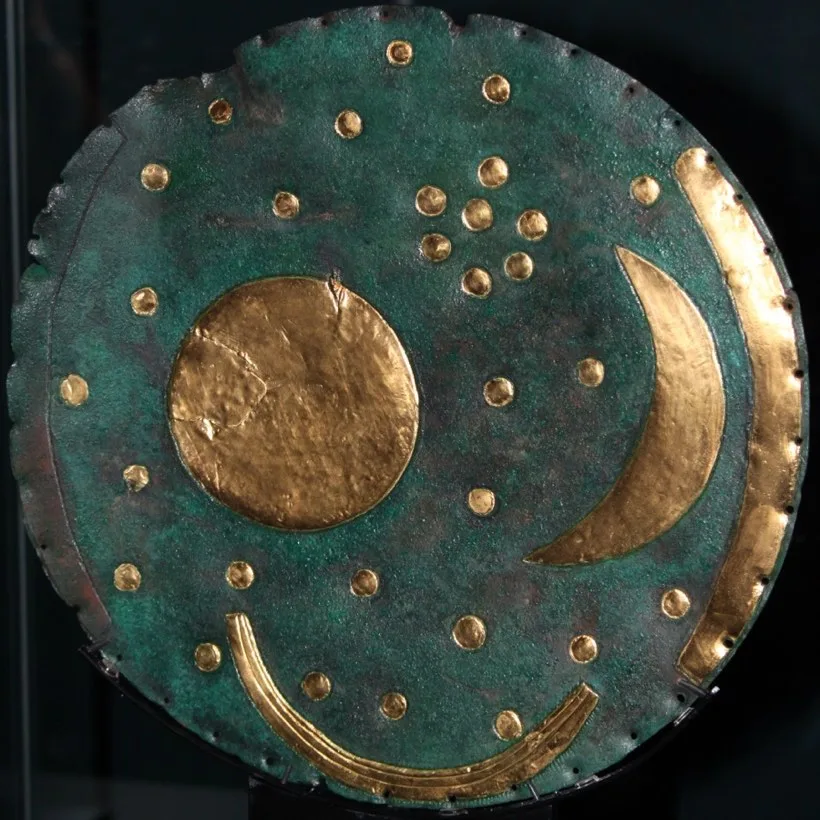
Two objects are worth knowing. The Nebra Sky Disc, found in Germany, is around 3,600 years old. It is a bronze disc with gold shapes showing the Sun, a crescent Moon and a cluster of stars. Many researchers think it is the oldest known picture of the night sky.
The second is not an object but a shape. Bronze Age people in Britain buried important people under round barrows, low circular mounds of earth. Hundreds survive, including many near Stonehenge.
What each metal was like
- Copper — soft on its own, so it bends and blunts
- Tin — very soft, and found in only a few places
- Bronze — hard, holds an edge, and easy to cast
- Gold — used for small ornaments rather than tools
- Cornwall — the part of Britain that became known for tin
The King of Stonehenge
In May 2002, archaeologists digging ahead of new houses at Amesbury in Wiltshire found a grave. The man in it died around 2300 BC, about three miles from Stonehenge, aged between 35 and 45.
Chemical clues in his tooth enamel showed that he had grown up far away, in the Alps region of central Europe. Enamel forms in childhood and locks in traces of the local water, so it works like a record of where you were.
He was buried with a rich collection. It held five Beaker pots, three copper knives and 16 flint arrowheads. There were also two stone wrist-guards for archery, a stone for working metal, and two small gold hair ornaments. That gold dates from as early as 2470 BC, and it is the earliest found in Britain.
His life was hard. An accident had torn off his left kneecap years before he died, leaving him in pain, and he had an abscess in his jaw. Newspapers nicknamed him the King of Stonehenge.
He matters because of where he came from. A man raised in the Alps was buried, with honour and treasure, beside the greatest monument in Britain.
A village frozen in time
Around 850 BC, in the Fens of eastern England, people built houses on wooden posts above a river. A fence of sharpened stakes ran all round them.
Nine to twelve months later the village burned down. The houses collapsed into the water below, and everything in them went too.
That is why it matters. Ordinary sites leave a smear of broken rubbish. At Must Farm, the river and the mud sealed whole pots, tools and half-eaten meals just where they fell, for nearly 3,000 years.
Archaeologists from the University of Cambridge excavated it in 2015 and 2016. The result is one of the clearest pictures we have of daily life in a Bronze Age village anywhere in Britain.
A disaster for the people who lived there. A gift to everyone who came after.
The finds include things that almost never survive. Wooden bowls with the food still in them. Balls of thread. A wooden wheel. Most Bronze Age sites give you postholes and pottery, and you guess the rest.
The houses of the period before this one are covered in Neolithic houses, and the people in Stone Age people.
Why a worse process won
Iron needs a much hotter fire than bronze, and far more work. On the face of it, bronze should have stayed.
But iron ore is far more common than tin. Once people knew how to work it, they could find the raw material almost anywhere. Bronze always depended on a long trade route that could be cut.
In the eastern Mediterranean, several great civilisations collapsed around 1200 BC. Cities were abandoned and trade routes broke down. Historians still argue about why, and most think several causes struck at once.
In Britain the change was gentler. Iron came into everyday use around 800 BC, and the Iron Age began. Our guide to Iron Age tools and weapons picks the story up there.
Bronze Age: fact or myth?
- The Bronze Age invented the wheel.
- Stonehenge is a Bronze Age monument.
- The Egyptian pyramids were built with bronze tools.
- Making bronze forced people who lived far apart to trade with each other.
- Most people in Bronze Age Britain worked metal for a living.
- A village burning down can be good news for archaeologists.
Gold from 2470 BC
Two small gold ornaments, worn in the hair, lay in the Amesbury Archer’s grave. They date from as early as 2470 BC, which makes them the earliest gold found in Britain.
They are tiny. You could hide both in a closed hand. But they mark the moment gold arrives in this country, and they were buried with a man who was not born here.
Put the two facts together and the Bronze Age looks different. Metal, skill and people were all moving across Europe long before anybody wrote a word about it.
Knowledge check
Iron replaced bronze. Why, when iron is harder to make?
Show answer
Harder to work, but you can find it almost anywhere.
Three things people get wrong
“The Bronze Age invented the wheel.” Wheels were already in use from around 3500 BC. Bronze tools made them easier to build, but the idea came first.
“Stonehenge is a Bronze Age monument.” The huge sarsens went up around 2500 BC, at the end of the Stone Age. Bronze Age people kept using the site and buried their dead around it.
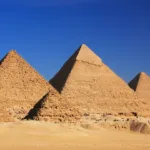
“The pyramids were built with bronze tools.” The Great Pyramid was finished around 2560 BC. Its builders used copper tools, stone hammers and a great deal of clever engineering.
Frequently asked questions
What is bronze made of?
Bronze is an alloy of roughly nine parts copper to one part tin. The mixture is much harder than copper alone, and it melts at a lower temperature, which makes it easier to cast.
When was the Bronze Age?
There is no single answer, because the Bronze Age began at different times in different places. It reached the Near East first, and Britain about 800 years later, lasting here from about 2500 BC to 800 BC.
Why was tin so important?
Tin is found in only a few places on Earth, yet bronze cannot be made without it. Villages with copper and no tin had to trade for it, sometimes across hundreds of miles.
Who was the Amesbury Archer?
The Amesbury Archer is a man who died around 2300 BC and was buried near Stonehenge with copper knives, flint arrowheads and gold ornaments. Tooth chemistry shows he grew up in the Alps.
What is the Nebra Sky Disc?
The Nebra Sky Disc is a bronze disc found in Germany, around 3,600 years old, decorated with gold shapes for the Sun, a crescent Moon and stars. Many researchers call it the oldest known picture of the night sky.
Why did the Bronze Age end?
Iron slowly replaced bronze because iron ore is far more common than tin, even though iron is harder to make. In Britain iron came into everyday use around 800 BC.
Sources
- Must Farm, University of Cambridge Archaeological Unit — the Bronze Age settlement, its fire and what the river preserved.
- English Heritage: the history of Stonehenge — the dates that place Stonehenge before the Bronze Age, and later use of the site.
- Royal Society of Chemistry: iron — why iron replaced bronze, and how common the ore is.
Bronze Age Final Challenge
- Roughly what is the recipe for bronze?
- Besides being harder, what else made bronze easier to work than copper?
- Why is a buried hoard of broken bronze worth keeping?
- The Uluburun wreck was found in 1982 by whom?
- What did the Uluburun cargo show about the Bronze Age world?
- Where did the Amesbury Archer grow up?
- How long did the village at Must Farm stand before it burned?
- What did people in Bronze Age Britain live in?