The Iron Age is the last part of prehistory. It is when iron took the place of bronze for tools and weapons. Iron is harder to make than bronze. But the rock it comes from is far more common, so iron tools could be made in large numbers. In Britain it ran from about 800 BC until the Romans invaded in AD 43.
Iron Age for Kids quick facts
- Iron Age smiths could not melt iron. Their fires never got hot enough, so they hammered it into shape instead.
- People knew about iron by 3000 BC, but treated it as a precious metal, a bit like gold.
- An early Iron Age axe in the British Museum is about 14.5 cm long and weighs 522 grams.
- Iron put weapons into ordinary hands for the first time, because the ore was everywhere.
- British prehistory ends with a date and an event: the Roman invasion of AD 43.
The metal nobody could use
People in the Middle East knew about iron as early as 3000 BC. At first it was rare, and rare things are precious. It was treated a bit like gold.
The problem was not finding iron. It was getting it out of the rock, and then working it once you had.
Between about 1200 and 1000 BC that changed. The knowledge of how to work iron spread quickly and widely, and iron objects spread with it.
The Iron Age did not begin everywhere at once. It started in the Middle East and south-eastern Europe about 1200 BC, but not until about 600 BC in China. In Britain it began around 800 BC.
Our guide to Iron Age tools and weapons covers this period in full. Further back still are Stone Age facts for kids and Bronze Age facts for kids.
Put these in order
- A precious metal People know about iron but treat it like gold
- The knowledge spreads How to work iron spreads quickly and widely
- Iron reaches Britain Iron comes into everyday use and the Iron Age begins
- Hillforts Communities raise banks and ditches on hilltops
- The Romans The invasion ends the British Iron Age, and prehistory with it
Hot, hard, skilled work
Iron does not come out of the ground as shiny metal. It is locked inside rock called iron ore.
To get it out, smiths heated the ore with charcoal in a small clay furnace. The heat produced a spongy lump of iron mixed with waste. The smith heated the lump again and again, hammering it each time to squeeze the waste out.
Bronze workers had poured liquid metal into moulds. Iron workers could not. Their furnaces never reached iron’s melting point, so they shaped it by hammering it hot on an anvil.
This is called forging, and the person who does it is a blacksmith. It takes strength, judgement and years of practice. Blacksmiths were important people in their communities, and it is easy to see why.
Iron Age words
- Iron ore — the rock that iron is locked inside
- Charcoal — what the ore was heated with in the furnace
- Forging — shaping hot metal by hammering it
- Blacksmith — the skilled person who shapes hot iron
- Hillfort — a hilltop enclosed by banks and ditches
When good metal stopped being rare
Bronze was always limited by tin. Iron was not. Once smiths knew the method, ore could be found almost anywhere.
So iron tools were made in large numbers, and farming got easier. Iron ploughshares could turn heavier soil, and iron sickles and axes lasted longer than stone ones.
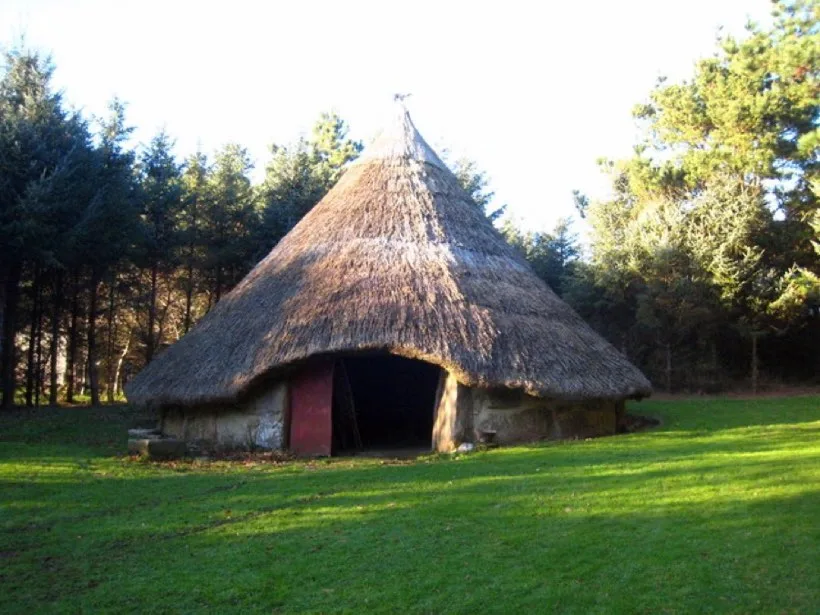
More food meant communities could grow. In Britain people lived in villages of roundhouses, with thick walls and cone-shaped roofs.
The other half of the change is less comfortable. Iron weapons became common too. For the first time, ordinary people could own good weapons rather than only chiefs and their warriors. Historians link that shift to centuries of movement and conflict across Europe and Asia.
| Bronze | Iron | |
|---|---|---|
| Raw material | Copper plus rare tin | Iron ore, found almost everywhere |
| Shaping | Melted and poured into moulds | Hammered hot on an anvil |
| Who could have it | Mostly the wealthy | Ordinary households too |
Iron where it counted
Iron Age people used a wide range of tools, and most of them were not iron. Wood, stone, leather and bronze were all still useful. Iron went where a strong edge or point was needed.
Axes cut down trees and shaped wood for houses, fences and tools. The British Museum holds an early Iron Age axe about 14.5 centimetres long, weighing 522 grams. That is roughly the weight of a large tin of beans.
Ploughshares were the pointed cutting parts at the front of a plough. An iron tip was far tougher than a wooden one, so farmers could break up heavier ground. One example was found in the mud of the Thames foreshore at Wandsworth in London.
Sickles had curved iron blades for cutting wheat and barley at harvest. The shape had not changed since the New Stone Age. The material had.
That is a useful thing to notice about tools in general. A good shape can outlast the material it was first made in by thousands of years. The curve of a sickle solves a problem about how corn falls, and that problem never changed.
That is the pattern of the whole age. Old jobs, old shapes, better edges.
Bronze did not disappear either. It stayed in use for brooches, buckets, mirrors and decorated fittings, where looks mattered more than a hard edge. A rich Iron Age household owned both metals and used each for what it was good at.
The stone tools these replaced are in Stone Age tools and weapons.
Which tool did the job?
- Axe — cutting trees and shaping wood for houses and fences
- Ploughshare — the pointed part at the front of a plough
- Sickle — cutting wheat and barley at harvest
- Anvil — the heavy block hot iron is hammered on
- Roundhouse — the home people lived in, with thick walls and a cone roof
Banks, ditches and a view
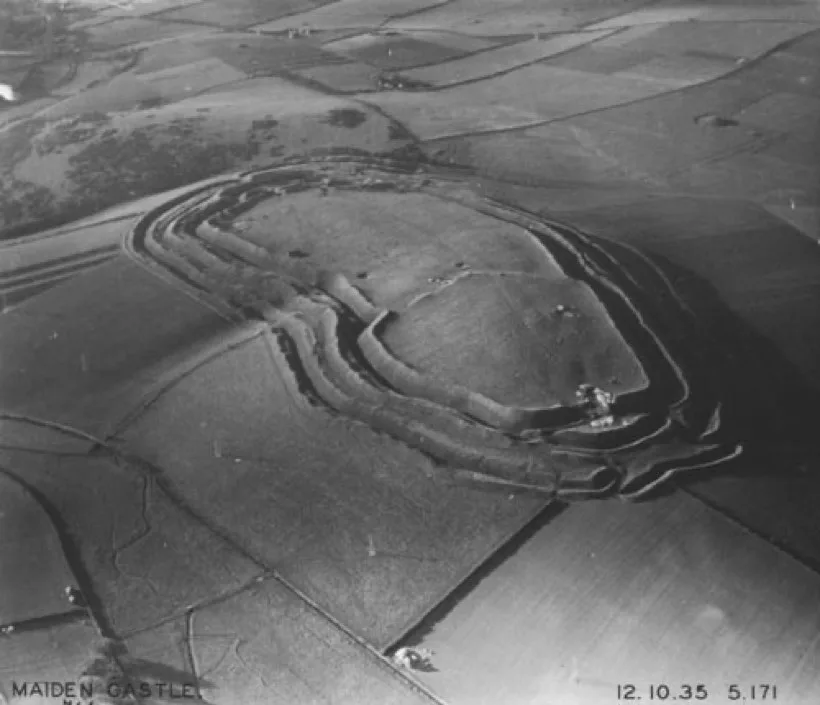
A hillfort is a hilltop enclosed by earth banks and ditches, often in rings, with a defended entrance. Some held houses, workshops and grain stores. Others may have been used only at certain times.
They were not castles. There is no stone keep, no tower and no drawbridge. What they have is height, a clear view and a great deal of moved earth.
Building one took the whole community. That tells you two things at once. People who can organise that much digging have leaders. And people who dig defences are expecting trouble.
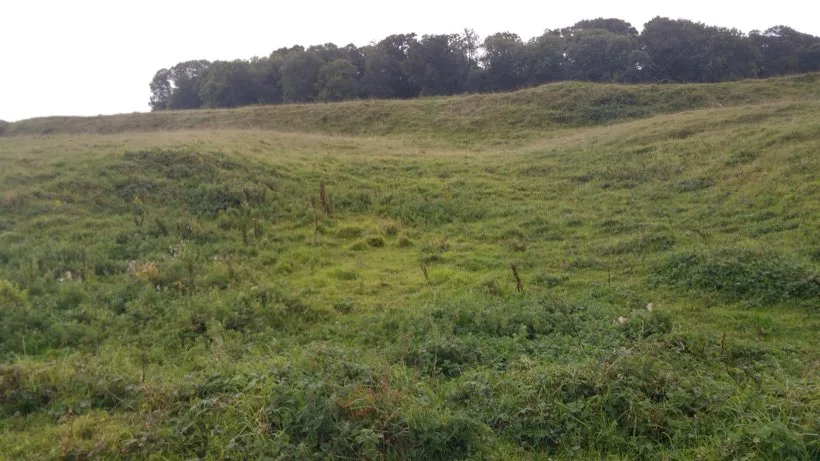
Hundreds survive across Britain, and many are still easy to walk around. The banks have slumped and softened over 2,500 years, but the rings are there in the grass, and you can usually still find the gateway.
Iron Age Britain was made up of tribes, each with its own territory and chief. They traded, and they fought. Hillforts sit at the meeting point of both.
Inside the banks, life looked much as it had for centuries. People lived in roundhouses with thick walls and cone-shaped roofs, kept cattle and sheep, and grew wheat and barley. A hillfort is a farming community with earthworks around it, not a garrison.
Some were huge. Others held only a few families. Archaeologists still argue about how they were used. Were most lived in all year, or kept as a refuge in bad times, or gathered in for markets and festivals? The honest answer is that different ones probably did different jobs.
An earlier age built monuments on this same landscape. Those are covered in New Stone Age tools and weapons. Daily life before metal is in Stone Age food.
Iron Age: fact or myth?
- Iron Age smiths made steel.
- A hillfort is a kind of stone castle.
- Early iron was better than good bronze in every way.
- Iron put good weapons into ordinary hands for the first time.
- Bronze stopped being used once iron arrived.
- Iron ploughshares let farmers break up heavier soil.
The moment the writing starts
The Romans invaded Britain in AD 43. That date is the usual end of the British Iron Age, and of British prehistory.
It is worth being clear about what that means. Prehistory does not end because people changed. It ends because somebody started writing things down.
Everything in this course happened before the first written word about Britain. Three million years, and not one name we can read.
For everything before this, archaeology is the only witness. A burnt village. A grave, a shaft cut into chalk, a hand stencilled on a cave wall.
That is the end of the course. Five stages, from the first chipped stone to the last hillfort. Not a single written sentence in any of them.
It is worth noticing how the evidence thins as you go back. The Iron Age leaves hillforts you can walk around today. The Old Stone Age leaves a few flakes of worked rock and a painted wall.
The further back you go, the more the story rests on very small things, carefully read. That is not a weakness in archaeology. It is the whole skill of it.
An axe the size of your hand
The British Museum holds an early Iron Age axe about 14.5 centimetres long, weighing 522 grams. It is not a famous treasure. There is no gold on it and no king attached.
That is why it is worth ending on. Somebody smelted the ore, hammered out the waste, shaped the blade and fitted the handle. Then somebody else used it until they died.
Every stage of this course has one of these: a flake, a microlith, a polished axe, a bronze knife, an iron blade. Different metals, same hand.
Knowledge check
What ended the Iron Age in Britain, and prehistory with it?
Show answer
Prehistory ends when writing starts.
Three things people get wrong
“Iron Age people made steel.” Steel is iron with carbon added, under control. Iron Age smiths could not melt iron at all, and everyday steel is far later.
“Hillforts are castles.” A hillfort is earth banks and ditches on a hilltop. Stone castles arrive more than a thousand years afterwards.
“Iron was better than bronze in every way.” Early iron was not always harder than good bronze. What it had was supply, because the ore is almost everywhere.
Frequently asked questions
When was the Iron Age?
The Iron Age began about 1200 BC in the Middle East and south-eastern Europe, and about 600 BC in China. In Britain it ran from around 800 BC until the Roman invasion of AD 43.
How did people make iron?
Smiths heated iron ore with charcoal in a small clay furnace, producing a spongy lump of iron and waste. Repeated heating and hammering squeezed the waste out and left usable metal.
Why could Iron Age smiths not pour iron into moulds?
Their furnaces never reached the melting point of iron, so the metal never became liquid. Bronze melts at a much lower temperature, which is why casting worked for bronze but not for iron.
What is a hillfort?
A hillfort is a hilltop enclosed by banks and ditches, usually with a defended entrance. Some contained houses, workshops and grain stores, while others may have been used only at certain times.
What tools did Iron Age people use?
Axes, ploughshares and sickles were the everyday iron tools, alongside plenty of wood, stone, leather and bronze. Iron was saved for cutting edges and points, where its strength mattered most.
Why does prehistory end with the Romans?
Prehistory means the time before written records. Roman writers described Britain after the invasion of AD 43, so from that point historians have text as well as archaeology.
Sources
- Royal Society of Chemistry: iron — the properties of iron and how it is won from its ore.
- English Heritage: the history of Stonehenge — the prehistoric timeline this stage closes.
- Must Farm, University of Cambridge Archaeological Unit — the late Bronze Age settlement immediately before the Iron Age.
Iron Age Final Challenge
- How was iron treated when it was still rare?
- What came out of an Iron Age furnace?
- Why could bronze be cast but iron could not?
- What was iron mostly saved for?
- Why did more food mean bigger communities?
- What does a hillfort tell us about the people who built it?
- How was Iron Age Britain organised?
- What does the word prehistory actually mean?