The black-footed ferret is a small, masked hunter of the North American grasslands. About 90% of its diet is prairie dogs, and it lives in their burrows. It was thought to be extinct twice, and by 1987 none were left in the wild. Captive breeding and releases brought it back, and in 2023 about 400 to 500 lived in the wild.
black-footed ferrets quick facts
- About 90% of a black-footed ferret’s diet is prairie dogs.
- They live in prairie dog burrows instead of digging their own.
- All 18 last wild ferrets were caught between 1985 and 1987.
- Elizabeth Ann, born in 2020, was the first cloned endangered animal in the US.
- In 2023, about 400 to 500 black-footed ferrets lived in the wild.
What is a black-footed ferret?
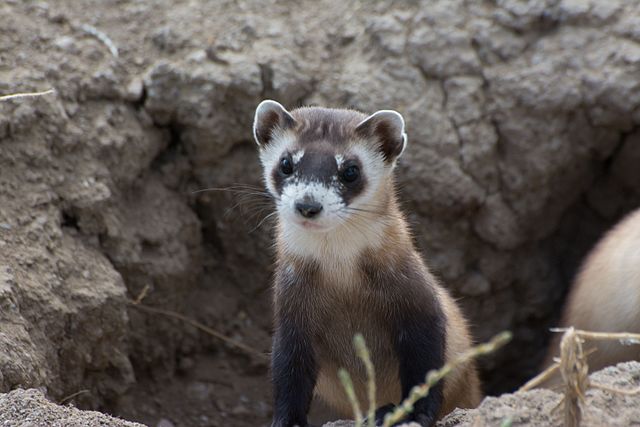
The black-footed ferret is a small, masked hunter that lives on the grasslands of North America. It spends most of its life underground, in burrows dug by prairie dogs.
It is also one of the great comeback stories of wildlife conservation. The US Fish and Wildlife Service says black-footed ferrets were thought to be extinct twice during the 20th century.
Today, hundreds of them live in the wild again, thanks to captive breeding, careful releases and even cloning.
| Black-footed ferret at a glance | |
|---|---|
| Where | Great Plains of North America |
| Length | 48 to 61 cm (19 to 24 in), including the tail |
| Weight | 635 g to 1.13 kg (1.4 to 2.5 lb) |
| Main food | prairie dogs |
| Kits | usually 3 or 4 in a litter |
| Wild numbers (2023) | about 400 to 500 |
| Status | endangered in the United States |
What does a black-footed ferret look like?
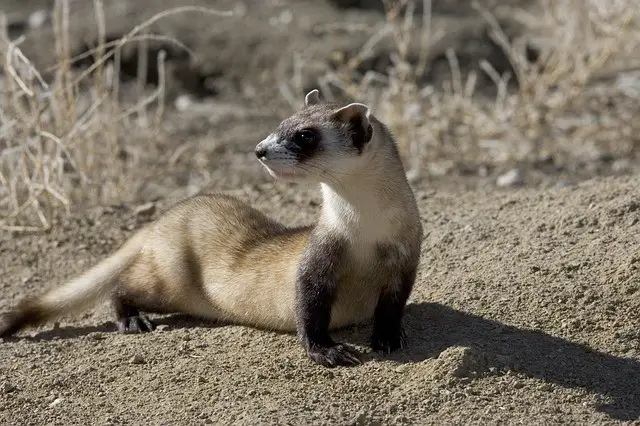
The US Fish and Wildlife Service says black-footed ferrets are 48 to 61 cm (19 to 24 in) long and weigh 635 to 1,134 g (1.4 to 2.5 lb). That makes them about as heavy as a pineapple.
The Smithsonian’s National Zoo says that length includes a tail 13 to 15 cm long. Males are slightly bigger than females.
They have yellowish-buff fur, black feet, a black tip on the tail and a black mask across the eyes, the Fish and Wildlife Service says. The National Zoo says their belly is lighter, and their forehead, muzzle and throat are nearly white.
Where do black-footed ferrets live?
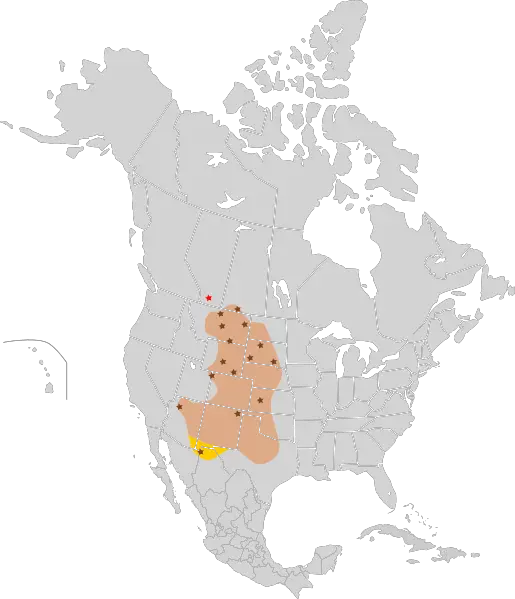
Black-footed ferrets once lived across the Great Plains of North America, wherever there were prairie dog towns, the National Zoo says. Their range stretched from southern Canada to northern Mexico.
The Fish and Wildlife Service says their old range covered 12 US states, plus Saskatchewan in Canada and Chihuahua in Mexico. It almost exactly matched the range of three kinds of prairie dog.
There used to be prairie dogs almost everywhere. The Fish and Wildlife Service says that in the late 1800s, prairie dog colonies covered an estimated 280 million hectares of North America.
Life underground
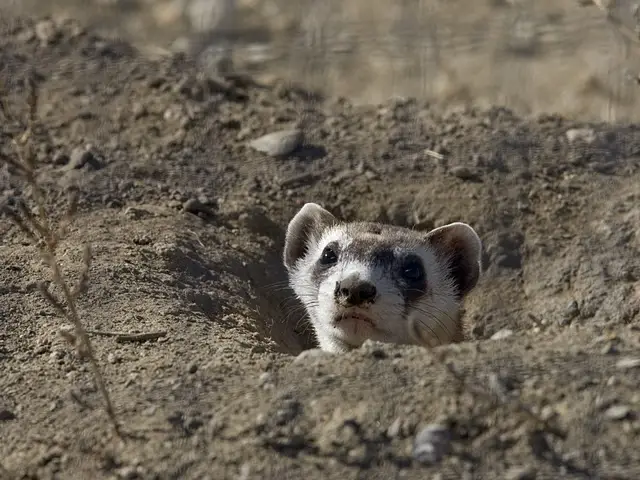
Black-footed ferrets do not dig their own homes. The Fish and Wildlife Service says they move into prairie dog burrows and reshape them.
They are mostly nocturnal, which means they are active at night. The National Zoo says a ferret may spend only a few minutes above ground each day, and in winter it can stay underground in the same burrow system for a week at a time.
Black-footed ferrets live alone, except in the breeding season or when a mother is raising her young, the National Zoo says.
They are quite noisy for such secretive animals. The National Zoo says a ferret chatters loudly when alarmed and hisses when scared. Mothers whimper to their young, and males “chortle” to females during courtship.
What do black-footed ferrets eat?
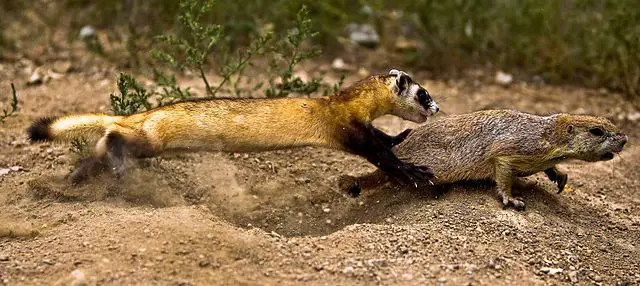
Black-footed ferrets depend on prairie dogs. The National Zoo says prairie dogs make up about 90% of their diet.
One ferret may eat more than 100 prairie dogs in a year, and a ferret family needs more than 250 a year, the National Zoo says.
They also eat mice, rats, ground squirrels, rabbits, birds, reptiles and insects. The Fish and Wildlife Service says ferrets have even been seen storing prairie dogs to eat later.
Because they need so many prairie dogs, ferrets can only survive where there are large prairie dog colonies. Learn how living things depend on each other in our ecosystem facts.
Black-footed ferret kits
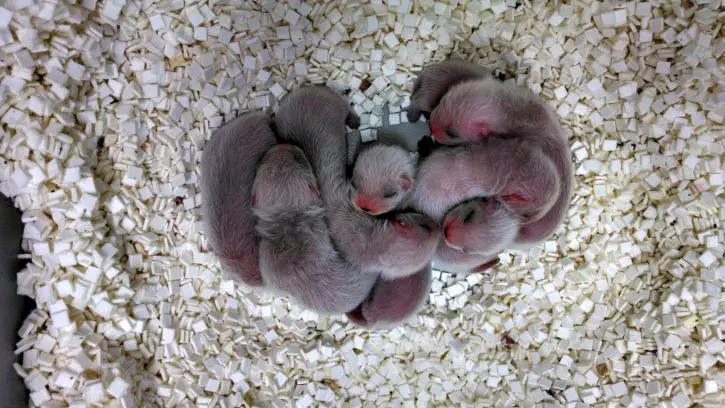
Baby ferrets are called kits. The National Zoo says black-footed ferrets breed in March and April, and the Fish and Wildlife Service says the kits are born underground, usually three or four in a litter.
Newborn kits are tiny. The National Zoo says each one weighs just 5 to 9 g, about as much as a couple of grapes.
The National Zoo says kits get their dark markings at three weeks old and open their eyes at 35 days. The Fish and Wildlife Service says they leave their mothers at about 100 days old and reach adult weight at about 125 days.
Ferrets can have kits of their own at one year old. Wild ferrets do not live long: the Fish and Wildlife Service says females can live up to five years and males up to four, and the National Zoo says few live beyond three or four.
Thought to be extinct
Black-footed ferrets once numbered in the tens of thousands, the Fish and Wildlife Service says. But as prairie dog towns were destroyed, the ferrets disappeared too.
The species was listed as endangered in the United States on 11 March 1967. By 1979, the National Zoo says, it was thought to be extinct.
Then came a surprise. In September 1981, a ranch dog killed a black-footed ferret near Meeteetse, Wyoming. The Fish and Wildlife Service says this led scientists to a small group of ferrets still living nearby.
But in 1985, a disease thought to be canine distemper hit the Meeteetse ferrets hard. Between 1985 and 1987, all 18 remaining ferrets were caught and taken into captivity to save the species. After that, there were no black-footed ferrets left in the wild.
Bringing ferrets back
The first captive ferret litters were born in the summer of 1987. The Fish and Wildlife Service says that in 1988, 13 litters with 44 kits were born, and 34 of them survived.
All black-footed ferrets alive today, apart from the clones, come from just seven of those last wild ferrets, the Fish and Wildlife Service says.
Six places now breed them, including the National Black-footed Ferret Conservation Center in Colorado, the Smithsonian Conservation Biology Institute in Virginia and Toronto Zoo in Canada. About 280 ferrets live at these breeding centres.
Ferrets have been released back into the wild since 1991. The Black-footed Ferret Recovery Implementation Team says 150 to 220 are released each year. The National Zoo says that since 1996, every ferret first spends time in outdoor practice pens, learning to live in burrows and hunt prairie dogs.
In September 2023, the Smithsonian reported that 400 to 500 black-footed ferrets lived in the wild, at 30 sites in eight US states, Canada and Mexico. It says about 4,500 ferrets have been released since the programme began.
Dangers for ferrets
The biggest danger is a disease called sylvatic plague. The Fish and Wildlife Service says it does not naturally belong in North America, and it is the greatest challenge to keeping ferret populations healthy.
Plague is spread by fleas, and it kills both ferrets and the prairie dogs they eat, the National Zoo says.
Other threats include loss of grassland, prairie dogs being poisoned and shot, drought and inbreeding, the Fish and Wildlife Service says. Ferrets can also die from canine distemper, pneumonia and parasites.
The cloned ferrets
Because every ferret comes from so few ancestors, scientists worried about inbreeding. So they tried something new: cloning.
On 10 December 2020, a ferret named Elizabeth Ann was born at the National Black-footed Ferret Conservation Center. The Fish and Wildlife Service says she was the first clone of an endangered species in the United States.
She was cloned from the frozen cells of Willa, one of the last wild ferrets. Willa’s cells had been frozen in 1988 at the San Diego Zoo’s Frozen Zoo. A domestic ferret carried Elizabeth Ann before she was born.
Willa’s genes matter. The Fish and Wildlife Service says they have about three times more unique variety than the average ferret alive today.
Two more clones of Willa, named Noreen and Antonia, were announced in April 2024. In 2024, Antonia had three kits with a male named Urchin, and two survived. The National Zoo says it was the first time a cloned endangered animal had given birth in the United States.
In summer 2025, the Fish and Wildlife Service says, four litters with 12 kits were born to Antonia, Noreen and Antonia’s two kits, Sibert and Red Cloud. The National Zoo says Elizabeth Ann and Noreen both died in 2025.
The Smithsonian says cloning adds to, but does not replace, protecting prairie habitat and releasing ferrets.
Three things people get wrong
Black-footed ferrets are not extinct. About 400 to 500 lived in the wild in 2023.
Ferrets do not dig their own burrows. They move into prairie dog burrows.
Cloning alone cannot save them. They still need prairie dogs and protected grasslands.
Did you know? A newborn black-footed ferret kit weighs just 5 to 9 g, about as much as a couple of grapes.
Try it
Draw a prairie dog town underground, with tunnels and rooms. Mark where a black-footed ferret might sleep and hunt.
Knowledge check
What makes up most of a black-footed ferret’s diet?
Show answer
Prairie dogs.
Who was Elizabeth Ann?
Show answer
The first cloned black-footed ferret, born in 2020.
Frequently asked questions
What do black-footed ferrets eat?
About 90% of their diet is prairie dogs. One ferret may eat more than 100 prairie dogs a year, plus mice, rabbits, birds and insects.
Where do black-footed ferrets live?
They live on the Great Plains of North America, in prairie dog burrows. Ferrets have been released in eight US states, Canada and Mexico.
Why are black-footed ferrets endangered?
They lost most of the prairie dog towns they depend on, and a disease called sylvatic plague kills both ferrets and prairie dogs.
How many black-footed ferrets are left?
In September 2023, the Smithsonian reported 400 to 500 in the wild, plus about 300 living in breeding centres.
Were black-footed ferrets ever extinct?
They were thought extinct twice. In 1987, the last 18 known wild ferrets were caught to save the species.
Why were black-footed ferrets cloned?
All living ferrets come from only seven ancestors. Clones of Willa, a ferret frozen in 1988, add lost genetic variety.
Sources
- US Fish and Wildlife Service: black-footed ferret — size, range, burrows, diet, breeding, history, breeding centres and threats
- US Fish and Wildlife Service: Elizabeth Ann (2021) — the first clone, Willa and the surrogate mother; the 2024 cloning releases and the 2025 kits story were also used
- US Fish and Wildlife Service: black-footed ferret recovery plan — Meeteetse, the last 18 ferrets, the first captive litters and prairie dog history
- Smithsonian’s National Zoo: black-footed ferret — size, diet, behaviour, sounds, kits and releases
- Smithsonian’s National Zoo: kit update (September 2023) — wild and captive numbers and history; its 2025 news on cloned ferrets’ kits was also used
- Black-footed Ferret Recovery Implementation Team: reintroduction — releases since 1991 and release sites