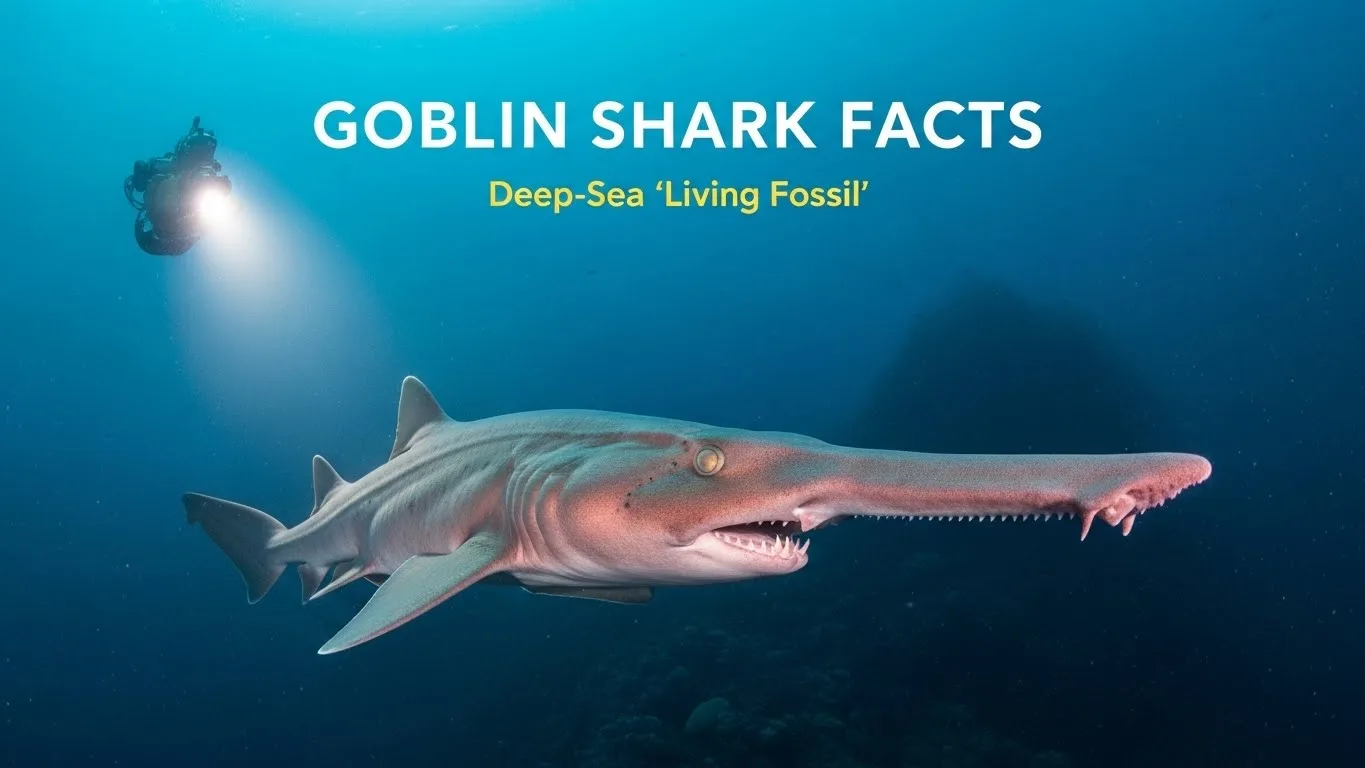
The goblin shark is a rare deep-sea shark that usually lives 270 to 960 m below the surface. It has a long, flat snout covered in electrical sensors, pinkish skin and jaws that shoot forward faster than any other shark’s to catch fish, squid and shrimps. It is usually 1 to 4 m long, and it is not considered dangerous to people.
goblin sharks quick facts
- The goblin shark can shoot its jaws forward faster than any other shark.
- It usually lives 270 to 960 m deep.
- Its skin looks pink because blood vessels show through.
- Its snout is covered in sensors that detect electricity.
- Nobody has ever caught a pregnant goblin shark.
What is a goblin shark?
The goblin shark is one of the strangest-looking animals in the ocean. It is a deep-sea shark with a long, flat snout and jaws that can shoot forward to grab its food.
Its scientific name is Mitsukurina owstoni. The Florida Museum of Natural History says it belongs to the mackerel shark order, a group of sharks called Lamniformes.
Goblin sharks are very rarely seen alive. The ocean conservation group Oceana says most of what scientists know comes from goblin sharks caught by accident in fishing nets.
| Goblin shark at a glance | |
|---|---|
| Scientific name | Mitsukurina owstoni |
| Usual length | about 1 to 4 m (3 to 13 ft) |
| Usual depth | about 270 to 960 m (890 to 3,150 ft) |
| Oceans | Pacific, Atlantic and Indian |
| Food | fish, squid, shrimps and crabs |
| Danger to people | not considered dangerous |
| Status | Least Concern |
How it got its name
The goblin shark was first described by scientists in 1898, the Florida Museum says.
Its scientific name honours two people. The first part comes from Kakichi Mitsukuri, a Japanese zoologist. The second part comes from Alan Owston, an English collector of Asian wildlife who lived from 1853 to 1915, the Australian Museum says.
In Japan, it is called tenguzame. Oceana explains that a tengu is a creature from Japanese folk tales that is part bird and part human, and “zame” means shark. The shark’s long snout looks like the long nose on a tengu mask.
Its English name comes from its spooky, goblin-like look, with its long snout and gaping jaws, Oceana says.
What does a goblin shark look like?
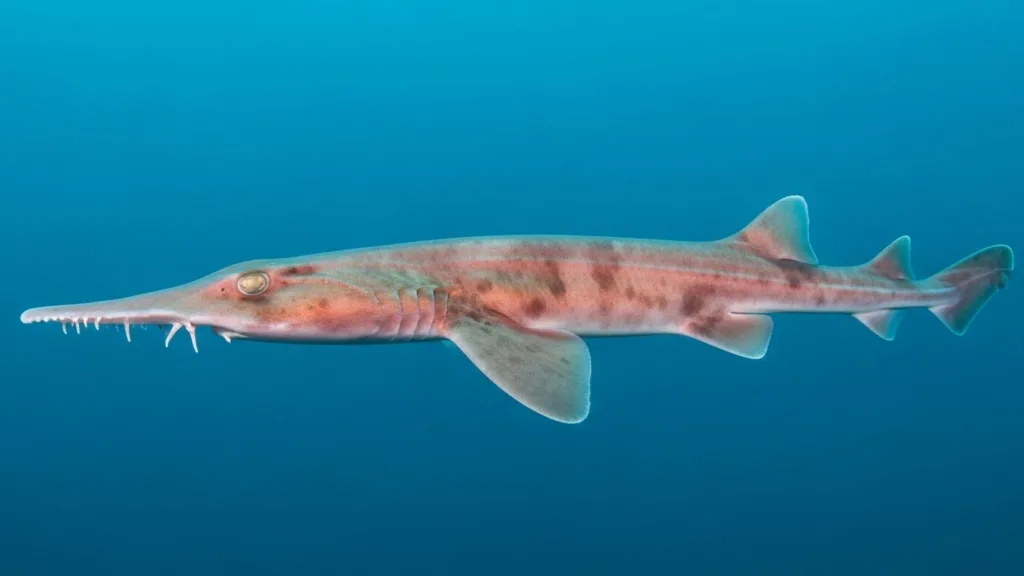
The goblin shark has a long, flat, shovel-shaped snout, the Australian Museum says. Its body is soft and flabby, and its tail has only a weak lower lobe.
Its colour is unusual too. The Florida Museum says its skin looks pinkish-white because blood vessels show through it, while its fins look bluish-grey. Young goblin sharks are a ghostly white.
Animal Diversity Web, a University of Michigan project, says the skin feels rubbery. After a goblin shark dies, it loses its pink colour and looks almost colourless.
Its body is not built for speed. The Shark Research Institute says its shape suggests it is not a strong swimmer.
How big is a goblin shark?
Goblin sharks are big fish. The Australian Museum says they grow to about 3.9 m (12 ft 10 in) long.
Animal Diversity Web says the goblin sharks that scientists have measured were between 1.07 m and 3.8 m long, with an average of 1.6 m (5 ft 3 in). Females are slightly larger than males.
Some may grow even bigger. The Florida Museum says measurements worked out from photographs suggest some reach 5.4 to 6.17 m. Oceana says they can probably reach at least 5.5 to 6 m, but says this is a guess, because so few have been seen.
The smallest goblin shark ever collected was 1.07 m (3 ft 6 in) long, the Florida Museum says. None of the sources we checked give a weight for a goblin shark.
Where do goblin sharks live?
Goblin sharks live deep in the ocean. The Florida Museum says they usually live between 270 and 960 m (about 890 to 3,150 ft) below the surface, and the deepest one recorded was at 1,300 m.
They are found near the edges of the continental shelves, on the upper slopes of the sea floor and around underwater mountains called seamounts, the Shark Research Institute says.
The Australian Museum says goblin sharks live in the Pacific, Atlantic and Indian Oceans. Their range is patchy, though: they turn up in some places and not in others.
Most reports come from Japan, the Florida Museum says. Goblin sharks have also been recorded off Guyana, Suriname, France, Portugal, Senegal, South Africa, Mozambique, California, the Gulf of Mexico, Australia and New Zealand.
Oceana reported that in 2014, a shrimp fisherman caught an 18-foot (about 5.5 m) goblin shark in the Gulf of Mexico, near the Florida Keys.
Finding food in the dark
Deep in the ocean, there is very little light. Oceana says goblin sharks rely less on their eyes and more on smell, sound and a special electrical sense.
The underside of the snout is covered in tiny pores called ampullae of Lorenzini. The Australian Museum says these pores sense electricity. The shark most likely finds its prey by picking up the tiny electric fields that living animals make.
The long snout is useful here. Oceana says it gives the shark more space for these electrical sensors, a bit like a metal detector for food.
Animal Diversity Web says goblin sharks are thought to be most active around dawn and dusk.
Slingshot jaws
The goblin shark’s most amazing trick is its jaws. The Australian Museum says it can shoot its jaws forward faster than any other kind of shark.
Oceana says the jaws shoot forward at about 11 km/h (nearly 7 mph), reaching out by more than 9% of the shark’s body length.
How does it work? The Florida Museum says a double set of stretchy ligaments at the jaw joints lets the jaws spring forward. When the shark is not feeding, the jaws are tucked back under its eyes. When it strikes, they push forward under the snout.
This helps a slow swimmer catch fast food. Oceana says the shark may swim slowly and wait until an animal comes close, then shoot out its jaws. That matters in the deep sea, where it may not find food very often.
Its teeth are long, narrow and fang-like. The Florida Museum says it has 35 to 53 teeth in its upper jaw and 31 to 62 in its lower jaw.
What do goblin sharks eat?
The Florida Museum says the goblin shark’s narrow teeth suggest it mostly eats soft-bodied animals, such as shrimps, octopus, fish and squid. It may also eat crabs.
Scientists have looked inside the stomachs of goblin sharks. The Australian Museum says they found bony fish, squid and crustaceans. Animal Diversity Web says they have also found tiny shelled animals called ostracods.
Other sharks eat very differently. Meet a powerful hunter of the surface waters in our great white shark facts.
Babies and mysteries
There is a lot we still do not know about goblin sharks. The Florida Museum says they are thought to give birth to live pups, with the eggs hatching inside the mother first. But nobody has ever caught a pregnant female.
Animal Diversity Web says nobody knows how many pups a female has, how long she is pregnant, or at what age goblin sharks become adults.
Nobody knows how long goblin sharks live, either. None have been studied in the wild, and none have been kept alive for long in an aquarium, Animal Diversity Web says.
Goblin sharks and people
Goblin sharks may look scary, but the Australian Museum says they are not considered dangerous to people. They live hundreds of metres below the surface, where people rarely go.
People do catch them sometimes. The Florida Museum says goblin sharks are caught by accident in deep-water trawl nets, longlines and deep-set gill nets, and their meat is rarely sold. Animal Diversity Web says they are sometimes fished off Japan.
The goblin shark is listed as Least Concern by the IUCN, the Florida Museum says, because fishers rarely catch it and there is little market for it. Oceana says goblin sharks are not known to be declining.
Sharks come in amazing shapes. Find another unusual head in our hammerhead shark facts.
Is it a living fossil?
You may read that the goblin shark is a living fossil. The Florida Museum says scientists once grouped it with an ancient shark called Scapanorhynchus, known from fossils described in 1889.
But scientists still debate whether the two sharks are really close relatives. So it is best to think of the goblin shark as an unusual living shark, not a fossil come back to life.
Three things people get wrong
Goblin sharks do not have pink skin. It looks pink because blood vessels show through it.
Goblin sharks are not a danger to people. They live far too deep to meet swimmers.
The long snout is not a weapon. It is covered in sensors that help the shark find food.
Did you know? In Japan the goblin shark is called tenguzame, after a long-nosed creature from Japanese folk tales.
Try it
Hold a ruler flat under your chin and slide it forward to copy how a goblin shark’s jaws shoot out.
Knowledge check
How does a goblin shark find food in the dark?
Show answer
It senses tiny electric fields with pores on its snout.
Why does its skin look pink?
Show answer
Blood vessels show through its skin.
Frequently asked questions
Where do goblin sharks live?
They live deep in the Pacific, Atlantic and Indian Oceans, usually 270 to 960 m below the surface, near continental slopes and seamounts.
How big do goblin sharks get?
Measured goblin sharks are usually 1 to 4 m long. Estimates from photos suggest a few may reach 5.4 to 6 m.
What do goblin sharks eat?
They eat soft-bodied animals such as fish, squid, octopus and shrimps, and possibly crabs, caught with their fast-moving jaws.
Are goblin sharks dangerous to humans?
No. The Australian Museum says they are not considered dangerous, and they live far deeper than people usually swim.
Why do goblin sharks have such long snouts?
The snout is covered in pores that sense electricity, which helps the shark find prey in the dark deep sea.
Are goblin sharks endangered?
No. They are listed as Least Concern, because they are rarely caught and are not known to be declining.
Sources
- Florida Museum of Natural History: goblin shark — naming, size, depth, distribution, teeth, jaws, colour, reproduction, fisheries and status
- Australian Museum: goblin shark — size, oceans, electrical sense, jaws, diet and safety
- Animal Diversity Web, University of Michigan: goblin shark — measured sizes, skin, activity, stomach contents and unknowns
- Oceana: goblin shark — size estimates, senses, hunting and bycatch; its 2017 blog on the Japanese name, jaw speed and the 2014 Gulf of Mexico shark was also used
- Shark Research Institute: goblin shark — habitat, patchy range and body form