A pumpkin is a fruit, not a vegetable: a hard-skinned berry called a pepo from the Cucurbita squash family. It takes about 90 to 120 days to grow from seed, and bees must pollinate its flowers. The heaviest pumpkin ever weighed 1,278.8 kg in the UK in October 2025.
Pumpkins quick facts
- A pumpkin is a type of berry called a pepo, with a hard rind.
- Pumpkin flowers open in the early morning and close by about noon.
- Wild squash bees feed almost only on pumpkin and squash flowers.
- Illinois grew about 220,000 tonnes of pumpkins in 2024, the most of any US state.
- The first jack-o’-lanterns were carved turnips in Ireland and Scotland.
Pumpkins at a glance
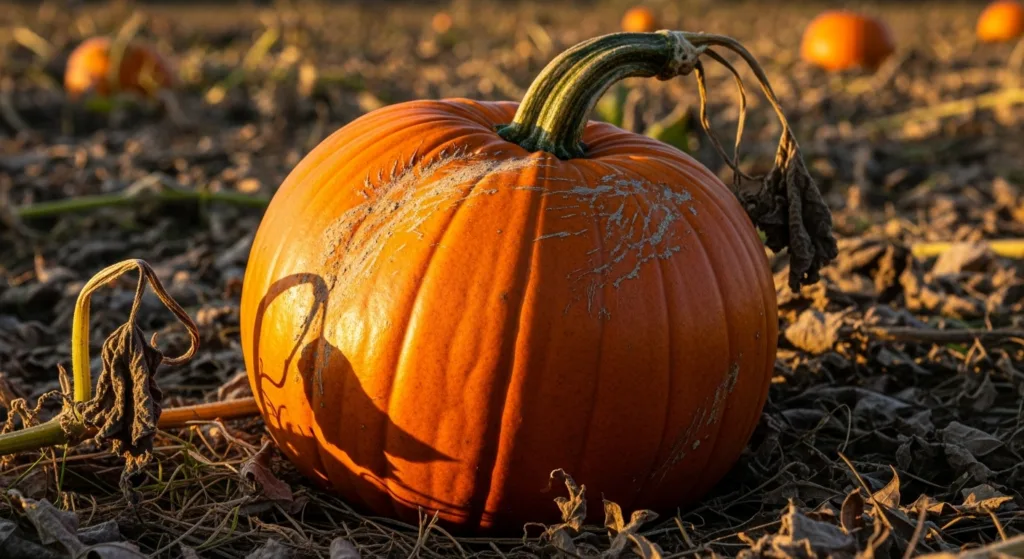
Pumpkins are big, bright and surprisingly clever plants. They grow on long vines, they need bees to make fruit, and a few of them grow heavier than a small car.
This guide explains what a pumpkin really is, how one grows from a flat seed, where most pumpkins are farmed, and why people carve them at Halloween. Every number comes from a farming university, a government office or Guinness World Records.
| Pumpkins at a glance | |
|---|---|
| Plant group | Cucurbita, the squash and gourd family |
| Fruit or vegetable? | A fruit: a hard-skinned berry called a pepo |
| Seed to harvest | About 90 to 120 days |
| Pollinated by | Squash bees, bumble bees and honey bees |
| Top US state (2024) | Illinois, about 220,000 tonnes |
| Heaviest ever (2025) | 1,278.8 kg (2,819 lb 4 oz), grown in the UK |
Is a pumpkin a fruit or a vegetable?
A pumpkin is a fruit. Clemson University explains that scientists call anything that grows from a flower and holds seeds a fruit. A pumpkin starts as a flower and is packed with seeds, so it passes the test.
Texas A&M AgriLife points out that tomatoes and cucumbers are fruits for the same reason. They are all fruits that we happen to cook like vegetables.
Clemson goes one step further. A pumpkin is a special kind of berry called a pepo, which is a berry with a hard outer rind. Cucumbers and melons are pepos too.
In the kitchen and at the shops, though, pumpkins are usually sold and cooked as vegetables. Both ideas are fine. One is about how the plant grows, and the other is about how we eat it.
The pumpkin family and its cousins
Pumpkins belong to a group of plants called Cucurbita. The University of Illinois Extension lists four main species that give us pumpkins, squashes and gourds.
The first is Cucurbita pepo. It includes the classic Halloween pumpkin, courgettes, acorn squash, spaghetti squash, mini pumpkins and small decorative gourds. Because they are one species, these plants can cross-pollinate with each other in a garden.
The second is Cucurbita maxima. This species includes the giant pumpkins, such as Atlantic Giant and Big Max, that win prizes at shows.
The third is Cucurbita moschata. Illinois Extension says most pumpkins grown for tins of pie filling belong to this species. The fourth is Cucurbita mixta, which includes some white and blue-green pumpkins.
Plants from different species cannot cross-pollinate with each other. A courgette flower cannot fertilise a giant pumpkin, however close together they grow.
Not every pumpkin is orange
Most people picture a round orange pumpkin. But Illinois Extension notes that some pumpkins are white, blue or blue-green when they are ripe.
The orange colour in most pumpkins comes from a pigment called beta-carotene. The same pigment makes carrots orange. Pumpkins can also be striped, warty, flat or tall, depending on the variety.
Farmers grow many kinds for different jobs. Some are small and sweet for cooking. Some are smooth and even for carving. Others are grown only to be as heavy as possible.
How a pumpkin grows from a seed
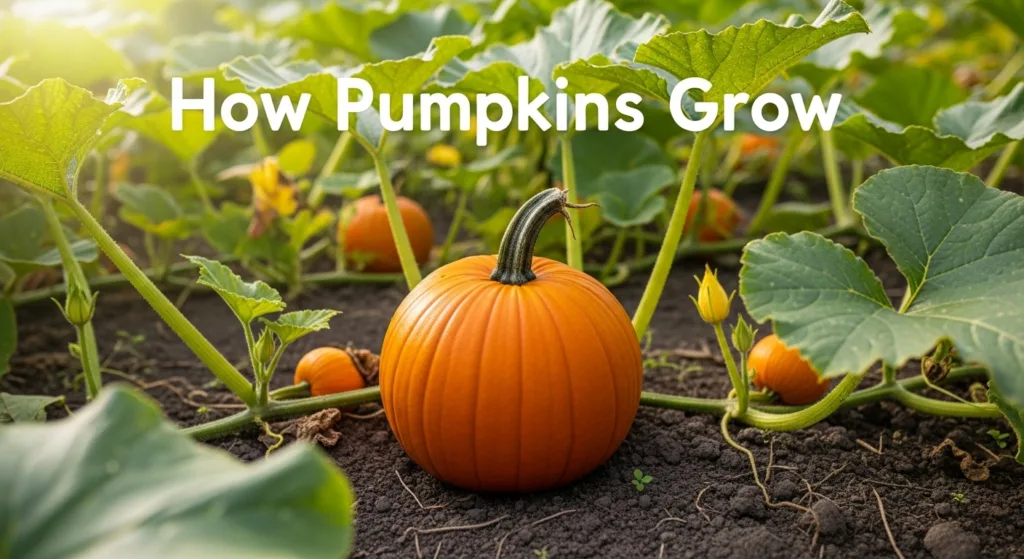
A pumpkin starts as a flat, pale seed. Illinois Extension says pumpkin seeds will not sprout in cold ground. Farmers wait until the frosts are over and the soil has warmed to about 14 to 16°C (58 to 60°F).
The seeds are pushed about 2.5 cm (1 inch) into the soil. Within about a week or two, a pair of seed leaves pokes up. Then the true leaves and the long, creeping vines follow.
Pumpkin plants need plenty of room. Illinois Extension suggests about 4.5 to 9 square metres (50 to 100 square feet) for each group of vining plants. The vines spread across the ground, and the big leaves shade out weeds.
Clemson University and History.com both say pumpkins take about 90 to 120 days to go from seed to harvest. That is why farmers who want pumpkins for Halloween usually plant in late May or June.
Timing matters. Illinois Extension warns that pumpkins planted too early may go soft and rot before the end of October.
Male flowers, female flowers and bees
One pumpkin plant grows two kinds of flower. The University of Florida IFAS Extension explains that there are male flowers and female flowers on the same vine.
Illinois Extension says the first flowers to open are almost always male. A female flower is easy to spot, because it has a tiny baby pumpkin at its base. That little pumpkin will only grow if the flower is pollinated.
Pumpkin flowers are open for a very short time. The University of Florida says they open in the early morning and close by about noon. A male flower opens for just one day and then drops off.
Bees do the important work. They carry pollen from the male flowers to the female flowers. Wild squash bees feed almost only on pumpkin and squash flowers, and the University of Florida calls them excellent pollinators.
Bumble bees and honey bees help too. Some farmers even bring in beehives. University of Florida research found that five visits from male squash bees gave much bigger pumpkins than a single visit.
How farmers know a pumpkin is ripe
A ripe pumpkin has a deep, even colour. Illinois Extension gives a simple test: press the skin with a fingernail. If the rind is too hard to dent, the pumpkin is ready.
Farmers cut pumpkins from the vine with about 7.5 to 10 cm (3 to 4 inches) of stem left on. Carrying a pumpkin by its stem is a bad idea, because the stem can snap off.
After harvest, pumpkins keep best somewhere dry and cool, at about 10 to 13°C (50 to 55°F). Kept like that, a sound pumpkin can last for weeks.
Growers also watch for problems. Illinois Extension lists powdery mildew, cucumber beetles and squash bugs as common troubles in pumpkin fields.
Where pumpkins are grown
The USDA Economic Research Service keeps track of pumpkins in the United States. In 2024, American farmers grew about 1.44 billion pounds of pumpkins. That is roughly 653,000 tonnes, harvested from about 27,900 hectares (68,900 acres).
Illinois grew far more than any other state. In 2024 it produced about 485 million pounds, or roughly 220,000 tonnes. After Illinois came Indiana, California, Michigan and Pennsylvania.
Illinois Extension says the state has big pumpkin-canning factories in the towns of Morton and Princeville. Much of the tinned pumpkin in American shops starts life there.
Most American pumpkins are not tinned, though. The USDA says about 85 out of every 100 acres are grown as fresh and decorative pumpkins, the kind sold for carving and autumn displays. In 2024, the whole crop was worth about $274 million.
Why pumpkin is good to eat
Clemson University says pumpkins are a good source of potassium, fibre and vitamin A. Texas A&M AgriLife adds that pumpkin also gives you vitamin C.
The orange flesh is full of beta-carotene. Illinois Extension explains that your body turns beta-carotene into vitamin A. Vitamin A helps your eyes work well in dim light.
Pumpkin flesh is mostly water. Texas A&M AgriLife suggests bakers can swap pumpkin purée for some of the oil or butter in a recipe, which makes cakes and muffins lighter.
People eat pumpkin in pies, soups, stews and breads. Clemson notes that the seeds are roasted as a snack and that pumpkins are even fed to farm animals.
Pumpkins in history
Pumpkins are native to the Americas. History.com says people in North America grew pumpkins for thousands of years, even before they grew beans and corn. You can read more about the first peoples of the continent in our guide to Native Americans.
The University of Florida notes that Cucurbita plants are native to North America. They have lived alongside the wild squash bees there for a very long time.
Pumpkins are also linked with Thanksgiving. Pumpkin pie is now a Thanksgiving favourite. But Plimoth Patuxet Museums says there was no pumpkin pie at the 1621 harvest meal, because the colonists had no butter and wheat flour to make pastry.
Where jack-o’-lanterns came from
The first jack-o’-lanterns were not pumpkins at all. History.com explains that people in Ireland and Scotland carved scary faces into turnips. In England, people carved large beets.
The name comes from an Irish folk tale about a man called Stingy Jack. In the story, Jack tricked the Devil and was left to wander the Earth with a burning coal inside a hollow turnip. History.com says the tale first appeared in print in the 1800s.
When Irish families moved to America, they found pumpkins growing there. Pumpkins were bigger and far easier to carve than turnips, so they became the new lanterns. Over time, “Jack of the Lantern” became “jack-o’-lantern”.
Today carved pumpkins are one of the best-known signs of Halloween. Our guide to the history of Halloween tells the rest of the story.
Record-breaking pumpkins
Giant pumpkins are grown for competitions around the world. According to Guinness World Records, the heaviest pumpkin ever weighed 1,278.8 kilograms (2,819 lb 4 oz).
It was grown by twin brothers Ian and Stuart Paton and weighed at Wargrave in Berkshire, England, on 6 October 2025. The pumpkin was nicknamed Muggle. Guinness says it was also the widest pumpkin ever, measuring 649.8 cm (255.8 inches) around.
Before that, the record belonged to Travis Gienger from Minnesota, USA. His pumpkin weighed 1,246.9 kg (2,749 lb) in October 2023. Guinness says it grew for 184 days and could have made more than 1,600 pies.
Pies can be giant too. The largest pumpkin pie weighed 1,678 kilograms (3,699 lb). Guinness says it was made by the New Bremen Giant Pumpkin Growers in Ohio, USA, on 25 September 2010.
Painting and carving pumpkins safely
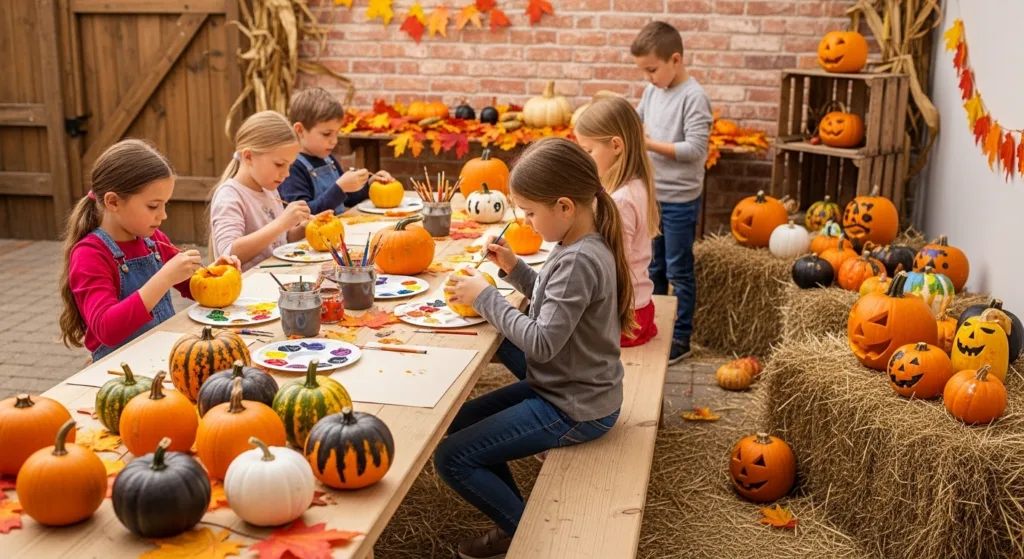
Decorating pumpkins is a favourite autumn activity. But carving knives are sharp. The US Consumer Product Safety Commission said in 2023 that about 3,200 people a year go to hospital with Halloween injuries, and more than half come from pumpkin carving.
The safest plan is to share the jobs. The commission advises that adults should do the cutting. Children can draw the face with a marker and scoop out the seeds with a big spoon.
Painting is a great alternative to carving. A painted pumpkin needs no knife at all, and it lasts longer because the skin is not cut open.
Light matters too. The commission says battery lights or glow sticks are safer than candles inside a jack-o’-lantern. If a candle is used, keep it away from curtains and decorations and never leave it burning alone.
Pumpkin projects to try
You can grow a pumpkin in a large pot or a sunny corner of a garden. Plant the seed once the soil is warm, water it well and watch for the first yellow flowers. See whether you can spot a female flower with its tiny pumpkin.
You can also save seeds from a pumpkin you have bought. Wash them, let them dry, and ask an adult to help you roast them for a crunchy snack.
Three things people get wrong
“Pumpkins are vegetables.” To a scientist they are fruits. Clemson University says a pumpkin is a kind of berry called a pepo, because it grows from a flower and holds seeds.
“The first jack-o’-lanterns were pumpkins.” They were carved turnips in Ireland and Scotland, and beets in England. History.com says pumpkins took over only after Irish families reached America.
“A pumpkin plant can make fruit on its own.” It cannot. Illinois Extension explains that bees must carry pollen from the male flowers to the female flowers, or no pumpkin grows.
Did you know? The record-breaking pumpkin weighed in 2025 was nicknamed Muggle, and it measured 649.8 cm (255.8 inches) around its middle.
Try it
Save the seeds from a pumpkin, count them and guess first. How close was your guess? Then ask an adult to help you roast them.
Knowledge check
Why is a pumpkin called a fruit?
Show answer
Because it grows from a flower and holds seeds.
What were the first jack-o’-lanterns made from?
Show answer
Turnips in Ireland and Scotland, and beets in England.
Frequently asked questions
Is a pumpkin a fruit or a vegetable?
A pumpkin is a fruit to scientists, because it grows from a flower and contains seeds. Cooks usually treat pumpkins as vegetables in meals.
How long does a pumpkin take to grow?
Pumpkins usually take about 90 to 120 days to grow from seed to harvest, so Halloween pumpkins are planted in late May or June.
Why do pumpkins need bees?
Pumpkin plants have separate male and female flowers. Bees carry pollen from male flowers to female flowers, and only pollinated female flowers grow into pumpkins.
What is the heaviest pumpkin ever grown?
Guinness World Records says the heaviest pumpkin weighed 1,278.8 kg (2,819 lb 4 oz). Twins Ian and Stuart Paton grew it in the UK in 2025.
Where are most pumpkins grown in the USA?
Illinois grows the most pumpkins in the USA. In 2024 the state produced about 220,000 tonnes, followed by Indiana, California, Michigan and Pennsylvania.
Why do people carve pumpkins at Halloween?
Carving comes from an Irish tale about Stingy Jack. People carved turnips first, then Irish families in America switched to pumpkins because they were easier to carve.
Sources
- Guinness World Records: heaviest pumpkin — the 2025 Paton record and earlier records; its largest pumpkin pie page was also used
- University of Illinois Extension: growing pumpkins — planting, flowers, harvest and storage; its pumpkins page and plant profile were also used
- Clemson University: pumpkins, fruit or veggie? — why pumpkins are fruits, pepos, nutrition and growing time
- University of Florida IFAS Extension: squash bees — pumpkin flowers and the bees that pollinate them
- USDA Economic Research Service: pumpkins background statistics — 2024 US production, top states and value
- History.com: the Irish origins of the jack-o’-lantern — Stingy Jack, turnips and Irish immigrants; its pumpkin facts page was also used