St Michael is one of the archangels, a chief angel in the Bible and the Qur’an. His name means “Who is like God?”. He is seen as a protector and the leader of heaven’s armies, and in the Book of Revelation he defeats a dragon. His feast day in Western churches, Michaelmas, is on 29 September.
St Michael quick facts
- The name Michael means “Who is like God?” in Hebrew.
- Michael appears in the Books of Daniel and Revelation and in the Letter of Jude.
- He is usually shown in art with a sword, fighting or standing over a dragon.
- Michaelmas, his feast in Western churches, is on 29 September.
- Most Eastern Orthodox churches honour St Michael and the angels on 8 November.
Who is St Michael?
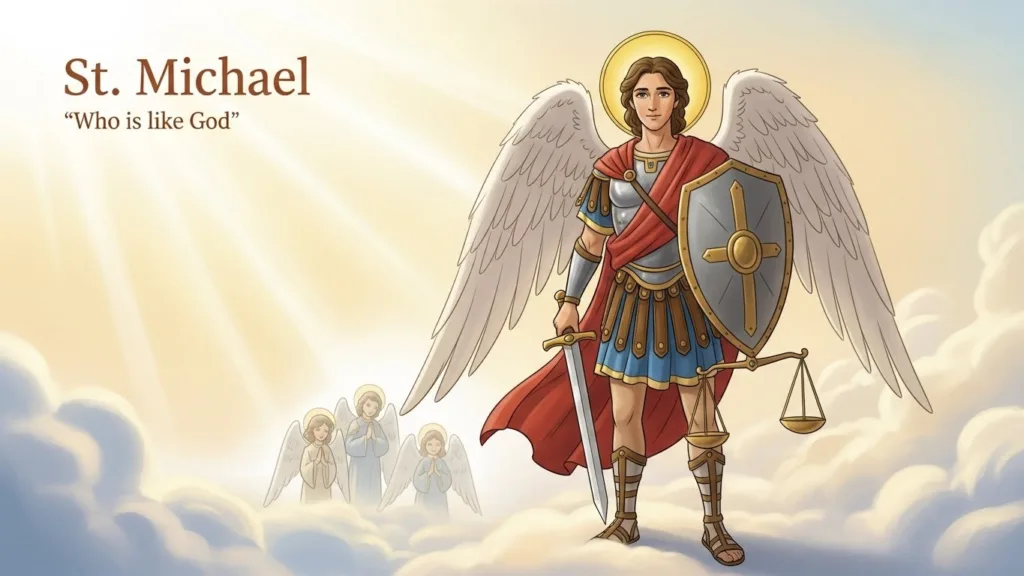
St Michael is one of the archangels, the most important angels in the Bible. He is known as a protector and a warrior, and as the leader of the armies of heaven.
His name comes from Hebrew and means “Who is like God?” It is a question, and the answer it expects is “No one”. So the name itself is a way of saying how great God is.
Michael appears in the Bible and in the Qur’an, where he is called Mīkāl. So he matters to Jews, Christians and Muslims, although most of the traditions in this guide come from Christianity.
What is an archangel?
The word angel comes from a Greek word meaning messenger. In the Bible, angels are God’s messengers and helpers.
The word arch means chief, so an archangel is a chief angel. In the Bible, Michael is the only angel actually given the title “the archangel”. It appears in the Letter of Jude.
Christians also honour two other named archangels, Gabriel and Raphael. Gabriel is the angel who, in Luke’s Gospel, tells Mary that she will have a son called Jesus. Angels appear many times in the Bible, but very few are given names.
Michael in the Bible
Michael is only mentioned by name a few times in the Bible, but each time he is doing something important.
The Book of Daniel. In Daniel, Michael is called “one of the chief princes”. He comes to help when another angel is held up for 21 days by a powerful enemy. Later in the same book he is called “the great prince” who protects God’s people in a time of great trouble.
The Letter of Jude. In this short letter, Michael the archangel argues with the Devil about the body of Moses. He does not insult the Devil himself. Instead, he leaves the judgement to God.
The Book of Revelation. This is Michael’s most famous scene. War breaks out in heaven. Michael and his angels fight against a great dragon and its angels. The dragon loses, and it is thrown down out of heaven. In Revelation, the dragon stands for the Devil.
The great captain
Because of these stories, Michael has often been described as the “great captain”, the leader of the heavenly hosts. Hosts is an old word for armies. According to some ancient traditions, Michael even knows the secret word that God spoke to create heaven and earth.
In the Old Testament he is shown as a warrior who helps the people of Israel. Early in the history of the Christian church, he also came to be seen as a helper of the church, and as its defender against the Devil.
Honouring St Michael began in the Eastern Church in the 4th century, and by the 5th century it had spread to Western Christianity. In 1886, Pope Leo XIII introduced a special prayer to St Michael, which many Catholics still say today.
How to spot St Michael in a picture
St Michael is one of the easiest saints to recognise in paintings, statues and stained-glass windows, once you know what to look for.
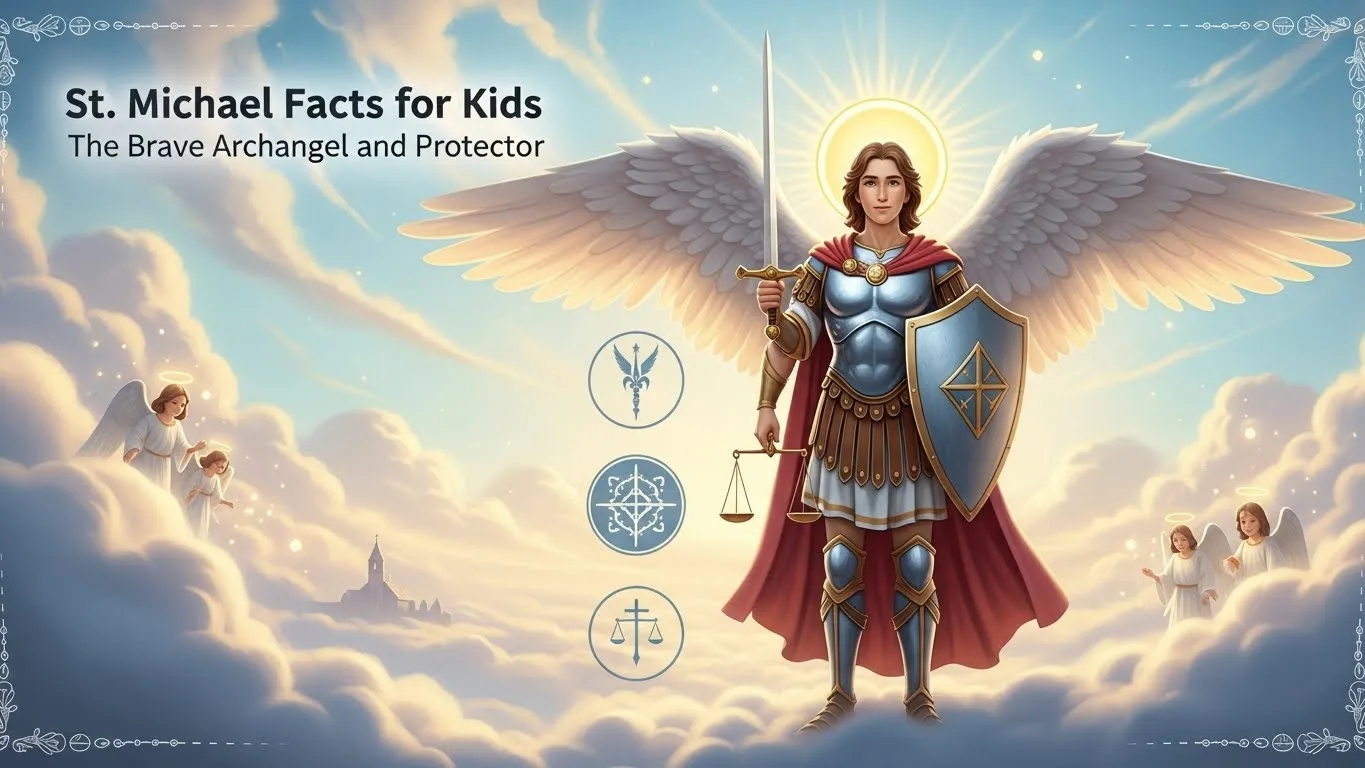
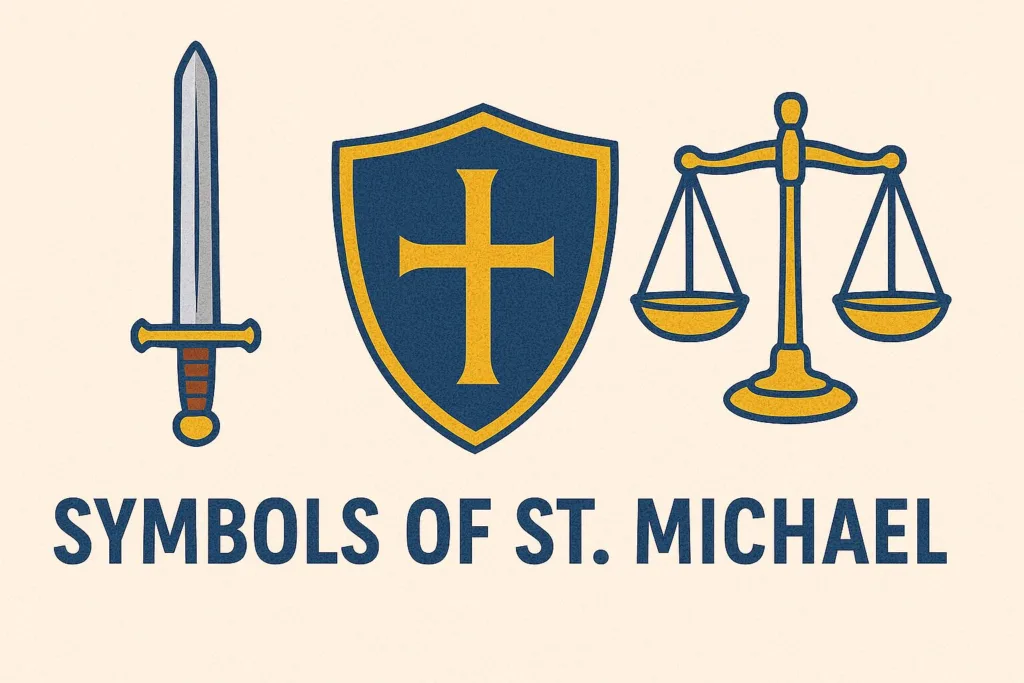
He is almost always shown as a warrior. He usually has wings, like other angels, and he often wears armour. He carries a sword, or sometimes a spear.
Very often he is shown fighting a dragon, or standing in triumph over one. That comes straight from the story in the Book of Revelation.
Next time you visit a church or a museum, look out for an angel with a sword and a dragon. Artists have painted and carved him this way for hundreds of years, in wood, stone, glass and paint. The chances are that it is St Michael.
St Michael’s feast days
A feast day is a special day in the church calendar for remembering a saint. St Michael has more than one. His feast began long ago in Phrygia, an ancient region in what is now Turkey, and spread from there.
In the Western churches, his feast is on 29 September. It is known as Michaelmas. In the Roman Catholic Church it is now usually kept as the feast of three archangels, Michael, Gabriel and Raphael. In the Anglican Church it is called the feast of St Michael and All Angels.
Because Michael was seen as the leader of all the angels, his feast slowly became a day for honouring every angel. For a long time, Michaelmas was also a Holy Day of Obligation, a day when Catholics had to go to church. That rule was gradually dropped.
The celebrations can be lively. In Turmi, in southern Ethiopia, members of the Ethiopian Orthodox Tewahedo Church mark the feast of St Michael with music, and children join in with drums.
Most Eastern Orthodox churches honour St Michael and the other angels on 8 November instead. The Ethiopian Orthodox Tewahedo Church honours him on the 12th day of every month.
There is one more date. On 8 May, the Roman Catholic Church remembers an appearance of St Michael on Mount Gargano, in southern Italy. According to legend, it happened in about 492. A sanctuary was built there, and the mountain became an important place of pilgrimage in the Middle Ages.
| Date | Who keeps it | What it is called |
|---|---|---|
| 29 September | Western churches | Michaelmas |
| 8 November | most Eastern Orthodox churches | St Michael and the angels |
| 12th of each month | Ethiopian Orthodox Tewahedo Church | a monthly feast of St Michael |
| 8 May | Roman Catholic Church | the Appearing of St Michael |
Michaelmas traditions
In the Middle Ages, Michaelmas was a great religious feast. It fell at harvest time in much of western Europe, so many popular customs grew up around it.
In England, people ate goose on Michaelmas. It was supposed to protect them from being short of money in the year ahead.
In Ireland, a ring was sometimes hidden inside a Michaelmas pie. Whoever found it was said to be getting married soon.
Michaelmas is one of several festivals in the Christian year with old customs attached. Others include Christmas and All Hallows’ Eve, which you can read about in our Halloween history for kids.
What St Michael means to Christians
For many Christians, St Michael is a reminder that good is stronger than evil. In the story in Revelation, the dragon is defeated and thrown out of heaven.
He is also a picture of courage. Michael stands up for God’s people and protects them when they are in danger. Many Christians pray to him for protection.
And the story in Jude shows another side of him, one that is easy to miss. Even when he argues with the Devil, he does not trade insults. He trusts God to judge.
Many churches around the world are named after St Michael, and so are many schools. Perhaps there is one near where you live. If there is, see whether you can spot a picture of him with his sword and dragon.
Three things people get wrong
Michael is not only a Christian figure. He appears in the Hebrew Bible, in the Book of Daniel, and in the Qur’an, where he is called Mīkāl.
Michaelmas is not St Michael’s only feast day. Eastern Orthodox churches honour him on 8 November, and the Roman Catholic Church also remembers him on 8 May.
The dragon in pictures of St Michael is not a real animal. It comes from the Book of Revelation, where the dragon stands for the Devil.
Did you know? In England it was once the custom to eat goose on Michaelmas, which was supposed to protect you from running short of money in the year ahead.
Try it
Look at pictures of St Michael in a book, a church or online with an adult. Count how many show a sword, a dragon, wings and armour.
Knowledge check
What does the word archangel mean?
Show answer
A chief angel. Arch means chief, and angel comes from a Greek word meaning messenger.
What happens to the dragon in the Book of Revelation?
Show answer
Michael and his angels defeat it, and it is thrown down out of heaven.
Frequently asked questions
Who is St Michael?
St Michael is one of the archangels, the chief angels in the Bible. He is seen as a protector, a warrior and the leader of the armies of heaven, and he also appears in the Qur’an as Mīkāl.
What does the name Michael mean?
The name Michael comes from Hebrew and means “Who is like God?”. The question expects the answer “No one”, so the name praises the greatness of God.
Where is St Michael in the Bible?
St Michael is named in the Book of Daniel, where he is called a chief prince and the great prince, in the Letter of Jude, where he is called the archangel, and in the Book of Revelation.
When is St Michael’s feast day?
In Western churches, St Michael’s feast day is 29 September, known as Michaelmas. Most Eastern Orthodox churches honour him on 8 November, and the Roman Catholic Church also remembers him on 8 May.
Why is St Michael shown with a dragon?
St Michael is shown with a dragon because of the Book of Revelation, where he and his angels fight a great dragon and throw it out of heaven. The dragon stands for the Devil.
What is Michaelmas?
Michaelmas is the Christian feast of St Michael, kept on 29 September in Western churches. In the Middle Ages it fell at harvest time, and customs included eating goose in England.
Sources
- Encyclopaedia Britannica: Michael, archangel — Michael in the Bible and the Qur’an, his role, his image in art and his feast days
- Encyclopaedia Britannica: Michaelmas — the feast on 29 September, its names in different churches, its history and old customs
- Bible Gateway: Daniel 10:13, Daniel 12:1, Jude 1:9 and Revelation 12:7–9 — the passages in which Michael is named