
A rainforest is a forest of tall, mostly evergreen trees that gets lots of rain. Tropical rainforests are hot and wet and grow near the equator. Temperate rainforests are cooler. Rainforests cover only 2 to 6 per cent of the Earth, but more than half of all plant and animal species live in them.
rainforests quick facts
- Rainforests have four layers: emergent, canopy, understorey and forest floor.
- The tallest rainforest trees can be 60 metres high.
- A tropical rainforest gets about 180 to 250 cm of rain a year.
- A tropical rainforest can make up to three quarters of its own rain.
- Rainforests grow on every continent except Antarctica.
What is a rainforest?
A rainforest is a forest of tall trees that gets lots and lots of rain. Most of its trees stay green all year round.
There are two kinds of rainforest. Tropical rainforests are hot and wet. Temperate rainforests are cooler, but they are still very wet.
Rainforests cover only a small part of our planet, just 2 to 6 per cent of the land. But more than half of all the kinds of plants and animals in the world live in them. That makes them some of the busiest places on Earth.
Tropical rainforests
Tropical rainforests grow near the equator. The equator is an imaginary line around the middle of the Earth.
It is warm there all year. In a tropical rainforest, the temperature is usually between 18°C and 30°C. There is no cold winter.
It rains a lot, too. A tropical rainforest gets about 180 to 250 cm of rain in a year. That is taller than most grown-ups!
Here is an amazing fact. A tropical rainforest makes a lot of its own rain. Water goes up from the leaves into the air, forms clouds and falls again. Up to three quarters of the rain in a tropical rainforest can come from the forest itself.
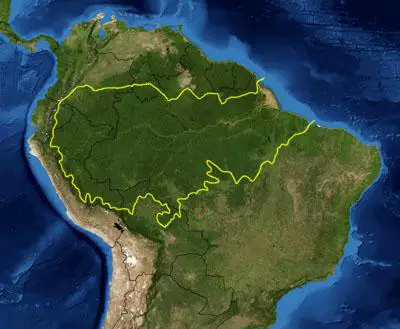
The biggest tropical rainforest is the Amazon rainforest in South America. You can find out lots more about it in our Amazon rainforest facts for kids. There are big rainforests in Africa and Asia too.
Temperate rainforests
Temperate rainforests grow further away from the equator, where it is cooler. They are not as sunny as tropical rainforests. They still get at least 140 cm of rain every year.
One of the biggest is the Tongass National Forest in Alaska, in the United States. It is the largest forest owned by the public in the whole country.
Its tallest trees are western hemlocks and Sitka spruces. Under them grow blueberries, ferns and mosses. Bears, deer, wolves, otters and bald eagles all live there.
Rainforests grow on every continent except Antarctica, which is far too cold.
Two kinds of rainforest
- Tropical rainforest — hot and wet, near the equator
- Temperate rainforest — cooler, but still very wet
- The Amazon — the biggest tropical rainforest, in South America
- The Tongass — a big temperate rainforest in Alaska
- Antarctica — the one continent with no rainforest
Rainforest plants
Rainforest plants have clever ways to live in such a wet, crowded place.
Some plants climb. Long vines wind up the tree trunks to reach the sunlight at the top.
Some plants grow high up on the branches of trees, instead of in the ground. They catch rain and bits of fallen leaves to help them grow.
Many rainforest leaves are big and shiny, with a pointed tip. The point helps rainwater run off quickly, so the leaf dries out.
The layers of a rainforest

A rainforest is like a tall building with floors. Scientists split it into four layers, from the top to the bottom.
The emergent layer is at the very top. A few giant trees poke up above all the others. Some are as tall as 60 metres. That is about as tall as 35 grown-ups standing on each other’s heads!
The canopy comes next. It is like a thick green roof of leaves and branches, about 6 metres deep. Lots of animals live up here, where there is plenty of light and food.
The understorey is below the canopy. It is darker and stiller down here, because the canopy blocks much of the sunlight.
The forest floor is at the bottom. It is the darkest layer of all. Fallen leaves and fruit land here and slowly rot away.
| Layer | What it is like |
|---|---|
| Emergent | the tops of the tallest trees, up to 60 m high |
| Canopy | a thick roof of leaves about 6 m deep |
| Understorey | darker and stiller, under the canopy |
| Forest floor | the darkest layer, covered in fallen leaves |
Rainforest animals

So many animals live in rainforests that scientists are still finding new ones.
Monkeys swing through the canopy. Colourful birds fly between the trees. Frogs, snakes and lizards hide among the leaves. Sloths hang upside down from branches and move very, very slowly. On the forest floor, beetles and ants tidy up by eating fallen leaves and fruit. Nothing goes to waste in a rainforest.
Each animal has its own place to live and its own food to eat. Together, all the plants and animals make up an ecosystem, where every living thing depends on others.
Can you think of an animal that lives in each layer? A bird might live at the top. A frog might live near the bottom.
A day in a tropical rainforest
Imagine you are standing on the forest floor, early in the morning. The air is warm and damp, and mist hangs between the trees.
High above you, birds are calling and monkeys are waking up. Insects hum all around.
As the day gets hotter, the forest goes quiet. Then, in the afternoon, dark clouds gather and the rain pours down. Drip, drip, drip goes the water from leaf to leaf.
When night comes, new animals wake up. Frogs croak, and bats flutter out to find food. The rainforest is never really asleep. There is always something awake, somewhere.
A day in the rainforest
- Early morning The air is warm and damp, and mist hangs between the trees.
- Just after Birds call, monkeys wake up and insects hum all around.
- Midday The forest goes quiet as the day gets hotter.
- Afternoon Dark clouds gather and the rain pours down.
- Night Frogs croak and bats flutter out to find food.
People in the rainforest

People live in rainforests too. Some families have lived there for a very long time. They know which plants are good to eat and which can be used as medicine.
Rainforests help people all over the world, even if we live far away. Many of the foods we enjoy first came from rainforests, like bananas, chocolate and some kinds of nuts.
Rainforest trees also take in carbon dioxide from the air and give out oxygen, the gas we need to breathe.
Why rainforests are in danger
Rainforests are being cut down. Some trees are cut for wood. Other forest is cleared to make room for farms, cattle and crops.
When a rainforest is cut down, the animals lose their homes. Some kinds of plants and animals might disappear for ever.
Scientists at National Geographic say that farming and building have badly damaged many rainforests. But people all over the world are working to protect them.
Living things in the rainforest
- Vines — climb up tree trunks to reach the sunlight
- Big shiny leaves — have a pointed tip so rain runs off quickly
- Sloths — hang upside down and move very slowly
- Monkeys — swing through the canopy
- Beetles and ants — eat fallen leaves on the forest floor
How you can help rainforests

You are never too young to help. Here are some things you can do.
Look for the green frog. Some chocolate, tea and coffee has a little green frog on the packet. It is the seal of the Rainforest Alliance. It means the food was grown by farmers and companies who try to look after people and nature.
Save paper. Paper is made from trees. Use both sides of the paper, and recycle it when you have finished.
Learn and share. Find out about a rainforest animal and tell your family and friends about it. The more people care, the more rainforests will be protected. You could make a poster, write a story or draw a picture of your favourite rainforest animal.
Plant something. Planting a tree or a flower is a small way to help nature where you live. Bees, birds and butterflies will thank you for it!
Rainforest words to know
Canopy means the roof of leaves and branches at the top of the forest.
Equator means the imaginary line around the middle of the Earth, where it is hot all year.
Species means one kind of plant or animal. A toucan is one species, and a tree frog is another.
Three things people get wrong
Not all rainforests are hot. Temperate rainforests, like the Tongass in Alaska, are cool but very wet.
Rainforests do not cover most of the Earth. They cover only 2 to 6 per cent of it, but more than half of all plant and animal species live there.
It does not rain in a rainforest just because clouds blow in. A tropical rainforest makes up to three quarters of its own rain.
Did you know? A tropical rainforest can make up to three quarters of its own rain. Water rises from the leaves, forms clouds and falls again.
Rainforests: fact or myth?
- Rainforest trees take in carbon dioxide and give out oxygen.
- The forest floor is the sunniest layer of the rainforest.
- Bananas and chocolate first came from rainforests.
- Nobody lives in a rainforest.
- Scientists are still finding new rainforest animals.
Try it
Draw a tall rainforest tree and split it into four layers. Draw an animal that might live in each layer, from a bird at the top to a beetle on the forest floor.
Knowledge check
What are the four layers of a rainforest?
Show answer
Emergent, canopy, understorey and forest floor.
What does the green frog on a packet mean?
Show answer
It is the Rainforest Alliance seal, showing the food was grown by people trying to look after people and nature.
Frequently asked questions
What is a rainforest?
A rainforest is a forest of tall, mostly evergreen trees that gets a lot of rain every year. There are tropical rainforests, which are hot, and temperate rainforests, which are cooler.
What are the layers of the rainforest?
A rainforest has four layers. From the top down, they are the emergent layer, the canopy, the understorey and the forest floor, which is the darkest layer.
Where are rainforests found?
Tropical rainforests grow near the equator, in places like South America, Africa and Asia. Temperate rainforests grow in cooler places, such as the Tongass in Alaska. There are none in Antarctica.
How much rain does a rainforest get?
A tropical rainforest gets about 180 to 250 cm of rain a year. A temperate rainforest gets at least 140 cm of rain a year.
Why are rainforests important?
Rainforests are home to more than half of all plant and animal species. They take in carbon dioxide and give out oxygen, and many foods first came from them.
How can children help rainforests?
Children can help rainforests by saving and recycling paper, looking for the Rainforest Alliance green frog seal on food, planting something, and learning about rainforest animals.
Sources
- National Geographic Education: rain forest — what a rainforest is, how much of the Earth it covers, rainfall, temperatures, the four layers and threats
- Encyclopaedia Britannica: Tongass National Forest — the temperate rainforest in south-eastern Alaska, its trees and wildlife
- Rainforest Alliance: find certified products — what the green frog seal means
Rainforest Final Challenge
- What is the equator?
- How tall can the tallest rainforest trees be?
- How much of the Earth do rainforests cover?
- What does the word species mean?
- Where does a lot of the rain in a tropical rainforest come from?
- Why are rainforests being cut down?
- How can saving paper help rainforests?
- What is one thing you could do to help nature where you live?