Tree kangaroos are kangaroos that live in rainforest trees in New Guinea and far north-east Queensland, Australia. They have strong front legs, curved claws and long tails for balance, and can leap about 9 m between trees. They mostly eat leaves. There are about 10 to 14 species, and half of them are Endangered or Critically Endangered.
tree kangaroos quick facts
- Tree kangaroos live in rainforests in New Guinea and north-east Australia.
- Their scientific name, Dendrolagus, means tree hare.
- They can leap about 9 m between trees.
- A newborn joey is the size of a jelly bean.
- Only two tree kangaroo species live in Australia.
What is a tree kangaroo?
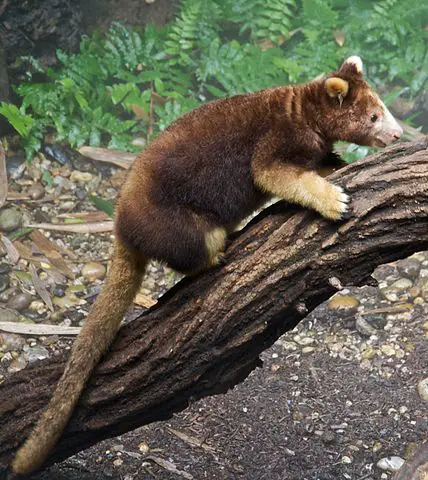
A tree kangaroo is a kangaroo that lives in trees. Instead of hopping across open grassland, it climbs and leaps through the branches of tropical rainforests.
San Diego Zoo Wildlife Alliance’s library says their scientific name, Dendrolagus, means “tree hare”. Tree kangaroos came from ground-living kangaroos, and later went back to living in the trees.
The Australian Museum says tree kangaroos are the largest tree-living animals in both Australia and New Guinea, weighing up to 17 kg. Meet their ground-living cousins in our kangaroo facts.
| Tree kangaroo at a glance | |
|---|---|
| Where | New Guinea and north-east Queensland, Australia |
| Species | about 10 to 14, and scientists are still counting |
| Weight | up to about 17 kg |
| Food | mostly leaves, plus fruit, flowers and ferns |
| Joeys | one at a time, born the size of a jelly bean |
| Longest leap | about 9 m between trees |
| Status | half of all species Endangered or Critically Endangered |
A long history
Tree kangaroos have been around for millions of years. The library says tree kangaroos and rock-wallabies split from a shared ancestor about 7.5 million years ago, and rock-wallabies are still their closest relatives.
The oldest tree kangaroo fossils are teeth 4 to 4.7 million years old, found in New South Wales and Victoria in Australia, the library says. The Australian Museum says fossils show tree kangaroos once lived right across Australia.
Where do tree kangaroos live?
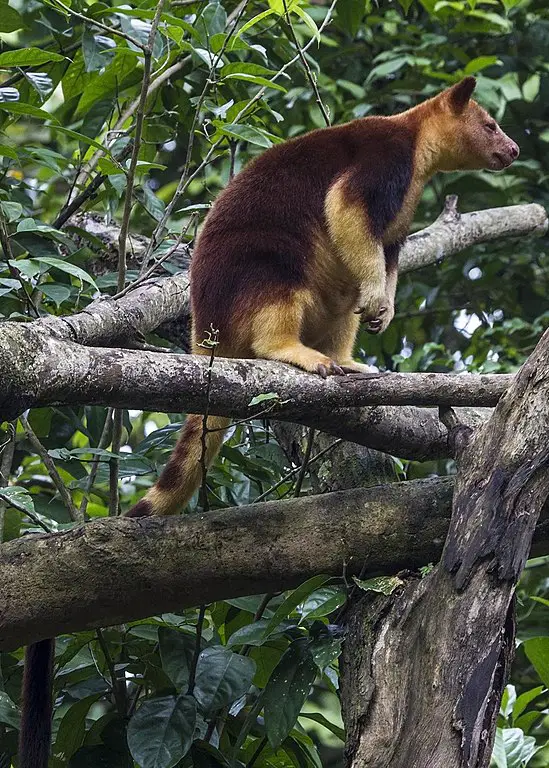
Tree kangaroos live in only three countries. Woodland Park Zoo, in Seattle, says they are found in Papua New Guinea, Indonesia (in the province of West Papua) and Australia.
Most species live on the island of New Guinea. The Australian Museum says only two live in Australia: Lumholtz’s tree-kangaroo and Bennett’s tree-kangaroo.
Both Australian species live only in the Wet Tropics of far north-east Queensland, one on each side of the Daintree River, the Australian Museum says. The Queensland Government describes Lumholtz’s tree-kangaroo as a mammal of the state’s tropical wet rainforest.
How many species are there? It is not simple. The Australian Museum says 10 species are recognised, but DNA studies have found 13 very different family lines. Woodland Park Zoo said in 2023 that there are 14 species. Scientists are still finding out.
Matschie’s tree kangaroo
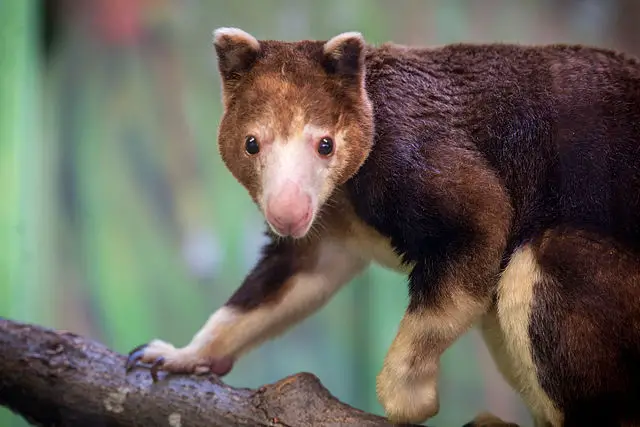
One of the best-studied species is Matschie’s tree kangaroo. The library says it lives only on the Huon Peninsula of Papua New Guinea, with small groups that people moved to nearby islands.
It lives high in the mountains, between about 1,000 and 3,300 m above sea level. Woodland Park Zoo’s Tree Kangaroo Conservation Program says it lives in cloud forests, mountain forests that are often wrapped in mist.
Animal Diversity Web, a University of Michigan project, says these forests have oak trees lower down and conifers higher up, with tree ferns and mosses growing everywhere.
A body built for climbing
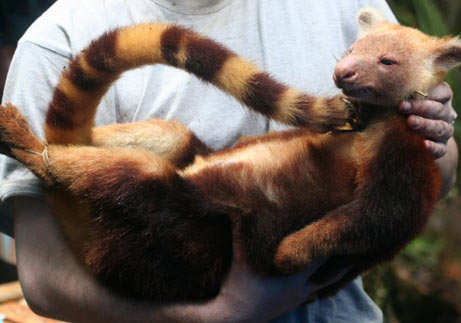
The library says a male Matschie’s tree kangaroo weighs 5.8 to 10 kg. Its body is about 61.5 to 66 cm long, and its tail adds another 55.5 to 62 cm.
Matschie’s tree kangaroos have beautiful chestnut to red-brown fur, with a yellow belly, feet and tail, Animal Diversity Web says. The library says each one has its own face pattern, often not the same on both sides.
Their bodies are made for climbing. The Australian Museum says tree kangaroos have short, broad feet and much stronger front legs than ground kangaroos. The library says their feet have big, grippy pads, and every toe has a strongly curved claw.
Their long tail is used for balance, Animal Diversity Web says, not for gripping branches like a monkey’s.
What do tree kangaroos eat?
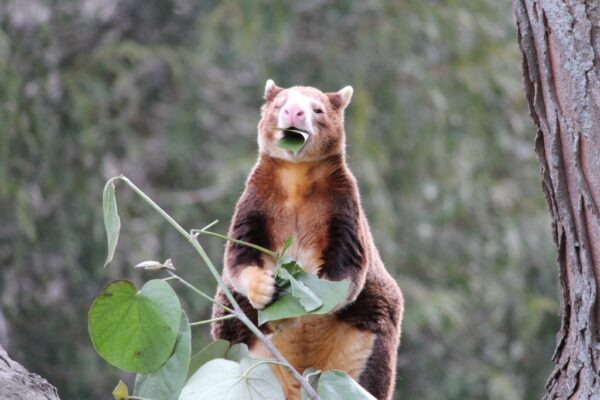
Matschie’s tree kangaroos mostly eat leaves, and they prefer older leaves, Animal Diversity Web says. They also eat wild fruit, flowers, nuts, insects, bark, sap and sometimes bird eggs.
They are not fussy. The library says a 1998 study found tree kangaroos in Papua New Guinea eating 160 different kinds of plant. They especially like ferns, and Matschie’s tree kangaroos eat the stems and young leaves of orchids that grow on trees.
Animal Diversity Web says a Matschie’s tree kangaroo feeds for 15 to 20 minutes about every four hours.
Leaping and walking
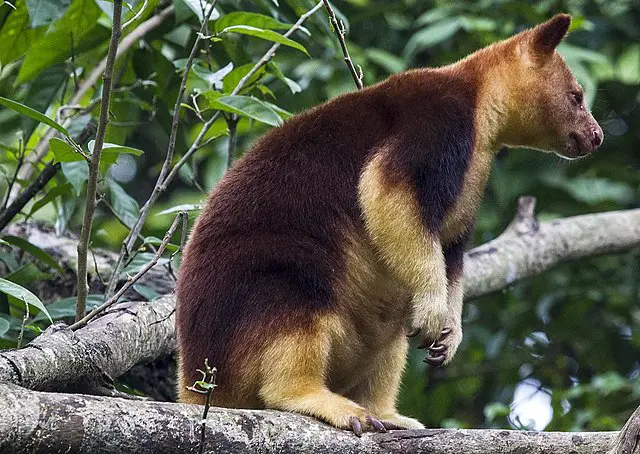
Tree kangaroos are amazing jumpers. Animal Diversity Web says they can leap as far as 9 m between trees, and jump down as far as 18 m to the ground without getting hurt.
Unlike ground kangaroos, they rarely hop. The library says Matschie’s tree kangaroos are good walkers, and the fastest one ever recorded reached 21 km/h.
They spend a lot of time resting. Animal Diversity Web says Matschie’s tree kangaroos sleep or rest for about 60% of the time.
Life in the treetops
Tree kangaroos usually live alone, the library says. Animal Diversity Web says each female keeps her own small area of forest, about 1.8 hectares, while males roam over larger areas that overlap.
The library says that in quiet forests they are active by day or at dawn and dusk, but where many people live, they become active at night instead.
They have their own warning signals. The library says a tree kangaroo clicks its tongue when it is angry or worried, and swishes its tail from side to side.
Tree kangaroo joeys
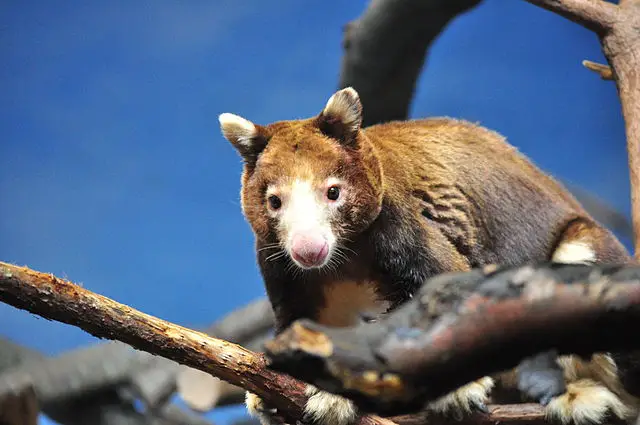
Like other kangaroos, tree kangaroos are marsupials, and the mother carries her baby, called a joey, in a pouch. The Tree Kangaroo Conservation Program says she is pregnant for only about 44 days.
A newborn joey is tiny. Woodland Park Zoo says it is the size of a jelly bean, and within one to two minutes it must crawl through its mother’s fur into her pouch to start feeding.
The joey stays fixed to its mother’s teat for about 100 days, the library says. It first peeks out of the pouch at about seven months, and leaves it for good at about ten months.
The Tree Kangaroo Conservation Program says young tree kangaroos become independent at about 18 months old. The oldest known tree kangaroo lived to 27 in a zoo.
Why tree kangaroos are in danger
Tree kangaroos face many threats. The library says they are hunted for food, and lose their forest homes to logging, farming, mining and climate change.
In Australia, Woodland Park Zoo says, they are also threatened by forests being split into pieces, and by being hit by cars or attacked by dogs.
Half of all tree kangaroo species are Endangered or Critically Endangered, Woodland Park Zoo says. The library says Matschie’s tree kangaroo is listed as Endangered, with fewer than 2,500 adults left in the wild.
Helping tree kangaroos
People are working hard to protect tree kangaroos. Woodland Park Zoo’s Tree Kangaroo Conservation Program began in 1996 to find out how Matschie’s tree kangaroos were doing in the wild.
The programme helped create the YUS Conservation Area, named after the Yopno, Uruwa and Som rivers. It says YUS was Papua New Guinea’s first nationally recognised Conservation Area, and the land stretches from coral reefs up to mountain peaks 4,000 m high.
Local people lead the work. The programme says more than 12,000 people live in 50 villages in YUS, and the conservation area is wholly owned by local people. Rangers chosen by their own communities patrol the forest for seven days each month.
Farmers in YUS also grow “YUS Conservation Coffee”, which helps families earn money while the forest stays protected. Another Australian tree-dweller is the koala; meet it in our koala facts.
More tree kangaroo facts
Tree kangaroos grow up slowly. The library says a joey stops drinking its mother’s milk at about 12 to 13 months old, and Animal Diversity Web says tree kangaroos are grown up and ready to breed at about two years old.
Scientists are still discovering new kinds. The Australian Museum says that since 1990, its scientists have described four new tree kangaroo species or subspecies.
Matschie’s tree kangaroo is not the only one in trouble. The library says Goodfellow’s tree kangaroo is also Endangered, after its numbers fell by at least half over three generations.
In Papua New Guinea, the forest belongs to local people. The Tree Kangaroo Conservation Program says more than 90% of the country’s land belongs to local families and clans. It says nearly 70% of the YUS landscape is one large, unbroken rainforest.
Mapping the forest helps protect it. The programme says its mapping team has mapped more than 45,000 hectares of YUS over ten years.
Sponsored link: custom pins.
Three things people get wrong
Not all kangaroos live on the ground. Tree kangaroos spend most of their time up in the rainforest trees.
Tree kangaroos are not mainly Australian. Most species live on the island of New Guinea.
Tree kangaroos do not hop much. Matschie’s tree kangaroos are good walkers and rarely hop.
Did you know? A tree kangaroo can jump down as far as 18 m from a tree to the ground without getting hurt.
Try it
Measure 9 m in a playground or garden with an adult. That is how far a tree kangaroo can leap between trees.
Knowledge check
What does a tree kangaroo use its tail for?
Show answer
Balance.
Where do most tree kangaroo species live?
Show answer
On the island of New Guinea.
Frequently asked questions
Where do tree kangaroos live?
They live in rainforests in Papua New Guinea, Indonesia’s West Papua province and far north-east Queensland in Australia.
What do tree kangaroos eat?
They mostly eat leaves, plus fruit, flowers, nuts, ferns, orchids, bark, sap and sometimes insects or bird eggs.
Can tree kangaroos hop?
They can, but Matschie’s tree kangaroos rarely hop. They are good walkers and climbers, and can leap about 9 m between trees.
How big is a baby tree kangaroo?
A newborn joey is about the size of a jelly bean. It crawls into its mother’s pouch and stays there for about ten months.
How many kinds of tree kangaroo are there?
About 10 species are recognised, but DNA studies suggest there may be more. Woodland Park Zoo said in 2023 there are 14.
Are tree kangaroos endangered?
Half of all species are Endangered or Critically Endangered. Matschie’s tree kangaroo has fewer than 2,500 adults left in the wild.
Sources
- Woodland Park Zoo, Tree Kangaroo Conservation Program: tree kangaroo facts — pregnancy, joeys, lifespan and cloud forests; its pages on managing YUS and the programme’s work were also used
- Woodland Park Zoo: two new joeys (2023) — species count, countries and threats; its 2013 post on pouch life was also used
- Australian Museum: out on a limb — species numbers, the two Australian species, size, fossils and legs
- Animal Diversity Web, University of Michigan: Matschie’s tree kangaroo — fur, diet, feeding, leaping, rest, territories and tail
- San Diego Zoo Wildlife Alliance Library: tree kangaroo fact sheet — size, feet and faces; its distribution, behaviour, reproduction, diet, taxonomy and population pages were also used
- Queensland Government: rainforest wildlife — Lumholtz’s tree-kangaroo as a rainforest mammal