
Giraffes quick facts
- Scientists now recognise four giraffe species, not one: Southern, Masai, Reticulated and Northern. The IUCN made the change in 2025.
- About 140,000 giraffes are left in the wild, and the Northern giraffe is down to roughly 7,000.
- A giraffe’s neck contains seven bones, exactly the same number as a human neck.
- Its heart weighs about 11 kg and produces roughly twice human blood pressure to push blood up to the brain.
- Giraffes hum to each other at night at about 92 hertz, discovered only in 2015.
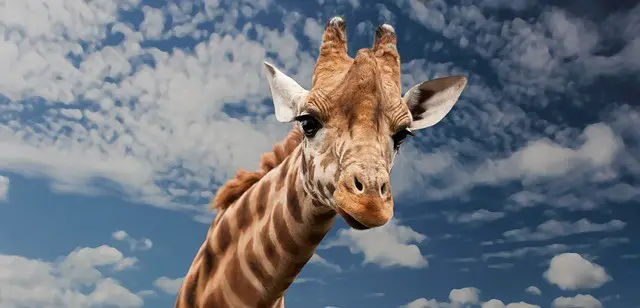
Here is something almost every giraffe page on the internet still gets wrong. Until very recently, scientists said there was one species of giraffe. In 2025 that changed: the IUCN now recognises four separate giraffe species, and the genetic gap between them is about as wide as the gap between a brown bear and a polar bear.
That is a big deal for an animal everybody thinks they already know. It also matters enormously for protecting them, because a species with 7,000 members left is in far more trouble than one with nearly 69,000.
Four giraffes, not one
| Species | Where | How many left (2025) |
|---|---|---|
| Southern giraffe | Southern Africa | about 68,837 |
| Masai giraffe | Kenya and Tanzania | about 43,926 |
| Reticulated giraffe | Kenya, Somalia, Ethiopia | about 20,901 |
| Northern giraffe | West and central Africa | about 7,037 |
Roughly 140,000 giraffes remain in the wild altogether. To put that number in context, there are around three times as many African elephants.
Conservationists call what has happened to giraffes the silent extinction, because their numbers fell sharply over recent decades while almost nobody noticed. The Masai giraffe alone has dropped from roughly 71,000 thirty years ago to under 44,000 today. In November 2024 the US Fish and Wildlife Service proposed protecting giraffes under the Endangered Species Act for the first time.
What a giraffe is actually like
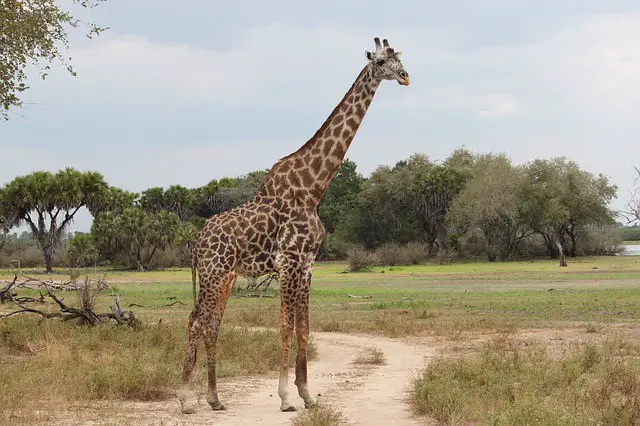
The giraffe is the tallest land animal on Earth. Males reach about 5.5 metres, which is taller than a double-decker bus, and can weigh over 1,200 kg. Females are a metre or so shorter.
The coat pattern is unique to each animal, like a fingerprint, and researchers use it to identify individuals in the wild. The patterns are also partly inherited: calves share pattern features with their mothers.
The spots are not only camouflage. Underneath each patch sits a complicated network of blood vessels, and researchers think giraffes use them as thermal windows, releasing body heat through the patches to keep cool in the African sun.
The neck, and the problems it creates

A giraffe’s neck can be over two metres long, and it contains seven bones. That is exactly the same number as in your neck, and in a mouse’s. Almost all mammals have seven neck vertebrae; a giraffe’s are simply enormous, each one up to 25 centimetres long.
Being that tall creates real engineering problems, and the giraffe solves every one of them.
- Getting blood to the brain. A giraffe’s heart weighs around 11 kg and generates roughly twice the blood pressure of a human’s, because it has to push blood two metres straight up.
- Bending down without fainting. When a giraffe lowers its head to drink, all that pressure would flood its brain. Valves in the neck arteries and a spongy network of vessels at the base of the skull absorb the surge.
- Standing up without swelling. The skin on a giraffe’s legs is unusually tight and thick, working like compression stockings to stop blood pooling in its feet. NASA has studied giraffe legs while designing suits for astronauts.
There is a nerve in a giraffe that makes the point beautifully. The recurrent laryngeal nerve runs from the brain, all the way down the neck, loops around a blood vessel near the heart, and travels all the way back up to the throat. That is a detour of about five metres to reach something a few centimetres from where it started. It is a leftover from fish ancestors, and evolution has never straightened it out.
How a Giraffe Copes With Being Tall
- An 11 kg heart — Pumps blood two metres up to the brain
- Valves in the neck — Stop blood flooding the brain when it bends to drink
- Tight leg skin — Works like compression stockings
- A nerve's long detour — Runs down to near the heart and back up to the throat
- The spots — May let body heat escape to keep it cool
Those things on their heads
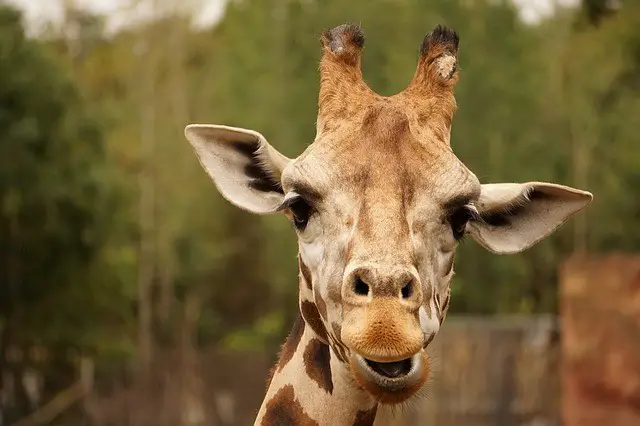
They are called ossicones, and they are not horns or antlers. They begin as cartilage and slowly fuse to the skull as the giraffe grows.
You can usually tell males from females by looking at them. Males use their heads as clubs in fights, which wears the hair off the tops, so an older bull often has bald, knobbly ossicones. Females keep neat tufts of hair on theirs.
Male giraffes fight by necking: swinging their heads on those long necks like sledgehammers and striking their opponent’s body. A full-grown bull’s head and ossicones together make a weapon heavy enough to knock a rival off his feet, and occasionally to break bones.
The tongue
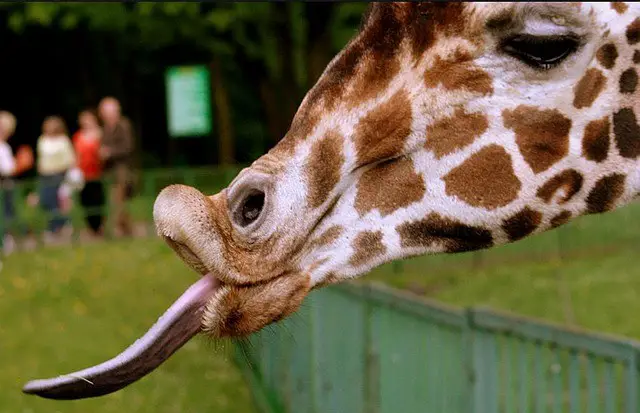
A giraffe’s tongue is around 45 to 50 centimetres long and coloured dark blue-purple at the tip. Most researchers think the dark pigment works like sunscreen, protecting the tongue during the hours a day it spends stretched out in full sun.
It is also extremely tough and coated in thick saliva, which matters because a giraffe’s favourite food is the acacia, a tree covered in long, sharp thorns. The giraffe simply wraps its tongue around a thorny branch and strips the leaves off.
The trees fight back. Acacias flood their leaves with bitter tannins within minutes of being browsed, and release a gas that warns nearby trees to do the same. Giraffes have learned to work around it: they feed for only a few minutes on one tree, then move upwind so the warning does not reach the next one.
An adult eats up to 45 kg of leaves a day. Like cows, giraffes chew the cud, bringing food back up to chew again, and you can watch a ball of it travel up that long neck.
Head to Tongue
- Ossicones — The knobs on its head, which start as cartilage
- Tongue — About 45 to 50 cm long and dark at the tip
- Thick saliva — Protects the tongue from sharp thorns
- Acacia — Its favourite tree, covered in long thorns
- Chewing the cud — Bringing food back up to chew again
Where giraffes live
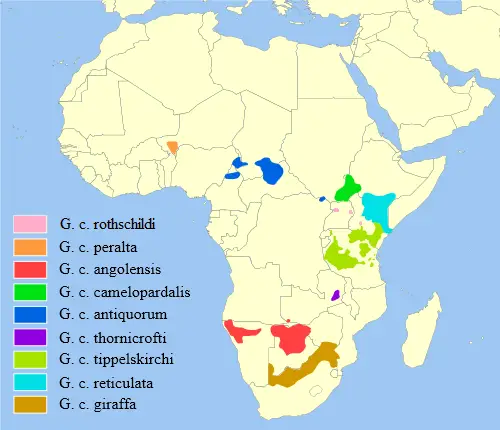
Only in Africa, in savannah, open woodland and scrub south of the Sahara. They need scattered trees to browse and open ground to see across, since spotting danger early is their main defence.
Giraffes live in loose herds called towers, which change membership constantly. Females that know each other well do form lasting friendships and stay together for years, and mothers share the job of watching over calves in a crèche while others feed.
Their closest living relative is not the camel or the deer. It is the okapi, a shy forest animal from the Congo that looks like a cross between a horse and a zebra and has a long dark tongue of its own.
Baby giraffes
A giraffe is pregnant for about 15 months and gives birth standing up, so the calf falls roughly two metres to the ground. The drop is thought to help start its breathing, and it is not usually hurt.
A newborn is already about 1.8 metres tall, taller than most adult humans, and is on its feet within an hour and running within a day. It has to be. Around half of all giraffe calves do not survive their first year, mostly taken by lions and hyenas.
Adult giraffes are much harder to kill. A kick from a giraffe can shatter a lion’s skull, so lions generally target calves or sick animals rather than a healthy adult.
A Giraffe Calf Arrives
- Waiting The calf grows inside its mother for more than a year.
- Birth The mother gives birth standing up, so the calf drops about two metres.
- First breath The drop is thought to help the calf start breathing.
- On its feet Within about an hour, the calf stands up.
- Running Within a day, the calf can run.
Giraffes barely sleep, and they hum in the dark
Wild giraffes sleep around 30 minutes to a few hours in each 24, usually in short bursts of a few minutes, and often standing up. Lying down and getting the head back up takes precious seconds when a predator arrives.
Giraffes were long thought to be almost silent. Then, in 2015, researchers at the University of Vienna recorded 947 hours of giraffe sound across three zoos and found something nobody expected: at night, giraffes hum, a low sustained note averaging about 92 hertz.
Note what that study also did. Many sources claim giraffes communicate in infrasound, below human hearing, like elephants. The Vienna recordings found no infrasound at all. The humming is within our hearing range; the zookeepers simply had never been listening at three in the morning.
Things people get wrong about giraffes
- “There is one species of giraffe.” The IUCN now recognises four, a change made in 2025.
- “Giraffes have extra neck bones.” Seven, the same as you.
- “Giraffes are mute.” They hum at night, and also snort, grunt and hiss.
- “Giraffes use infrasound.” The 2015 Vienna study specifically looked for it and found none.
- “They never sleep.” They do, in short bursts, often standing.
- “Their closest relative is the camel.” It is the okapi, a forest animal from the Congo.
- “Giraffes are doing fine.” Numbers have fallen sharply and the northern giraffe is down to about 7,000 animals.
You can read more about giraffe adaptations, or compare them with a very different desert survivor in our guide to the camel.
Giraffes: Fact or Myth?
- Giraffes are completely silent.
- Every giraffe's coat pattern is unique, like a fingerprint.
- Giraffes never sleep.
- Wild giraffes live only in Africa.
- A giraffe's closest relative is the camel.
- Giraffe mothers take turns watching over the calves.
- Giraffes talk to each other in sounds too low for us to hear.
- A newborn giraffe is already taller than most adult humans.
Ten giraffe facts worth remembering
- There are four giraffe species, recognised by the IUCN in 2025.
- About 140,000 giraffes remain in the wild, roughly a third as many as African elephants.
- A giraffe’s neck has seven bones, the same number as a human’s.
- Its heart weighs around 11 kg and produces about twice human blood pressure.
- The tongue is about 45–50 cm long and dark purple, probably as protection from sunburn.
- Newborn calves fall about two metres at birth and can run within a day.
- Giraffes hum to each other at night at around 92 hertz.
- A giraffe kick can kill a lion.
- Their closest living relative is the okapi.
- NASA has studied giraffe leg skin while designing suits for astronauts.
Common questions
How many giraffe species are there?
Four: the Southern, Masai, Reticulated and Northern giraffe. The IUCN recognised the split in 2025, having previously treated them all as one species.
How tall is a giraffe?
Males reach about 5.5 metres, taller than a double-decker bus. Females are around a metre shorter. Giraffes are the tallest land animals alive.
How many bones are in a giraffe’s neck?
Seven, the same as a human neck. Each one is simply much larger, up to about 25 centimetres long.
What do giraffes eat?
Mainly leaves, especially from thorny acacia trees, up to about 45 kg a day. They strip leaves using a tough tongue nearly half a metre long.
Are giraffes endangered?
Some are. The Masai giraffe is Endangered and the Northern giraffe is down to roughly 7,000 animals. Numbers have fallen so quietly that conservationists call it the silent extinction.
Do giraffes make any sound?
Yes. Researchers recording them at night found giraffes hum at about 92 hertz, along with snorts, grunts and hisses. They are quiet, not silent.
Did you know? NASA has studied the skin on giraffe legs. It is unusually tight and thick, working like compression stockings to stop blood pooling in their feet, which is exactly the problem astronauts face in space.
Try it
Feel the back of your own neck and count the bumps of the bones. A giraffe has the same number as you do — seven — but each of its bones can be 25 cm long. Measure 25 cm to see.
Knowledge check
How many species of giraffe are there?
Show answer
Four: the Southern, Masai, Reticulated and Northern giraffe. The IUCN recognised the split in 2025. Before that, giraffes were treated as a single species, so most older books and websites say one.
How many bones are in a giraffe’s neck?
Show answer
Seven, exactly the same number as in your neck. A giraffe’s are just far bigger, up to about 25 centimetres each.
Frequently Asked Questions About Giraffes
How many species of giraffe are there?
Four. In 2025 the IUCN changed its position and now recognises four separate giraffe species rather than one: the Southern, Masai, Reticulated and Northern giraffe. The genetic gap between them is about as wide as the gap between a brown bear and a polar bear.
How tall is a giraffe?
A male giraffe reaches about 5.5 metres, which is taller than a double-decker bus, and can weigh over 1,200 kg. Females are roughly a metre shorter. That makes the giraffe the tallest land animal on Earth.
How many bones are in a giraffe’s neck?
Seven, exactly the same number as in a human neck. Each bone is simply enormous, up to 25 cm long. Almost all mammals have seven neck vertebrae, whether they are a mouse, a person or a giraffe.
How many giraffes are left in the wild?
About 140,000 altogether. They are not spread evenly: roughly 68,800 Southern giraffes, 43,900 Masai, 20,900 Reticulated and only about 7,000 Northern giraffes. Conservationists call the decline the silent extinction, because numbers fell sharply while almost nobody noticed.
Do giraffes make any sound?
Yes. Giraffes hum to each other at night at about 92 hertz, a sound so low that people rarely notice it. Researchers discovered it in 2015 after recording 947 hours of giraffes in three European zoos. Nobody is yet certain what the humming is for.
How long is a giraffe’s tongue?
Around 45 cm, and it is dark purple. The colour is thought to protect it from sunburn while the giraffe feeds for hours in the open. The tongue is prehensile, meaning it can grip, which lets a giraffe strip leaves from between acacia thorns.
Sources
- Giraffe Conservation Foundation: State of Giraffe 2025 — the four-species split and the population figure for each.
- IUCN Red List — conservation status of each giraffe species.
- US Fish and Wildlife Service (November 2024) — the proposal to protect giraffes under the Endangered Species Act.
- BMC Research Notes (2015): nocturnal humming in giraffes — the 947 hours of recordings and the 92 Hz hum.
- San Diego Zoo Wildlife Alliance: giraffe — anatomy, calves and behaviour.
Giraffe Final Challenge
- About how tall can a male giraffe grow?
- What name was given to the quiet fall in giraffe numbers over recent decades?
- What is a group of giraffes called?
- How do acacia trees fight back when a giraffe eats them?
- Why do lions usually go after giraffe calves rather than healthy adults?
- Why can lying down be risky for a giraffe?
- How do male giraffes fight?
- Why do giraffes need open ground where they can see a long way?