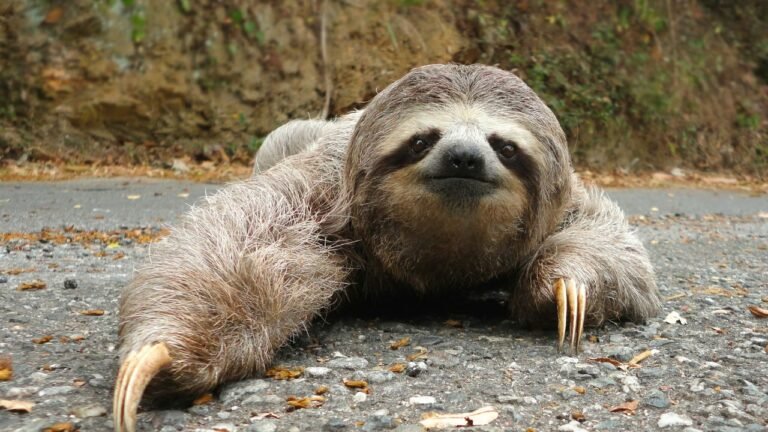
sloths quick facts
- There are six living species of sloth: two two-toed and four three-toed.
- Algae grow in grooves in sloth fur, sometimes turning it green.
- Sloths come down from the trees about once every six days to go to the toilet.
- Food can stay in a two-toed sloth’s gut for about a month.
- Sloths are good swimmers.
What is a sloth?
A sloth is a slow-moving mammal that lives in the trees of the rainforests of Central and South America. It spends most of its life hanging upside down from branches, eating leaves and sleeping.
Sloths are famous for being slow. They move slowly and carefully, and their bodies run slowly too. Find out just how slow in our guide to how fast a sloth can move.
There are six living species of sloth. They are split into two groups: two-toed sloths and three-toed sloths.
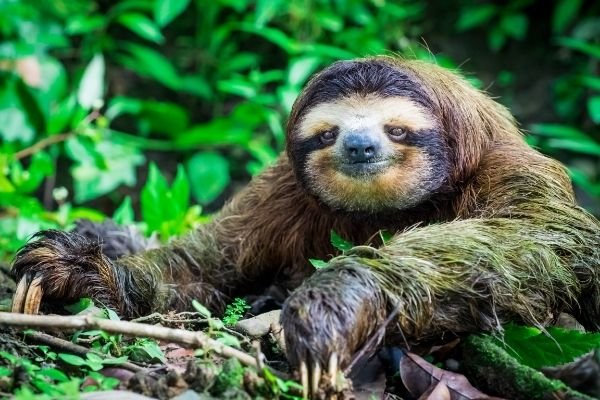
Two-toed and three-toed sloths
The two groups look quite similar, but scientists now put them in separate families, because they are more different than they seem.
Two-toed sloths have two long claws on their front feet. They spend almost all their time hanging flat underneath branches.
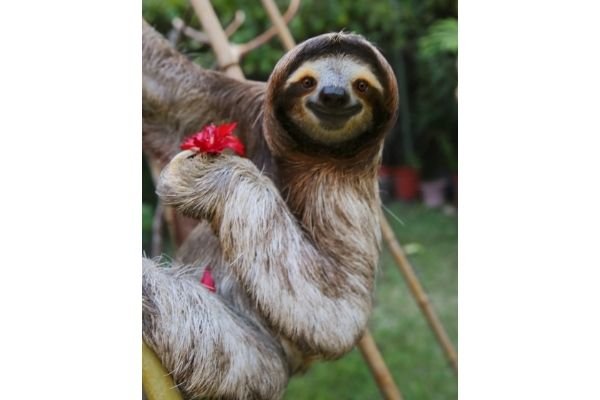
Three-toed sloths have three claws on their front feet. They move in the same way, but they often sit in the fork of a tree instead of hanging. There are four species of three-toed sloth, and the patterns on their faces make them look as if they are always smiling.
Three-toed sloths are also called “ai” in parts of Latin America, after the high-pitched cry they make when they are upset.
Two-Toed or Three-Toed?
- Two-toed sloths — Spend almost all their time hanging flat under branches
- Three-toed sloths — Often sit in the fork of a tree
- The ai — A Latin American name for three-toed sloths, after their high cry
- Face markings — Make three-toed sloths look as if they are smiling
- Separate families — How scientists now group the two kinds
| Two-toed sloths | Three-toed sloths | |
|---|---|---|
| Claws on front feet | two | three |
| Usual position | hanging under branches | often sitting in tree forks |
| Number of species | two | four |
| Face | plainer | markings that look like a smile |
What sloths look like
Sloths have long legs, a stumpy tail and a round head with small ears that are hard to see. Their long, curved claws work like hooks, letting them hang from branches without using much effort.
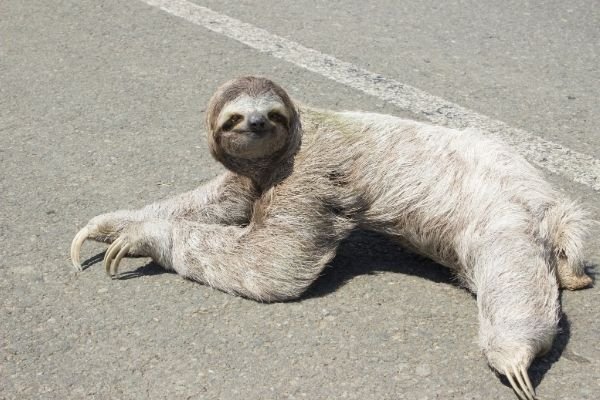
A two-toed sloth is about 53 to 74 cm long and weighs 4 to 8 kg, about the size of a small dog.
A sloth’s limbs are built for hanging, not for standing. So on the ground, a sloth is almost helpless. It can only drag itself along with its claws.
Where do sloths live?
All sloths live in the lowland tropical rainforests of Central and South America. Two-toed sloths are found from Central America into northern South America, including parts of Brazil and Peru.
They live high in the forest canopy, the thick roof of leaves and branches. Some also live in drier forests and in mangrove swamps along the coast. Many live in the Amazon rainforest, near the Amazon River. You can read more in our guide to where sloths live.
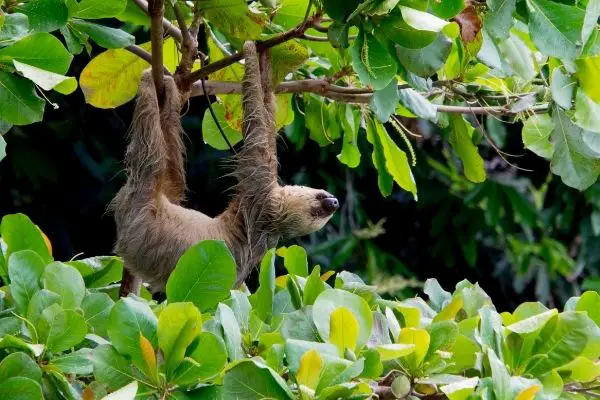
What sloths eat
Sloths eat mainly leaves. Two-toed sloths also eat fruit, stems, buds and fresh green shoots, and now and then an insect or a bird’s egg.
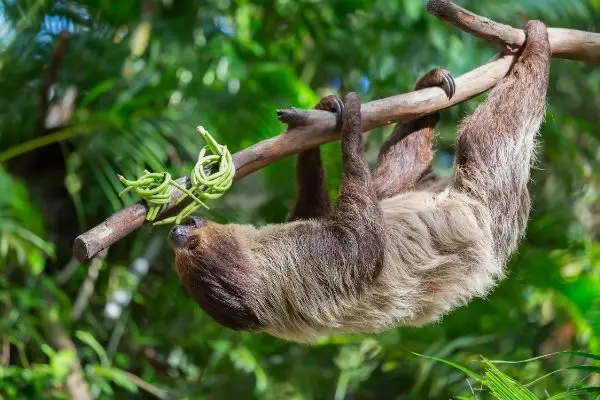
Leaves are hard to digest and give very little energy. Sloths have large stomachs with several chambers, and they can cope with the strong chemicals that many leaves contain.
Digesting a meal takes a very long time. Britannica says it can take up to a week, and the Smithsonian’s National Zoo says food can stay in a two-toed sloth’s gut for about a month. A sloth’s stomach is always full, and its contents can make up about 30% of its body weight.
Why sloths are so slow
Sloths are slow because of the food they eat. Leaves give them so little energy that they have to save as much as they can.
Their bodies work very slowly. A two-toed sloth’s metabolism, the speed at which its body uses energy, is only about 40 to 45% of what you would expect for an animal of its size.
Moving slowly has another advantage. Predators such as jaguars and big eagles often spot their prey by movement. A sloth that barely moves is hard to notice among the leaves.
Sloth by Numbers
- 53 to 74 cm — How long a two-toed sloth is
- 4 to 8 kg — What a two-toed sloth weighs
- About a month — How long food can stay in a two-toed sloth's gut
- About 30% — How much of a sloth's weight is the food in its stomach
- 40 to 45% — How fast a two-toed sloth uses energy, compared with what you would expect for its size
A changing body temperature
Most mammals keep their bodies at a steady temperature. Sloths cannot do this well.
A sloth’s body temperature usually ranges from about 25 to 35°C, and it can drop as low as 20°C. San Diego Zoo Wildlife Alliance says the two-toed sloth has the lowest and most changeable body temperature of any mammal. When it gets too cold, a sloth becomes sluggish and still.
To warm up, sloths often rest in the sunshine at the top of the canopy.
Green, furry and full of life
Sloth fur is amazing. Most mammals’ fur grows from the back towards the belly, but a sloth’s grows the other way, from its belly towards its back. When a sloth hangs upside down, rain runs straight off it. Tiny green algae also grow in the grooves of its fur, giving it a greenish tinge that helps it hide among the leaves. Each hair has tiny grooves running along it, and in those grooves grow two kinds of blue-green algae, tiny plant-like living things.
In the wet season, the algae can give sloths a greenish tint. That helps them blend in with the leaves, so they are even harder to spot.
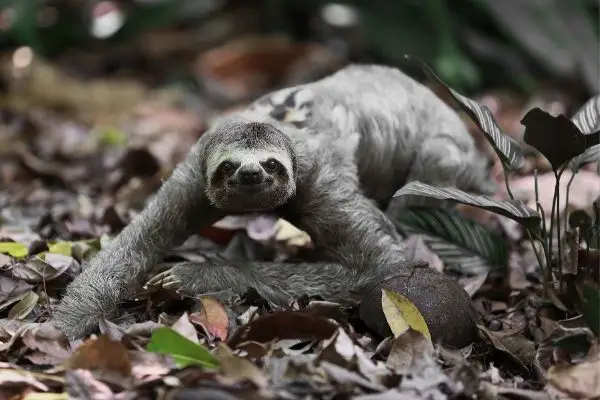
A sloth’s fur is like a tiny ecosystem of its own, home to algae and small creatures such as moths.
Life upside down
Sloths do almost everything upside down. They sleep, eat, mate and even give birth hanging from branches.
Two-toed sloths are mostly active at night. They sleep for about 15 to 18 hours during the day and wake up after dark to feed.
Their eyesight and hearing are not very good, so they find their way mostly by touch.
Coming down to the ground
Sloths rarely leave the trees. They climb down only to move to a new tree or to go to the toilet.
Britannica says sloths come down about every six days to wee and poo. It is a slow and risky trip, because on the ground they are much easier for predators to catch.
Surprising swimmers
Here is a surprise. Although sloths are slow in the trees and helpless on the ground, they are good swimmers.
They can drop from branches into rivers and swim across the water, using their long arms to paddle. That helps them reach new trees.
Baby sloths
A mother sloth has a single baby at a time. Her pregnancy lasts about six to ten months, depending on the species.
The baby clings to its mother’s fur and travels everywhere with her. Young two-toed sloths may stay with their mothers for anywhere from six months to two years, learning which leaves to eat.
Sloths can live a long time. In zoos, two-toed sloths typically live about 15 or 16 years.
Giant sloths of the past
Today’s sloths are small, but their relatives were not always so. During the last Ice Age, giant ground sloths lived in the Americas.
Unlike today’s sloths, they lived on the ground rather than in trees. Some were as big as an elephant, and they could rear up on their back legs to pull down branches to eat.
The giant ground sloths died out thousands of years ago. Only the small, tree-living sloths survive today, the last members of a once much bigger family.
Are sloths in danger?
Two-toed sloths are listed as Least Concern, which means they are not in danger of dying out right now. But some sloths are much rarer.
The biggest threat is the loss of their forest homes, as trees are cut down for farms, towns and roads. Power lines and roads are also dangerous for sloths that have to cross them.
Protecting rainforests, and building rope bridges over roads, can help sloths travel safely between trees.
Sloth Survival
- Least Concern — How the two-toed sloth is listed
- Forest loss — The biggest threat to sloths
- Power lines and roads — Dangers for sloths moving between trees
- Jaguars and harpy eagles — Predators that hunt sloths
- Giant ground sloths — Relatives that could be as big as an elephant
Three things people get wrong
Sloths are not lazy. They move slowly to save energy, because their leafy food gives them so little.
Sloths are not monkeys. Their closest living relatives are anteaters and armadillos.
Sloths cannot walk well on the ground. Their bodies are built for hanging, so on the ground they can only drag themselves along.
Did you know? The two-toed sloth has the lowest and most changeable body temperature of any mammal, from about 24 to 33°C.
Sloths: Fact or Myth?
- Sloths are a kind of monkey.
- Sloths are good swimmers.
- Sloths can walk well on the ground.
- Two-toed sloths are mostly active at night.
- Sloths have excellent eyesight.
- A sloth's stomach has several chambers.
- Sloths keep a steady body temperature, like most mammals.
- A sloth's fur grows from its belly towards its back.
Try it
Try moving across a room as slowly as a sloth, taking a whole minute for each step. How long could you keep it up?
Knowledge check
Why do sloths move so slowly?
Show answer
Because their leafy food gives them very little energy, so they save it by moving slowly.
Why is sloth fur sometimes green?
Show answer
Because algae grow in tiny grooves in each hair.
Frequently asked questions
Where do sloths live?
Sloths live in the lowland tropical rainforests of Central and South America, high in the forest canopy. Many live in the Amazon rainforest.
What do sloths eat?
Sloths eat mostly leaves. Two-toed sloths also eat fruit, stems, buds and shoots, and occasionally insects or bird eggs. Their food takes a very long time to digest.
Why are sloths so slow?
Sloths are slow because leaves give them very little energy. Their metabolism runs at only about 40 to 45% of what you would expect for their size, so they save energy by moving slowly.
How long do sloths sleep?
Two-toed sloths sleep for about 15 to 18 hours a day. They are mostly active at night, when they wake up to eat.
Can sloths swim?
Yes. Sloths are surprisingly good swimmers. They can drop into rivers and paddle across with their long arms to reach new trees.
How often do sloths come down from trees?
Sloths come down to the ground only to change trees or to go to the toilet, which Britannica says they do about every six days.
Sources
- Encyclopaedia Britannica: sloth — the six species, two-toed and three-toed sloths, body, digestion, toilet trips and body temperature
- Smithsonian’s National Zoo: two-toed sloth — size, range, diet, metabolism, sleep, digestion, algae, swimming, breeding, lifespan and status
- San Diego Zoo Wildlife Alliance: two-toed sloth — sleep, digestion, algae, body temperature, babies, lifespan and threats
Sloth Final Challenge
- Where do sloths live?
- What do sloths mostly eat?
- How long do two-toed sloths sleep during the day?
- Why does a sloth come down to the ground?
- How long do young two-toed sloths stay with their mothers?
- How low can a sloth's body temperature drop?
- About how long do two-toed sloths live in zoos?