Florida is a state in the south-eastern United States, known as the Sunshine State. It became the 27th state on March 3, 1845, and its capital is Tallahassee. About 23.4 million people lived there in 2024. Most of Florida is a low, flat peninsula between the Atlantic Ocean and the Gulf of Mexico.
Florida quick facts
- Florida’s northernmost point is about 100 miles further south than California’s southern border.
- Only Alaska has a longer coastline than Florida’s 8,400 miles.
- Florida’s highest point is just 345 feet above sea level.
- St. Augustine, founded in 1565, is the oldest European settlement in the continental United States.
- The Everglades is really a slow, shallow river, often called a river of grass.
Where is Florida?
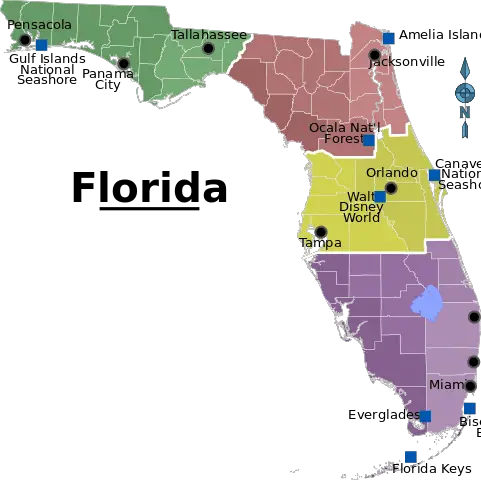
Florida is in the far south-east of the United States. Most of it is a long peninsula, a finger of land that pokes out into the sea towards Cuba and the Caribbean.
On one side is the Atlantic Ocean. On the other is the Gulf of Mexico. Florida shares a land border with only two states, both to the north: Georgia and Alabama.
The nearest foreign land is the island of Bimini, in the Bahamas, just 50 miles (80 km) east of Florida’s southern tip.
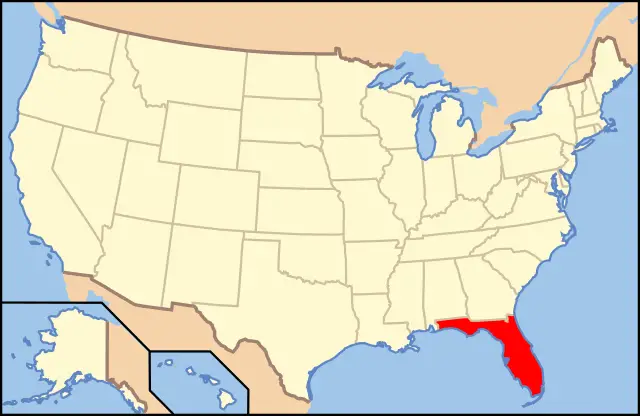
Florida is the southernmost of the 48 states that are joined together. Its northernmost point is about 100 miles further south than California’s southern border. At the bottom, a curve of small islands called the Florida Keys reaches to within about 75 miles of the Tropic of Cancer.
Florida fact file
- Capital
- Tallahassee
- Population
- About 23.4 million (2024 estimate)
- Nickname
- The Sunshine State
- Bordering states
- Only two states, both to the north: Georgia and Alabama
- Statehood date
- March 3, 1845, the 27th state
- State bird
- Mockingbird
- State flower
- Orange blossom
- Landmarks
- The Everglades, and St Augustine, the oldest European town in the continental United States
- Rivers and lakes
- The Everglades is really a slow, shallow river, often called a river of grass
- Climate
- Warm and sunny. Florida sits where tropical and temperate climates meet
And a few things no report form asks for:
| Area | 65,757 square miles (170,311 km²) |
| Coastline | more than 8,400 miles (13,500 km) |
| Highest point | 345 feet (105 m), in Walton County |
A record coastline
Florida has more than 8,400 miles (13,500 km) of shoreline, counting every bay and inlet. About 5,100 miles of it is along the Gulf of Mexico.
Among all the US states, only Alaska has a longer coastline. Much of Florida’s coast is fringed by long, sandy barrier islands, which give the state many of its best beaches.
How Florida got its name
In 1513, the Spanish explorer Juan Ponce de León landed on Florida’s coast. He named the land La Florida, which means “The Flower” in Spanish, and claimed it for Spain.
For centuries after that, European powers fought over Florida, because of where it sits. It guards one of the entrances to the Gulf of Mexico and lies on the sea routes between North and South America.
The oldest European town in the country
In 1565, the Spanish founded St. Augustine, on Florida’s north-east coast. It is the oldest European settlement within what became the continental United States.
That means St. Augustine is older than any English colony. It was founded more than 40 years before the English settled at Jamestown in Virginia.
Florida finally became part of the United States later, and on March 3, 1845, it was admitted as the 27th state.
A low, flat land
Florida is one of the flattest places in the country. Most of it is less than 100 feet (30 m) above sea level.
Its highest point, in Walton County near the Alabama border, is only 345 feet (105 m) high. That is lower than many hills, and it is the lowest high point of any US state.
Most of Florida is covered with sand and limestone. Rain slowly dissolves limestone, and over thousands of years this has shaped the land, creating springs, sinkholes and lakes. About three-quarters of the state is flat coastal lowland, much of it swampy.
The Everglades: a river of grass
In the south of Florida lies the Everglades. It is often called a swamp, but it is really a shallow, slow-moving river, about 150 miles long and 50 miles wide. People call it a “river of grass”.
The Everglades formed about 5,000 years ago on a bed of porous limestone rock. It sits where tropical and temperate climates meet, so it holds plants found nowhere else on Earth.
It is a haven for migratory birds and endangered animals, and a nursery where young wading birds and fish grow up. Water is its lifeblood. Without it, the whole ecosystem would disappear.
The northern part has been changed with canals and pumping stations, and much of it is now used to grow sugar cane. The southern part is protected in Everglades National Park.
Alligators
Florida is famous for its alligators. They live in freshwater lakes, slow-moving rivers and wetlands, and sometimes in brackish water, where fresh and salt water mix.
Female alligators rarely grow longer than 10 feet (3 m), but males can grow much bigger. Florida’s longest recorded alligator was a male 14 feet 3½ inches long, from Lake Washington in Brevard County. The heaviest weighed 1,043 pounds.
A mother alligator builds a mound nest of soil and plants and lays about 32 to 46 eggs in late June or early July. The eggs take 63 to 68 days to hatch, so baby alligators appear from mid-August to early September.
Want to compare them with their cousins? Read about what crocodiles eat.

Manatees
Florida’s coastal waters, rivers and springs are home to the Florida manatee. It is a large, gentle animal, sometimes called a sea cow.
Adult manatees are usually 9 to 10 feet (about 3 m) long, though some grow to more than 13 feet. Most weigh around 1,000 pounds, and the heaviest reach 3,500 pounds.
Manatees eat only plants. They can spend up to eight hours a day grazing on seagrass and other water plants, and they may eat up to a tenth of their own body weight in a day.
Cold is dangerous for them. They cannot cope with water below 68°F (20°C) for long. So in winter, manatees crowd into warm places, such as natural springs, the warm water flowing out of power plants, and sheltered basins that hold on to heat.
A mother manatee feeds her calf on milk and looks after it for about two years, teaching it how to survive.
Their biggest dangers are being hit by boats, losing their habitat, and getting tangled in fishing gear. Cold snaps and red tide, a bloom of harmful algae, kill manatees too. They are protected by two US laws: the Endangered Species Act and the Marine Mammal Protection Act.
Who lives in Florida?
About 23.4 million people lived in Florida in 2024, up from about 21.5 million in 2020. It is the most populous state in the south-east and the second most populous Southern state, after Texas.
Florida’s warm climate and beaches bring huge numbers of visitors. Tourism is now the biggest part of its economy, ahead of farming and manufacturing.
Florida is also one of the states where the number of people born in other countries is growing fastest. Many come from Latin America, which is why Spanish is spoken widely in cities such as Miami.
Where rockets blast off
Florida’s east coast is where many American space missions begin. NASA’s Kennedy Space Center opened on July 1, 1962, under the name Launch Operations Center. In 1963 it was renamed in honour of President John F. Kennedy.
Launching from the coast means rockets fly out over the ocean, away from towns. Today Kennedy is a busy spaceport shared with about 100 private companies, and more than 10,000 people work there.
It supports missions that carry astronauts into space, as well as launches of space telescopes and rovers. NASA also uses it to work on ways for people to live on the Moon one day.
The Sunshine State
Florida’s nickname is the Sunshine State, thanks to its warm, sunny weather. Its state bird is the mockingbird, and its state flower is the orange blossom, a reminder of Florida’s famous orange groves.
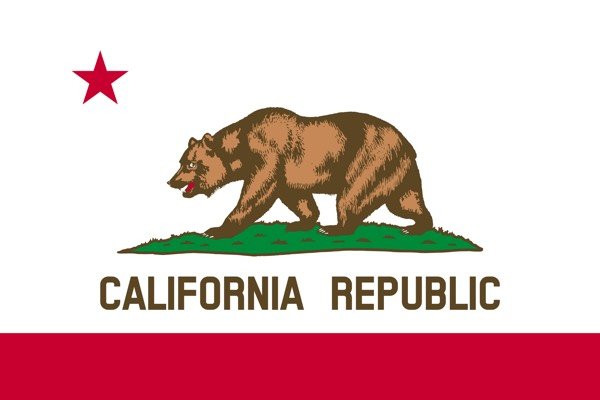
Don’t mix it up with California, which is the Golden State. Mixing the two nicknames up is one of the most common mistakes people make.
Three things people get wrong
Florida is not the southernmost US state. Hawaii is further south. Florida is the southernmost of the 48 states that are joined together.
Miami is not the capital. Florida’s capital is Tallahassee, in the north-west of the state.
The Everglades is not just a swamp. It is a very wide, very slow river of water and grass, flowing south across the tip of Florida.
Did you know? The nearest foreign land to Florida is the island of Bimini in the Bahamas, only about 50 miles east of the state’s southern tip.
Try it
Find Florida on a map of the United States, then find California. Use a ruler to see how far south of California’s southern border Florida’s northern edge lies.
Knowledge check
What is the capital of Florida?
Show answer
Tallahassee, in the north-western part of the state.
Why is the Everglades called a river of grass?
Show answer
Because it is really a shallow, slow-moving river, about 150 miles long and 50 miles wide, filled with grass.
Frequently asked questions
What is the capital of Florida?
The capital of Florida is Tallahassee, in the north-western part of the state known as the Panhandle. Miami and Orlando are bigger, but neither is the capital.
When did Florida become a state?
Florida became the 27th US state on March 3, 1845. Before that it was ruled by Spain and fought over by several European powers.
Why is Florida called the Sunshine State?
Florida is called the Sunshine State because of its warm, sunny climate, which draws huge numbers of visitors. Its state flower is the orange blossom and its state bird is the mockingbird.
How many people live in Florida?
About 23.4 million people lived in Florida in 2024. It is the most populous state in the south-east and the second most populous Southern state, after Texas.
What is the Everglades?
The Everglades is a shallow, slow-moving river of water and grass in southern Florida, about 150 miles long and 50 miles wide. It formed about 5,000 years ago and is home to plants found nowhere else.
How big do Florida alligators get?
Female alligators rarely grow longer than 10 feet, but males can be much bigger. Florida’s longest recorded alligator was 14 feet 3½ inches, and the heaviest weighed 1,043 pounds.
Where do manatees live in Florida?
Florida manatees live in the state’s coastal waters, rivers and springs. In winter they gather in warm water, such as natural springs and the outflows of power plants, because they cannot cope with water below 68°F for long.
Sources
- Encyclopaedia Britannica: Florida — location, statehood, capital, population, area, coastline, name, St. Augustine, land and the Everglades
- Florida Fish and Wildlife Conservation Commission: alligator facts — where alligators live, record sizes and nesting
- US National Park Service: Everglades nature — how the Everglades formed and why it matters for wildlife
- US Fish and Wildlife Service: West Indian manatee — manatee size, diet, winter warm-water refuges, calves, threats and legal protection
- NASA: Kennedy Space Center — when the space centre opened, its renaming and its work today