The Iron Age was when people began making tools and weapons from iron, starting about 1200 BCE in the Middle East and about 800 BCE in Britain. Iron Age tools included axes, ploughshares, sickles, hammers and rotary querns for grinding grain. Weapons included spears, swords and shields, and some warriors wore mail armour.
Iron Age tools quick facts
- The Iron Age began about 1200 BCE in the Middle East and about 600 BCE in China.
- In Britain the Iron Age ran from about 800 BCE until the Roman invasion in AD 43.
- Iron Age smiths shaped iron by heating and hammering it, not by melting it.
- Iron ploughshares let farmers break up heavier soil.
- Hillforts like Maiden Castle were protected by huge banks of earth and ditches.
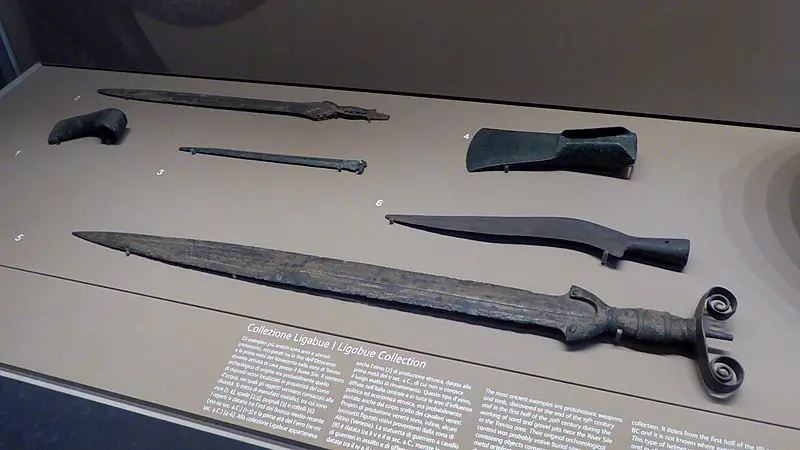
What was the Iron Age?
The Iron Age was the time when people learned to make tools and weapons out of iron. It came after the Stone Age and the Bronze Age, and it is the last of the three ages that archaeologists use to describe prehistory.
During the Iron Age, iron mostly took the place of bronze for tools and weapons. Iron was harder to work, but the rock it came from was far more common than the copper and tin needed to make bronze.
The Iron Age did not begin everywhere at the same time. It started in the Middle East and south-eastern Europe about 1200 BCE, but not until about 600 BCE in China. In Britain it began around 800 BCE and lasted until the Romans invaded in AD 43.
Why iron changed everything
People in the Middle East knew about iron as early as 3000 BCE. At first it was rare, and it was treated as a precious metal, a bit like gold. Nobody seemed to realise how useful it could be.
Between about 1200 and 1000 BCE, that changed. The knowledge of how to work iron spread quickly and widely, along with iron objects themselves.
Once iron tools could be made in large numbers, farming became easier and people settled in more permanent homes. Iron weapons also became common, putting weapons into the hands of ordinary people for the first time. Encyclopaedia Britannica says this set off great movements of peoples that went on for 2,000 years and changed Europe and Asia.
How iron was made
Iron does not come out of the ground as shiny metal. It is locked inside rock, called iron ore.
To get it out, Iron Age smiths heated the ore with charcoal in a small clay furnace. The heat turned it into a spongy lump of iron mixed with waste. The smith then heated the lump again and again, hammering it each time to squeeze out the waste. It was hot, hard work.
Iron Age people could not get their furnaces hot enough to melt iron and pour it into moulds, as they had done with bronze. Instead, they shaped hot iron by hammering it on an anvil. This is called forging, and a person who does it is a blacksmith. Blacksmiths were highly skilled, and they were important people in their communities.
People had known about iron long before the Iron Age. The Royal Society of Chemistry says the Hittites, who lived in what is now Turkey, were the first to smelt iron from its ore, around 1500 BC. Smelting means heating rock to get the metal out.
Iron made by heating and hammering is called wrought iron. Two other kinds of iron came much later, once furnaces were hot enough. What makes them different is how much carbon they contain. Carbon is the main thing in charcoal.
| Kind of iron | Carbon in it | What it is like |
|---|---|---|
| Wrought iron | very little | made by hammering, as in the Iron Age; tough and can be bent |
| Steel | up to about 2% | harder and stronger; used today for bridges, tools and cars |
| Cast iron | about 3 to 5% | melted and poured into moulds; cheaper, but not as tough as steel |
The British Museum has an early Iron Age axe from London, made around 800 to 500 BC, that shows this change. Its shape copies the bronze axes that came before it, a shape that was easy to cast in bronze but not well suited to iron.
Iron Age words
- Iron ore — the rock that iron is locked inside
- Smelting — heating rock to get the metal out of it
- Forging — shaping hot metal by hammering it
- Blacksmith — the skilled person who shapes hot iron
- Anvil — the heavy block that hot iron is hammered on
Iron Age tools

Iron Age people used a wide range of tools. Not everything was made of iron. Wood, stone, leather and bronze were still useful. Iron was most valuable for strong cutting edges and points.
| Tool | Made from | Used for |
|---|---|---|
| Axe | iron head, wooden handle | cutting and shaping wood |
| Ploughshare | iron tip on a wooden plough | breaking up and turning the soil |
| Sickle | curved iron blade and handle | cutting crops at harvest |
| Hammer and tongs | iron and wood | holding and shaping hot metal |
| Rotary quern | two round stones | grinding grain into flour |
| Knife | iron blade, wood or bone handle | cutting food and materials |
Axes were used to cut down trees and shape wood for houses, fences and tools. The British Museum’s early Iron Age axe is about 14.5 cm long and weighs 522 g.
Ploughshares were the pointed cutting parts at the front of a plough. An iron tip was much tougher than wood, so farmers could break up heavier soil. The British Museum has one found in the mud of the River Thames foreshore at Wandsworth, in London.
Sickles had curved iron blades for cutting wheat and barley at harvest time.
Rotary querns were two round, flat stones, one on top of the other. Grain went in a hole in the top, and turning the top stone by a handle ground it into flour.
Hammers, tongs and anvils were the blacksmith’s tools, used to hold and shape hot iron.
Farming in the Iron Age
Most Iron Age people were farmers. They grew crops such as wheat and barley and kept cattle, sheep and pigs.
Iron tools made farming easier and faster. Iron ploughshares could turn heavier soils, and iron sickles and axes lasted longer than stone ones.
With more food, communities could grow larger. In Britain, people lived in villages of round houses, called roundhouses, with thick walls and cone-shaped roofs.
How iron spread
- about 1500 BC The Hittites, in what is now Turkey, are the first to smelt iron from its ore.
- about 1200 BCE The Iron Age begins in the Middle East and south-eastern Europe.
- 1200 to 1000 BCE Knowledge of how to work iron spreads quickly and widely.
- about 800 BCE The Iron Age begins in Britain.
- about 600 BCE The Iron Age begins in China.
- AD 43 The Romans invade Britain and the British Iron Age comes to an end.
Iron Age weapons
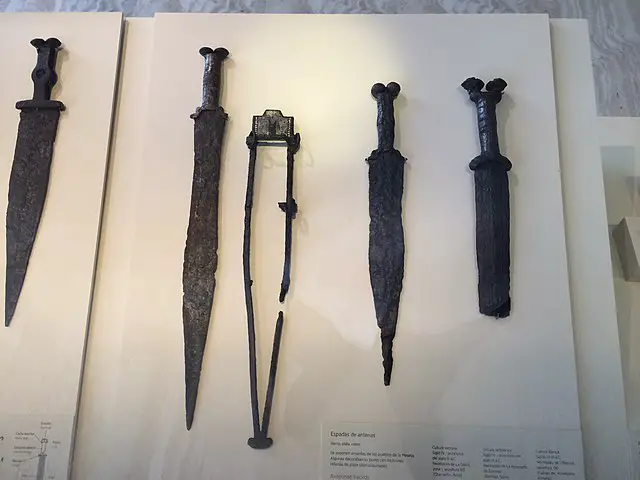
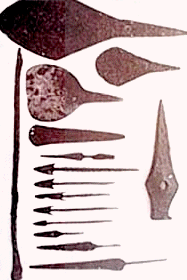
Iron made strong, sharp weapons. The most common were spears, with iron points on long wooden shafts. Spears could be thrown or used for stabbing, and they were used for hunting as well as fighting.
Swords were rarer and more precious. Owning a fine sword was a sign that someone was important.
The British Museum has an Iron Age sword from Stanwick, in North Yorkshire, made around AD 1 to 100. Its blade is almost 70 cm long, and with its fittings the whole sword weighs 948 g. It was found still inside its wooden scabbard, which had bronze fittings.
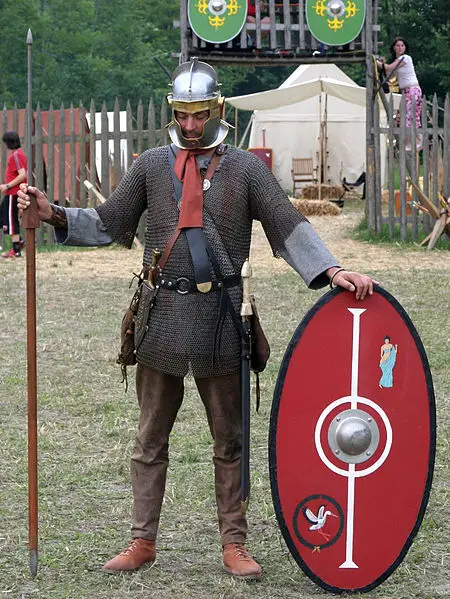
Warriors also carried shields made of wood and leather, sometimes with metal fittings.
Armour
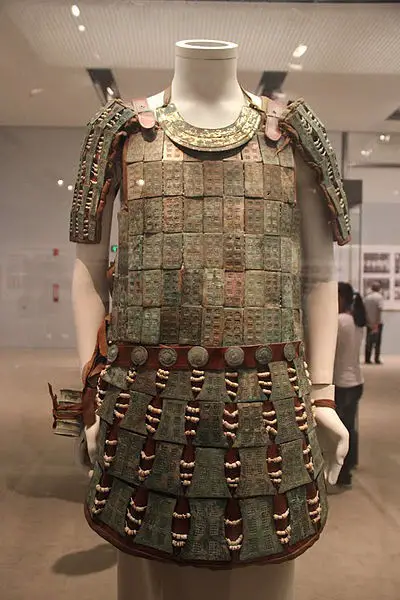
Some Iron Age warriors wore armour to protect their bodies.
Mail armour, sometimes called chain mail, was made of thousands of small iron rings linked together to form a flexible shirt. It took a very long time to make, so only wealthy warriors could afford it.
Scale armour was made of many small metal plates, like the scales of a fish, fixed to a backing of cloth or leather.
Most ordinary fighters had no armour at all, and relied on a shield.
Here are the main Iron Age weapons and armour at a glance.
| Weapon or armour | Made from | Used for |
|---|---|---|
| Spear | iron point on a long wooden shaft | throwing or stabbing, in hunting and fighting |
| Sword | iron blade, often kept in a wooden scabbard | fighting; owning one showed you were important |
| Knife | iron blade, wood or bone handle | cutting, and fighting at close range |
| Shield | wood and leather, sometimes with metal fittings | protecting the body in a fight |
| Mail armour | thousands of small linked iron rings | a flexible shirt for wealthy warriors |
| Scale armour | small metal plates on cloth or leather | protecting the body like the scales of a fish |
Hillforts
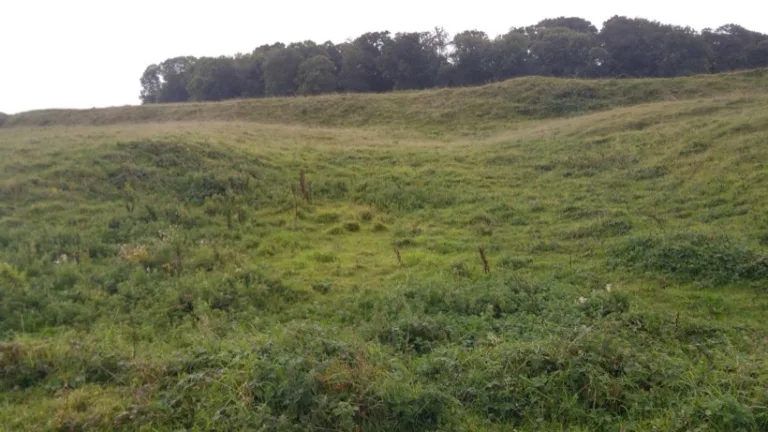
Iron Age people in Britain built hillforts. These were settlements on the tops of hills, protected by huge banks of earth and deep ditches, called ramparts.
One of the biggest is Maiden Castle, in Dorset, which has several rings of ramparts. Old Oswestry, in Shropshire, is another. Hillforts may have been used for defence, for meetings, for trade, or to show off a group’s power. Inside the ramparts, people lived in roundhouses, stored grain and kept animals.
Places on the map
- Maiden Castle, Dorset — one of the biggest hillforts, with several rings of ramparts
- Old Oswestry, Shropshire — another Iron Age hillfort in Britain
- Stanwick, North Yorkshire — where an iron sword was found still inside its scabbard
- The Wandsworth foreshore, London — where an iron ploughshare was found in the river mud
- Asia Minor, now Turkey — where the Hittites first smelted iron from its ore
Tribes and chiefs
Iron Age Britain was divided into tribes, each with its own leaders. Some people were buried with rich objects, which shows that they were important.
Some Iron Age leaders had strong links with the Roman world long before the Romans invaded in AD 43. After the conquest, much of Britain became part of the Roman Empire, and the Iron Age came to an end.
The Iron Age around the world
The Iron Age happened in different ways in different places. Iron working spread across the Middle East, Europe, Asia and Africa, but tools and weapons looked different from place to place. In parts of Africa, people were making iron tools more than 2,000 years ago.
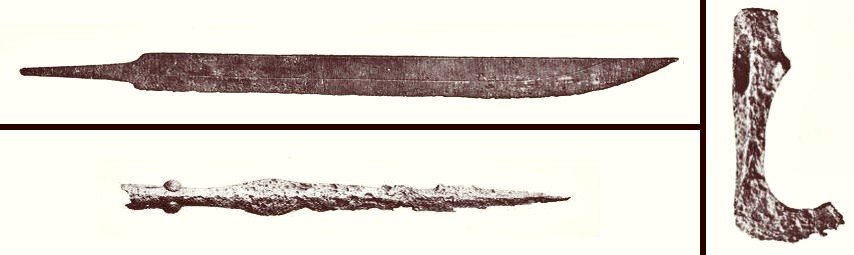
A British Iron Age sword might look quite different from one made in India or West Africa at the same time. Archaeologists work out how tools were used from the objects themselves, from workshops, and from wear marks on their edges. Iron rusts away in damp ground, so many Iron Age tools have not survived at all. That makes the ones in museums all the more precious.
To see how tools changed before the Iron Age, read our guides to Stone Age tools and weapons and New Stone Age tools and weapons.
Three things people get wrong
The Iron Age did not start everywhere at once. It began about 1200 BCE in the Middle East, around 800 BCE in Britain and about 600 BCE in China.
Iron Age tools were not all made of iron. Wood, stone, leather and bronze were still used, often alongside iron.
Iron was not poured into moulds. Iron Age furnaces could not melt iron, so smiths shaped it by heating and hammering it.
Did you know? The British Museum has an Iron Age sword from Stanwick, North Yorkshire, that was found still inside its wooden scabbard.
Iron Age: fact or myth?
- Iron was treated as a precious metal, a bit like gold, long before the Iron Age began.
- Swords were the everyday weapon of ordinary Iron Age fighters.
- Almost every Iron Age tool that was ever made has survived for us to dig up.
- Mail armour was made of thousands of small iron rings linked together.
- All Iron Age people in Britain lived inside hillforts.
- Archaeologists can tell how a tool was used from wear marks on its edges.
Try it
Draw a timeline across a sheet of paper with three sections: Stone Age, Bronze Age and Iron Age. Add a tool to each section, such as a flint axe, a bronze axe and an iron sickle.
Knowledge check
What is a ploughshare?
Show answer
The pointed cutting part at the front of a plough, which breaks up and turns the soil.
Why couldn’t Iron Age people pour iron into moulds?
Show answer
Their furnaces could not get hot enough to melt it, so they shaped it by heating and hammering.
Frequently asked questions
When was the Iron Age?
The Iron Age began at different times in different places: about 1200 BCE in the Middle East and south-eastern Europe, about 800 BCE in Britain and about 600 BCE in China.
What tools did people use in the Iron Age?
Iron Age people used iron axes, ploughshares, sickles, knives, hammers and tongs, along with stone rotary querns for grinding grain into flour.
What weapons were used in the Iron Age?
Iron Age weapons included spears with iron points, swords, knives and shields. Some wealthy warriors also wore mail or scale armour.
How was iron made in the Iron Age?
Iron Age smiths heated iron ore with charcoal in a clay furnace to make a spongy lump of iron, then heated and hammered it to remove waste and shape it.
Why was iron better than bronze?
The ore used to make iron was far more common than the copper and tin needed for bronze, so iron tools could be made in large numbers once people learned how.
What is a hillfort?
A hillfort was an Iron Age settlement on a hilltop, protected by large banks of earth and ditches called ramparts. Maiden Castle in Dorset is one of the biggest.
Sources
- Encyclopaedia Britannica: Iron Age — when the Iron Age began in different regions and how iron changed farming, settlement and warfare
- English Heritage: prehistory — the Iron Age in Britain, hillforts, roundhouses, tribes and the Roman conquest
- British Museum: Iron Age axe (WG.1785) — an early Iron Age looped socketed iron axe from London, 800 to 500 BC
- British Museum: Iron Age ploughshare (1906,0530.36) — an iron ploughshare found on the Wandsworth foreshore
- British Museum: Iron Age sword (1952,0202.1) — an iron sword and scabbard from Stanwick, North Yorkshire
- Royal Society of Chemistry: iron — the Hittites as the first to smelt iron, around 1500 BC, and how steel, wrought iron and cast iron differ in carbon
Iron Age Tools and Weapons Final Challenge
- Which age came just before the Iron Age?
- Why did iron take the place of bronze?
- What was a rotary quern used for?
- What was the most common Iron Age weapon?
- Which kind of iron has the most carbon in it?
- How heavy is the British Museum's early Iron Age axe from London?
- What were ramparts?
- What was scale armour made of?
- Why did the British Museum's early iron axe copy the shape of a bronze axe?
- What did most Iron Age people do for a living?